Posted by Altair Media on July 12, 2026 · Leave a Comment

Ownership as an Industrial Question
Europe has spent decades strengthening its capacity to innovate. Universities produce world-class research, companies develop advanced technologies and governments increasingly invest in strategic industries ranging from semiconductors to artificial intelligence.
Much of the debate surrounding innovation therefore focuses on research, patents, entrepreneurship and technological capability. Yet one question often remains surprisingly absent. Who ultimately owns the companies that transform European innovation into industrial reality?
For decades, ownership has largely been regarded as a financial matter. Investors provide capital. Markets determine valuations. Companies are bought and sold as part of the normal functioning of modern economies. Increasingly, however, ownership is becoming something else. It is becoming an industrial question.
Ownership Shapes More Than Companies
When ownership changes, far more changes than the names listed in a shareholder register. Ownership influences where boards meet. It shapes where future investments are made. It determines where intellectual property is developed, where research laboratories expand and where long-term strategic decisions are ultimately taken.
Ownership determines far more than financial returns. It determines where industrial gravity begins to form.
Factories may remain in place for years. Engineers may continue their work. Products may continue to carry familiar names. Operational capacity and strategic control, however, are not the same thing.
A factory may continue producing exactly where it always has. Yet decisions about future investment, production priorities, intellectual property and long-term direction may increasingly be made elsewhere. Industrial capacity can remain local while strategic ownership gradually shifts abroad. Over time, the centre of gravity begins to move.
Capital gradually redirects investment. Headquarters attract new functions. Research follows long-term priorities established elsewhere. Supply chains reorganise around new centres of decision-making. Ownership quietly reshapes economic geography.
The Invisible Layer of Industrial Policy
Industrial policy is often discussed in terms of subsidies, regulation and technological capability.
Factories can remain. Production can continue. But strategic decision-making may already have moved elsewhere.
Governments debate semiconductor fabrication plants, battery factories, artificial intelligence, defence industries and advanced manufacturing. Public investment increasingly seeks to strengthen Europe’s strategic autonomy by expanding industrial capacity.
Yet industrial policy rarely addresses a more fundamental question. Who ultimately controls the companies these policies are designed to support? Public investment can accelerate innovation. Ownership determines where its long-term benefits accumulate.
Where Decisions Are Made
Headquarters are often viewed as administrative centres. In reality, they perform a very different function. They determine investment priorities. They decide where new production facilities are built. They allocate research budgets. They acquire other companies. They establish international partnerships. And increasingly, they determine where artificial intelligence capabilities, cloud infrastructure and advanced manufacturing ecosystems continue to develop.
Headquarters also attract activities that rarely appear in economic statistics alone. Corporate finance, specialised legal expertise, venture capital, research partnerships, executive talent and professional services naturally cluster around centres of decision-making. Over time, these networks reinforce one another, creating concentrations of knowledge that become difficult to replicate elsewhere.
Every headquarters therefore becomes more than an office. It becomes a centre of economic gravity.
Ownership Creates Ecosystems
Successful companies rarely grow alone. Around every industrial leader emerges a wider ecosystem. Suppliers invest nearby. Universities establish research partnerships. Start-ups emerge around specialised expertise. Professional services expand. New generations of engineers gain experience before founding companies of their own.
Industrial sovereignty depends not only on what Europe invents, but also on who owns the companies capable of shaping its future.
Industrial ecosystems therefore depend not only upon innovation itself, but upon the long-term presence of companies capable of anchoring them. Ownership determines whether those anchors remain.
Beyond Financial Returns
Traditional finance evaluates ownership primarily through financial returns. Industrial strategy asks different questions. Where will future research take place? Where will tomorrow’s engineers build their careers?Which countries will collect corporate taxes?Which regions will attract suppliers? Where will the next generation of industrial investment be concentrated? And where will strategic decisions be made during future crises? Ownership influences every one of these questions.
Ownership Determines Strategic Options
Ownership does not simply determine who benefits from today’s innovation. It also determines who retains the ability to shape tomorrow’s choices.
Companies decide where new technologies are commercialised, where production expands, which suppliers are selected and where future research programmes are established. These decisions gradually influence the direction of entire industries.
Ownership therefore shapes more than economic outcomes. It shapes strategic options.
For Europe, this is becoming increasingly important. Strategic autonomy depends not only on possessing technological capabilities, but also on retaining meaningful influence over the companies that develop and deploy them.
Innovation and Sovereignty
Europe increasingly speaks about technological sovereignty. The discussion often focuses on semiconductors, artificial intelligence, cloud infrastructure and critical raw materials. These are undoubtedly strategic technologies.
Innovation creates technologies. Ownership determines where their long-term value ultimately accumulates.
Yet sovereignty ultimately depends upon something even more fundamental. Whether Europe retains long-term influence over the companies developing them. Innovation may begin inside laboratories. Industrial sovereignty depends upon ownership.
Conclusion
Europe’s innovation strategy increasingly focuses on strengthening technological capabilities. That ambition is both necessary and justified. Yet technology alone does not determine where industrial power resides.
Ownership shapes where decisions are taken, where ecosystems develop, where capital is reinvested and where future generations of innovation ultimately take root.
Ownership is no longer simply a financial concept. It has become part of Europe’s industrial architecture
The question is therefore no longer simply whether Europe can invent the technologies of tomorrow. It is whether Europe will continue to own the companies capable of building tomorrow’s industries.
Ownership should therefore no longer be understood solely as a financial concept. In an era of strategic technologies, ownership has become part of industrial policy itself.
Because the future of innovation will be shaped not only by those who invent it, but increasingly by those who own the institutions capable of transforming invention into enduring industrial strength.
Part of Capital Sovereignty, an Altair Media series examining Europe’s evolving financial architecture, growth ecosystems and long-term economic trajectory.
Image Credit
Illustration: OpenAI (ChatGPT), created for Altair Media
Caption
Ownership is about far more than shares and financial returns. It determines where headquarters remain, where research expands, where industrial ecosystems take root and where long-term strategic decisions are made. As technology becomes increasingly strategic, ownership itself is emerging as a fundamental element of Europe’s industrial architecture.
Category: European Financial Architecture, Capital, Future Economy Forum, Insights · Tags: Capital, Economic Sovereignty, Europe, governance, industrial policy, Innovation, ownership, Serie - Capital Sovereignty, Strategic Autonomy
Posted by Altair Media on July 5, 2026 · Leave a Comment
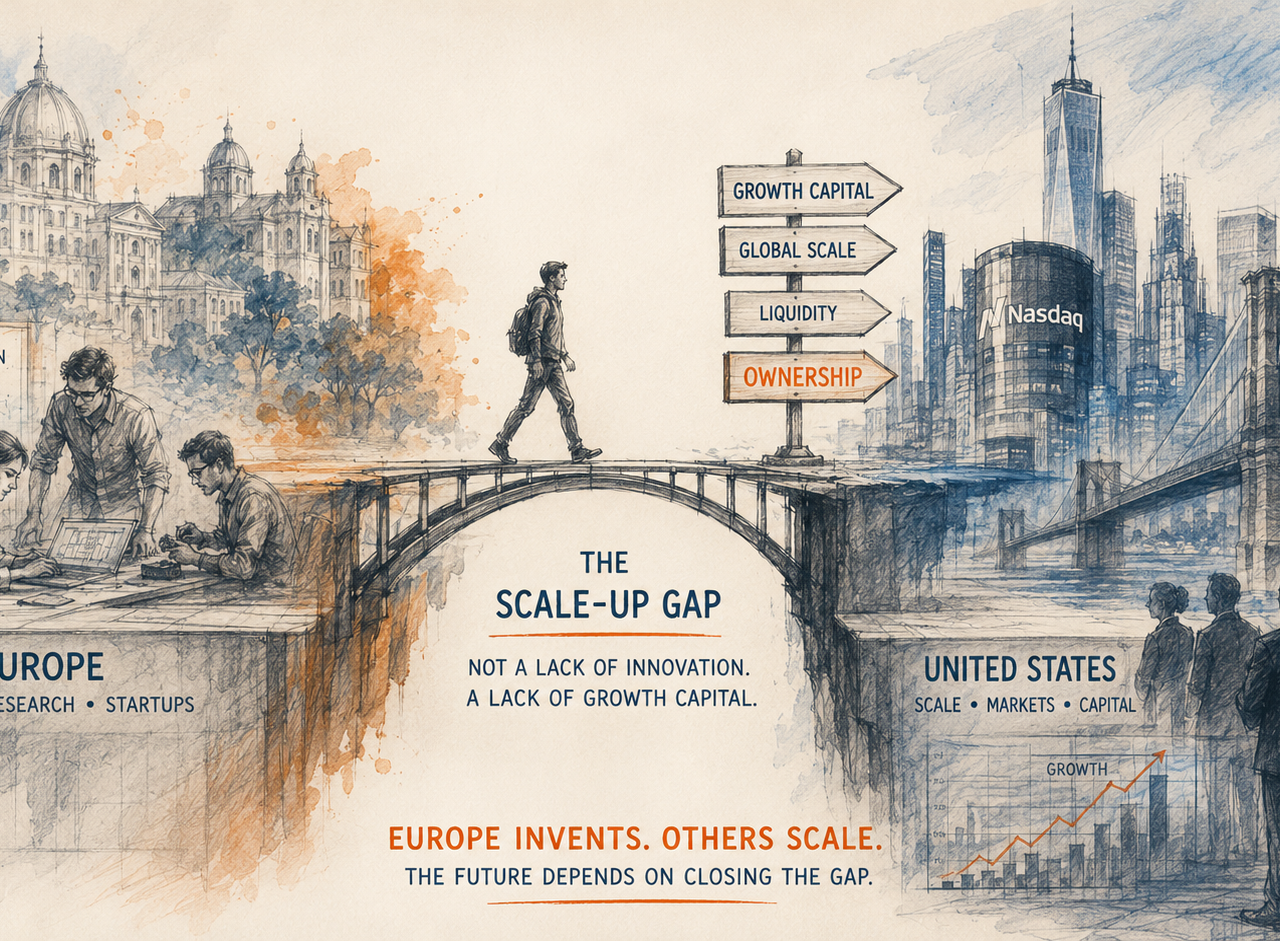
Why Europe Invented Companies It Could Not Keep
Europe has long excelled at producing knowledge, talent and technological breakthroughs. Yet many of its most promising companies reach global scale elsewhere. The challenge may not be innovation itself, but the financial architecture required to transform innovation into long-term ownership, influence and economic sovereignty.
Europe has never lacked ideas. Its universities rank among the world’s best. Its laboratories continue to produce breakthroughs in semiconductors, photonics, biotechnology, advanced manufacturing and artificial intelligence. European researchers remain highly cited, while European firms occupy leading positions in industries that increasingly define technological competition. Yet Europe also exhibits a recurring pattern.
Many companies are founded in Europe, developed within European ecosystems and supported by European research programmes, only to mature into global enterprises elsewhere. Their technologies often remain European. Their talent frequently stays in Europe. But ownership structures, stock market listings and strategic decision-making gradually migrate across the Atlantic.
Perhaps Europe has never suffered from an innovation deficit. Perhaps Europe has historically suffered from a growth capital deficit.
The European Paradox
For decades, Europe invested heavily in research and innovation. National governments expanded their scientific capabilities, universities deepened their international networks and European programmes such as Horizon Europe provided billions of euros in funding to emerging technologies. These investments have generated remarkable results.
The challenge, however, rarely appears during the startup phase. It tends to emerge later, when companies attempt to move beyond technological validation and enter a period of rapid international expansion.
At that stage, businesses no longer require millions of euros. They require hundreds of millions, and in some cases billions, to build production capacity, acquire competitors, establish international sales organisations and compete in global markets. It is here that a structural asymmetry becomes visible.
American capital markets have traditionally offered deeper pools of financing, larger institutional investors and a greater willingness to accept risk. Venture capital evolved into a mature industry capable of supporting firms from inception to global scale, while pension funds increasingly became important providers of patient capital. Nasdaq itself developed beyond a stock exchange and became an ecosystem that offers liquidity, visibility, analyst coverage and access to global investors.
Europe, by contrast, often excelled at creating companies while relying upon others to finance their transformation into global champions. Europe produced innovation. America produced valuations. Europe generated knowledge. America captured scale.
The Exit Economy
For many years, this process was not considered problematic. A sale to a major American technology company or a listing on Nasdaq was widely regarded as the ultimate sign of entrepreneurial success. Venture capital firms celebrated successful exits. Founders secured liquidity. Investors generated returns.
From the perspective of individual entrepreneurs, this model often worked exceptionally well. From the perspective of economic architecture, however, it raises more difficult questions.
When ownership migrates, future profits migrate as well. Strategic decision-making shifts elsewhere. Headquarters move. Acquisitions are directed from abroad. The next generation of investments increasingly benefits ecosystems outside Europe.
What appears to be a successful exit for an entrepreneur may simultaneously represent a gradual transfer of economic influence away from Europe.
The distinction between technological excellence and economic ownership therefore becomes increasingly important. Innovation creates capabilities. Ownership determines where value accumulates.
The Capital Question
Europe’s challenge may therefore be less about creating more startups and more about building the financial infrastructure required to retain them. This inevitably brings institutional capital into the discussion.
European pension funds collectively manage some of the largest pools of capital in the world. Yet historically, much of that capital has remained relatively distant from high-growth technology investments. Regulation, prudential frameworks and risk aversion have often encouraged a stronger focus on stability and diversification than on long-term industrial transformation.
At the same time, the United States benefited from decades of institutional investment in emerging sectors, supported not only by venture capital but also by pension funds, public procurement and defence-related innovation programmes. The result is a striking paradox.
Europe possesses world-class research institutions, highly productive industrial clusters and enormous pools of savings, yet it has often struggled to connect these components into a coherent growth ecosystem.
The issue is therefore not necessarily one of scarcity. It may be one of organisation.
A Changing Landscape
There are, however, indications that this architecture is beginning to evolve. Policymakers increasingly speak about economic security, technological resilience and strategic autonomy. Institutional investors are reconsidering their role in supporting long-term European competitiveness, while new investment initiatives seek to provide growth capital for companies that might previously have looked abroad.
Recent multibillion-euro commitments aimed at supporting European scale-ups reflect this broader shift. Such initiatives alone will not eliminate Europe’s scale-up gap, but they do suggest that a different understanding is emerging.
Innovation alone is no longer sufficient. Research creates possibilities. Capital determines where those possibilities ultimately take root.
Perhaps Europe is gradually moving beyond an economic model built around exits and towards one centred upon anchored growth. An economy in which companies are not only founded in Europe, but also scale, mature and remain strategically embedded within European ecosystems.
Ownership as Sovereignty
For decades, ownership was largely viewed as an outcome of market dynamics. Increasingly, it is becoming a strategic variable. Technological sovereignty is difficult to sustain when the ownership of critical companies, the location of their headquarters and the direction of future investment decisions are concentrated elsewhere.
Europe therefore faces a new question. Not simply how to create innovation. But how to ensure that European innovation also becomes European scale, European ownership and European influence. Because perhaps Europe never lacked ideas.
Perhaps it lacked a financial architecture capable of transforming innovation into sovereignty.
Innovation creates capabilities. Ownership determines where those capabilities ultimately reside.
Part of Capital Sovereignty, an Altair Media series examining Europe’s evolving financial architecture, growth ecosystems and long-term economic trajectory.
Credit
Illustration by Altair Media / OpenAI
Caption
The Scale-Up Gap. Europe produces world-class innovation, yet many of its most promising companies reach global scale elsewhere. The challenge may not be invention itself, but the capital architecture required to transform innovation into European ownership, anchored growth and long-term economic sovereignty.
Category: European Financial Architecture, Capital, Future Economy Forum, Insights · Tags: Economic Sovereignty, European capital, Growth Capital, Innovation, institutional investors, Nasdaq, ownership, scale-ups, Serie - Capital Sovereignty
Posted by Altair Media on June 27, 2026 · Leave a Comment

Why Europe may finally be treating capital as a strategic capability
Europe has spent decades building laboratories, innovation programmes and world-class technology ecosystems. Yet many of its most promising companies still encounter the same obstacle once they reach maturity: the absence of sufficient growth capital. The Scaleup Europe Fund suggests Europe may finally be attempting to build the missing infrastructure layer.
🟦 Why does Europe produce innovation but struggle to produce scale?
Europe’s innovation ecosystem is often portrayed as a success story. Horizon Europe, the European Innovation Council, research universities and specialised clusters such as Brainport Eindhoven, imec and the European photonics ecosystem have created an impressive pipeline of technologies. Yet the paradox remains striking.
Europe finances discovery. Others finance expansion.
Many European deep-tech firms rely on American investors once they reach Series B rounds and beyond. Capital therefore becomes more than funding. It increasingly determines where intellectual property, strategic decision-making and long-term value creation ultimately reside.
Innovation was never Europe’s principal bottleneck. Scale may be.
Read More
Category: Strategy Governance, Capital, Featured Headlines, Infrastructure · Tags: Deep Tech, EQT, European Sovereignty, Growth Capital, industrial policy, Innovation Ecosystems, Photonics, Scaleup Europe Fund
Posted by Altair Media on June 23, 2026 · Leave a Comment

Can Resource Wealth Strengthen Future Generations Rather Than Weaken Them?
Few countries have benefited more from natural resources than Norway. Oil and gas transformed the country’s economy during the second half of the twentieth century, generating extraordinary levels of national wealth and helping create one of the world’s highest standards of living.
Yet Norway’s significance extends beyond the resources beneath the North Sea. The more interesting question is what Norway chose to do with that wealth. Many resource-rich countries struggle with a phenomenon often described as the resource curse. Commodity exports generate prosperity, but can also create economic dependence, political instability and long-term vulnerability.
Norway followed a different path. Its story is therefore not simply about natural resources. It is about stewardship.
From Natural Resources to National Strategy
Norway’s economic success did not begin with oil. Fishing, shipping and maritime industries have long connected the country to global markets.
When large offshore oil and gas reserves were discovered in the late twentieth century, Norwegian policymakers faced a strategic choice. Consume the wealth today. Or preserve part of it for tomorrow. The decision helped shape modern Norway.
Norway’s greatest resource may not be oil. It may be the discipline with which it manages it.
Rather than allowing resource revenues to dominate the domestic economy, Norway gradually developed institutions designed to manage wealth across generations.
The World’s Largest Sovereign Wealth Fund
At the centre of Norway’s model stands the Government Pension Fund Global. Built from oil and gas revenues, the fund has become the largest sovereign wealth fund in the world. Its purpose extends beyond investment returns. The fund acts as a mechanism for converting finite natural resources into long-term financial assets.
In effect, Norway transformed temporary resource wealth into a permanent source of national resilience. Rather than spending all revenues immediately, a significant portion was invested on behalf of future generations. This reflects a broader principle. Resource wealth belongs not only to current citizens. It also carries obligations toward those who come after them.
Norway demonstrates that resource wealth becomes an asset only when societies develop the institutions to govern it.
The fund is ultimately a reflection of trust. Citizens trust that today’s wealth will be preserved for tomorrow. Governments accept limits on how much can be spent in the present. Future generations are treated not as an abstraction, but as stakeholders in national decision-making.
In an era often dominated by short-term thinking, this may be one of Norway’s most remarkable achievements.
Energy and the Future Economy
Norway remains one of Europe’s most important energy producers. Oil and gas continue to play a central role in the economy. Yet Norway increasingly finds itself at the centre of another debate. What role should energy play in a low-carbon future Hydropower already supplies most domestic electricity. Offshore wind, carbon management technologies and new industrial initiatives are becoming increasingly important.
The country therefore occupies a unique position. Norway is both a major fossil fuel exporter and a potential contributor to Europe’s energy transition. This creates an unusual paradox. Norway has become one of the world’s most electrified societies while remaining a major exporter of oil and gas.
In many respects, the country finances parts of its own green transition through the sale of fossil fuels abroad.
Norway’s challenge is no longer creating wealth from energy. It is transforming energy wealth into future capabilities.
The question is not whether this contradiction exists. The question is how long it can be sustained.
The Infrastructure Behind Artificial Intelligence
As artificial intelligence expands, energy is becoming a strategic resource. Data centres, cloud infrastructure and advanced computing systems require vast amounts of reliable electricity. This creates new opportunities for countries capable of providing abundant and stable energy supplies.
Norway’s combination of renewable hydropower, technological expertise and political stability gives it advantages that extend far beyond traditional energy markets. In many respects, the country’s future may depend as much upon electricity as it once depended upon oil. The geography of intelligence increasingly follows the geography of energy.
For decades, Norway’s strategic advantage was measured in barrels of oil and cubic metres of natural gas. Increasingly, it may be measured in megawatts of clean electricity. As artificial intelligence, cloud infrastructure and advanced computing become more energy intensive, countries capable of providing stable and abundant power may acquire new forms of strategic relevance.
Norway’s energy resources could therefore play a role not only in Europe’s industrial economy, but also in its emerging intelligence economy.
Trust, Institutions and Long-Term Thinking
Like its Nordic neighbours, Norway benefits from high levels of institutional trust. The management of resource wealth relies upon public confidence that revenues are being used responsibly and transparently. This may be one of the country’s most important competitive advantages.
Natural resources alone do not create successful societies. Institutions determine how resources are governed. Norway demonstrates that economic wealth and social trust can reinforce one another when supported by strong governance.
Natural resources create opportunities. Institutions determine whether those opportunities endure.
The country’s success suggests that long-term prosperity depends not only on what a society possesses, but also on how effectively it governs those assets.
Prosperity and Pressure
Norway’s model is not immune to challenges. The economy remains connected to industries that many countries hope to reduce over time. Global energy markets remain volatile. Demographic change creates growing pressures on public finances and labour markets.
At the same time, questions are emerging about how quickly the country should diversify beyond hydrocarbons. Another challenge is less visible. Resource wealth can create stability, but it can also reduce urgency.
Societies that become accustomed to prosperity may find it more difficult to cultivate the risk-taking and experimentation that often drive future innovation. The challenge for Norway is therefore not only preserving wealth. It is ensuring that wealth does not become a substitute for renewal.
Unlike Sweden, where innovation has become a societal habit, Norway faces a different question. Can a society built upon successful resource management remain equally successful in creating the industries of the future?
Looking Ahead
Norway represents one of the most successful examples of resource management in modern economic history. Rather than consuming extraordinary wealth as quickly as it appeared, the country built institutions designed to preserve and extend its benefits across generations.
As societies confront new questions about energy, sustainability and technological transformation, Norway offers an important lesson. Wealth alone does not determine the future. The management of wealth does.
The true measure of Norway’s success is not how much wealth it created, but how much of that wealth it preserved for generations yet to come.
The central question facing Norway therefore remains:
Can resource wealth strengthen future generations rather than weaken them?
For much of the past half-century, Norway’s answer has been yes.
This article is part of Economic Europe, a United Europe series exploring the economic architectures that shape modern Europe. The Northern Europe chapter examines how Denmark, Sweden, Norway, Finland and Iceland have built distinctive models of resilience through trust, innovation, institutional capacity and long-term adaptation.
Credit
Illustration generated by OpenAI’s DALL·E for Altair Media Europe
Caption
Norway’s economic model is built upon more than natural resources alone. From offshore energy and hydropower to sovereign wealth management and emerging AI infrastructure, the country demonstrates how resource wealth can be transformed into long-term resilience through trust, stewardship and institutional discipline.
Category: Social Dynamics, Capital, Cultural Systems, Energy, Essays, Human Capital, Insights, Society & Culture · Tags: Artificial Intelligence Infrastructure, Data Centres, Economic Europe, economic resilience, energy security, Energy transition, Government Pension Fund Global, Hydropower, Long-term Thinking, Natural Resources, Northern Europe, Norway, Norwegian Economy, oil and gas, Series — Economic Europe: Northern Europe June 2026, Sovereign Wealth Fund, Stewardship, Sustainability, Trust Economy
Posted by Altair Media on June 13, 2026 · Leave a Comment

Europe and the Challenge of State-Backed Competition
For decades, Europe built its prosperity around a simple assumption: open markets create fair competition. Companies innovate. Consumers choose. The best products succeed. That model helped transform Europe into one of the world’s largest economic regions. Yet it increasingly faces a challenge that policymakers did not fully anticipate.
What happens when competitors are not simply companies, but entire state-supported industrial ecosystems?
The question is becoming increasingly relevant as Europe confronts a new generation of competitors from China across sectors ranging from electric vehicles and batteries to solar panels, telecommunications equipment and autonomous aviation systems.
The challenge is no longer limited to manufacturing costs. It is about the structure of competition itself.
Company Against Company
Europe’s economic model was largely built around competition between firms. Businesses raise capital, develop products, compete for customers and succeed or fail according to market demand. In theory, the same rules apply to everyone. Yet that assumption becomes more complicated when competitors operate within fundamentally different economic systems.
Europe often competes company against company. China frequently competes ecosystem against ecosystem. The distinction matters.
In Europe, businesses typically operate within market conditions shaped by private investment, commercial financing and regulatory oversight.
In China, many strategic industries exist within a broader framework of industrial policy. Companies may benefit from state-backed financing, preferential access to land, infrastructure, domestic procurement programmes, coordinated supply chains or support from state-owned enterprises.
The result is not always visible in a balance sheet. But it can be visible in prices.
A European manufacturer may face competitors capable of producing similar products at costs that appear difficult to explain through efficiency gains alone.
The Infrastructure Behind the Product
The challenge extends beyond the final product. A drone is not merely a drone. An electric vehicle is not merely a vehicle. Behind every advanced technology lies a physical ecosystem of batteries, semiconductors, sensors, software, rare earth materials, logistics networks and industrial manufacturing capacity. Increasingly, strategic competition is occurring at this deeper level.
Control over the supply chain often matters as much as control over the finished product. This is particularly visible in emerging sectors such as artificial intelligence infrastructure, autonomous aviation, advanced robotics and next-generation communications.
The question is no longer simply who builds the best technology. It is increasingly about who controls the industrial foundations that make that technology possible.
From Solar Panels to Autonomous Systems
The effects are already visible across multiple industries. Europe’s solar manufacturing sector was largely displaced by lower-cost Chinese production. Similar pressures are now emerging in electric vehicles, batteries, advanced robotics and autonomous systems.
The rise of companies such as Times Feipeng illustrates how this dynamic is expanding into new technological domains. Few Europeans have heard of the company. Yet it represents a broader trend.
Chinese firms are increasingly moving beyond consumer products into advanced industrial technologies, including autonomous cargo drones and next-generation logistics systems.
These technologies are not merely commercial. They sit at the intersection of transportation, digital infrastructure, artificial intelligence and national security.
The challenge for Europe is not that Chinese companies innovate. Competition itself is healthy. The challenge is whether European firms can realistically compete when market participants operate under fundamentally different economic conditions.
The Consumer and the Citizen
This creates a paradox. Consumers often benefit from lower prices and greater choice. Cheaper products can increase purchasing power and accelerate technological adoption. Yet citizens may experience a different reality.
When domestic industries decline, supply chains move abroad and strategic technologies become concentrated elsewhere, the long-term costs may become visible only years later.
The same individual may benefit as a consumer while becoming more vulnerable as a worker, taxpayer or citizen. This tension increasingly sits at the heart of Europe’s economic debate.
Europe’s Strategic Dilemma
For policymakers, this creates a delicate balancing act. Europe benefits enormously from international trade. Protectionism carries its own risks. Yet complete openness can also create vulnerabilities when critical capabilities disappear.
The debate is therefore shifting. Increasingly, European policymakers are asking not only whether products are affordable, but whether Europe retains the capacity to produce them itself.
This has already become visible in initiatives aimed at strengthening semiconductor manufacturing, battery production, critical raw materials and clean technologies.
Yet Europe faces a deeper dilemma. The European Union was built around principles of openness, competition and international trade. Many of the tools now being discussed — industrial policy, strategic subsidies, investment screening and defensive tariffs — sit uneasily alongside those traditions.
Europe is therefore attempting something difficult. It is trying to become more strategically resilient without abandoning the economic model that helped create its prosperity.
Beyond Price
The broader objective is not isolation. It is resilience. A resilient economy does not produce everything. But it retains enough strategic capability to avoid becoming dependent on others for essential technologies.
That principle may become increasingly important as competition expands into sectors such as artificial intelligence infrastructure, autonomous aviation, advanced robotics and next-generation communications.
The question facing Europe is therefore larger than any individual company. It concerns the future shape of the European economic model itself.
Can open markets survive in a world where major economic powers increasingly combine markets with industrial strategy? Or will Europe need to rethink the balance between competition, sovereignty and resilience?
The answer may define the next chapter of Europe’s economic history. The question is no longer whether foreign products are cheaper. The question is what Europe loses when entire industries become dependent on them.
Credit
Image generated by OpenAI DALL·E for Altair Media.
Caption
A symbolic illustration of Europe’s challenge in competing with state-backed industrial ecosystems. As strategic competition shifts from individual products to entire supply chains, questions of resilience, sovereignty and industrial capacity become increasingly important.
Category: Leadership & Institutions, Capital, Essays, Featured, Governance, Insights, Physical Infrastructure · Tags: Artificial Intelligence, Autonomous Systems, China, Critical Technologies, Drones, Economic Sovereignty, Europe, European economy, Geopolitics, industrial policy, Industrial Strategy, infrastructure, manufacturing, resilience, Semiconductors, Strategic Autonomy, Supply Chains, Trade Policy
