Saturday, July 11, 2026

Communication is increasingly becoming one of Europe’s most critical infrastructures. Behind emergency services, airports and secure networks lies an invisible architecture of trust, where resilience matters more than speed and continuity becomes a strategic capability in its own right.
Read More
Thursday, July 9, 2026

Europe’s cloud future may not be defined by replicating hyperscalers, but by orchestrating them. In an era increasingly shaped by compute, resilience, optionality and strategic capacity may prove as important as scale itself. Success, perhaps, is not measured by dominance, but by preserving the freedom to adapt.
Read More
Thursday, July 9, 2026

Digital sovereignty is often discussed after dependence has already emerged. Yet resilient infrastructures are rarely built through correction alone. They are designed from the outset to preserve choice, maintain adaptability and ensure that critical capabilities remain transferable, interoperable and resilient. Sovereignty, in this sense, becomes less an aspiration and more an architectural principle.
Read More
Wednesday, July 8, 2026

For more than a decade, cloud strategy was synonymous with centralisation. Yet as artificial intelligence, data gravity and strategic autonomy reshape the digital landscape, organisations are rediscovering an old idea in a new form: control itself may once again become a competitive advantage. The private cloud returns not as nostalgia, but as infrastructure designed for resilience.
Read More
Wednesday, July 8, 2026

Cloud sovereignty is often discussed through geography, ownership and regulation. Yet the more consequential question may be different: which capabilities can societies, institutions and organisations simply not afford to externalise? In the age of artificial intelligence, control increasingly begins with understanding what truly matters.
Read More
Wednesday, July 8, 2026

Cloud sovereignty is often framed as a choice between dependence and autonomy. Yet resilience may depend less on ownership alone and more on architecture itself. In an increasingly interconnected world, sovereignty may ultimately be the ability to preserve options, distribute risk and maintain control over what matters most.
Read More
Wednesday, July 8, 2026
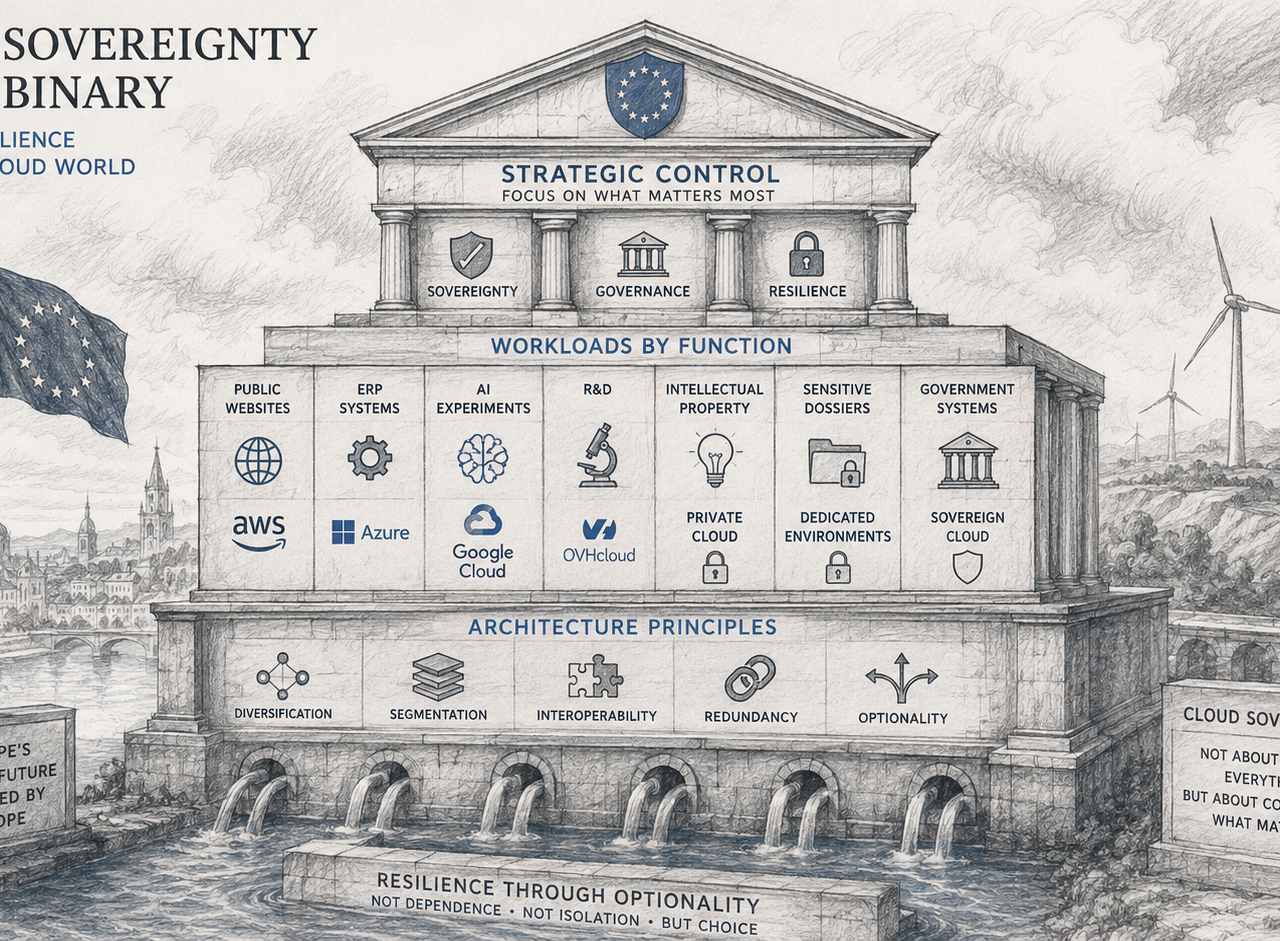
Cloud sovereignty is often presented as a binary choice between dependence and autonomy. Yet resilience may depend less on ownership alone and more on architecture itself: understanding which functions require strategic control, which workloads benefit from scale and which capabilities societies simply cannot afford to lose.
Read More
Thursday, June 25, 2026

While many societies spent decades optimising for efficiency, Finland quietly invested in resilience. From education and cybersecurity to strategic reserves and comprehensive preparedness, the country demonstrates how uncertainty can become a catalyst for institutional strength rather than vulnerability.
Read More
Friday, June 19, 2026

Northern Europe is often associated with prosperity, innovation and high levels of trust. Yet beneath these achievements lies a distinctive regional model built upon strong institutions, technological adaptation and long-term investment in people. As many societies confront demographic pressures, digital transformation and geopolitical uncertainty, the Nordic experience raises an important question: can trust itself become a strategic asset?
Read More
Saturday, June 13, 2026

Europe’s challenge is no longer simply competing with foreign companies. It is increasingly competing with state-backed industrial ecosystems. As strategic industries shift from products to infrastructure, Europe faces difficult questions about resilience, sovereignty and the future of open markets.
Read More

 Available here: