Finland and the Power of Resilience
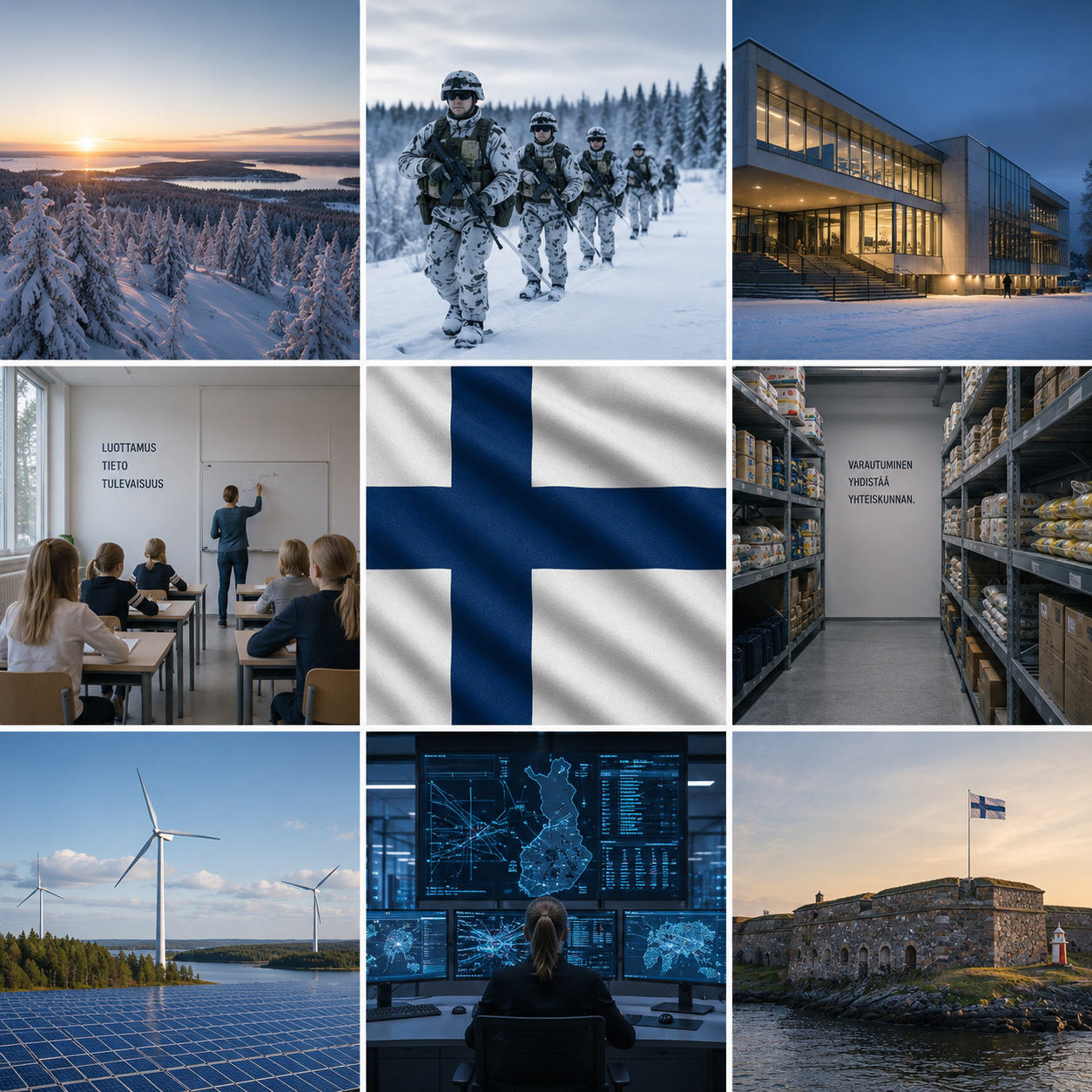
Can Resilience Become a Competitive Advantage?
Few European countries have been shaped more profoundly by geography than Finland. Situated on the edge of Northern Europe and sharing a long border with Russia, Finland has spent much of its modern history navigating uncertainty. This experience has left a lasting mark on the country’s institutions, culture and strategic thinking.
Many countries build prosperity around innovation, natural resources or financial power. Finland built something different. Resilience. The Finnish story is therefore not simply about economic success. It is about preparedness.
Geography and Strategic Culture
Geography has always mattered in Finland. For generations, the country has lived alongside a much larger neighbour. Security, self-reliance and national preparedness therefore became central elements of public policy.
This strategic culture extends far beyond defence. It influences infrastructure planning. Energy security. Education. Emergency preparedness. Institutional design.
Finland’s strength lies not in predicting the future, but in preparing for multiple futures.
Finland often approaches uncertainty not as an exception, but as a permanent feature of reality.
Education as National Infrastructure
Finland’s education system is frequently cited as one of the world’s most successful. Yet the deeper significance of education extends beyond international rankings. Education is viewed as a strategic national asset. A highly educated population strengthens economic competitiveness, social cohesion and democratic resilience.
In many respects, Finland treats knowledge as infrastructure. Teachers enjoy high levels of professional trust. Educational outcomes remain relatively strong. Lifelong learning has become increasingly important as technological change accelerates. The objective is not simply to create workers. It is to create citizens capable of adapting to change.
Defence and Societal Preparedness
Finland maintains one of Europe’s most comprehensive approaches to national preparedness. Military readiness forms part of a broader concept often described as comprehensive security. Government institutions. Businesses. Civil society. Critical infrastructure operators. Citizens. All play a role.
This philosophy reflects an understanding that modern crises rarely fit neatly into traditional categories. Cyber attacks. Energy disruptions. Supply chain shocks. Military threats. Increasingly, these challenges overlap.
Finland’s approach to preparedness extends into areas that many countries would consider purely economic. Through the National Emergency Supply Agency, the country maintains strategic reserves of fuel, food, medicines and critical materials.
These reserves are rarely visible in everyday life. Yet they reflect a deeper philosophy. Resilience is not created during a crisis. It is created before a crisis occurs.
Preparedness is not an emergency response. It is a permanent national capability.
Finland’s accession to NATO did not fundamentally change this strategic culture. In many respects, it confirmed it. The country entered the alliance with institutions, infrastructure and societal preparedness that had been developed over decades. Finland did not join NATO because it suddenly discovered security. It joined after spending generations preparing for it.
Technology and Strategic Capability
Finland is often associated with technological innovation. The rise of Nokia transformed the country’s economy and demonstrated how a relatively small nation could compete globally in advanced technology sectors.
Although the technology landscape has evolved, Finland continues to invest heavily in research, digital infrastructure and emerging technologies. Cybersecurity, telecommunications, artificial intelligence and advanced manufacturing increasingly form part of the country’s strategic capabilities.
In Finland, technology is often valued not only for what it creates, but for what it helps protect.
The objective is not innovation for its own sake. It is innovation that strengthens resilience. Technology is viewed not only as a source of growth, but also as a means of maintaining strategic autonomy.
Trust and Institutional Capacity
Like its Nordic neighbours, Finland benefits from relatively high levels of trust. Public institutions generally enjoy credibility. Citizens participate actively in civic life. Cooperation between public authorities, businesses and communities remains comparatively strong.
Infrastructure can fail. Institutions can be disrupted. Trust often determines how quickly societies recover.
Trust matters because resilience cannot be built through infrastructure alone. It depends upon the willingness of people and institutions to cooperate when circumstances become difficult. In this respect, Finland demonstrates that social cohesion can become a strategic asset.
Prosperity and Pressure
Finland’s model faces significant challenges. Demographic ageing is placing pressure on public services and labour markets. Global competition continues to intensify. Technological change is accelerating.
The war in Ukraine has reinforced the importance of security and preparedness throughout Northern Europe.
At the same time, maintaining resilience requires continuous investment. Preparedness is rarely visible when it succeeds. Its value often becomes apparent only during moments of crisis.
Maintaining resilience also carries costs. Strategic reserves require funding. Redundant systems often appear inefficient. Long-term preparedness demands continuous investment in capabilities that may never be fully used.
The challenge is convincing societies to invest in resilience before a crisis makes that investment appear necessary.
There is also a cultural challenge. Societies that prioritise preparedness can sometimes become more cautious than innovative. Balancing resilience with dynamism remains an ongoing task. The objective is not merely to withstand disruption. It is to remain capable of renewal despite it.
The challenge facing Finland is therefore not whether resilience matters. The challenge is how to sustain it across generations.
Looking Ahead
As geopolitical uncertainty grows and technological disruption accelerates, Finland’s experience may become increasingly relevant beyond Northern Europe.
Many societies have spent decades optimising for efficiency. Finland often appears to optimise for resilience. The distinction may prove increasingly important. Efficiency seeks to minimise costs. Resilience seeks to maintain capability under stress.
In an era characterised by uncertainty, the ability to absorb shocks may become a competitive advantage in its own right.
Finland demonstrates that resilience is not the opposite of progress. It is the foundation that makes progress sustainable.
The central question facing Finland therefore remains:
Can resilience become a competitive advantage?
For much of its modern history, Finland’s answer has been yes.
Series — Economic Europe: Northern Europe
This article is part of Economic Europe, a United Europe series exploring the economic architectures that shape modern Europe. The Northern Europe chapter examines how Denmark, Sweden, Norway, Finland and Iceland have built distinctive models of resilience through trust, innovation, institutional capacity and long-term adaptation.
Credit
Illustration generated by OpenAI’s DALL·E for Altair Media Europe
Caption
Shaped by geography and history, Finland has developed a culture of resilience that extends far beyond defence. Education, trust, infrastructure, technology and societal preparedness together form an economic architecture designed not only to withstand disruption, but to continue functioning through it.
