Which Data Requires Control?
Classifying Strategic Dependence
Strategic Briefing
For years, cloud discussions revolved around geography. Where is data stored? Which jurisdiction applies? Who owns the datacentre?
Yet these questions may only address part of the challenge. Perhaps the more important question is different.
Not:
Where is data located?
But:
What happens if access to it disappears?
Because not all information possesses the same strategic significance. Some data creates convenience. Some data creates efficiency. Some data creates competitive advantage. And some data underpins capabilities societies simply cannot afford to lose.
From Location to Consequence
Europe’s cloud debate has long focused on residency. Frankfurt. Paris. Amsterdam. Stockholm. But physical location alone does not determine strategic importance.
A public website hosted abroad rarely threatens institutional resilience. A semiconductor design database might. A marketing platform differs fundamentally from a pharmaceutical research archive.
Customer analytics differ from advanced manufacturing knowledge. Hospital records differ from advertising data. Cloud sovereignty therefore becomes less about geography. And increasingly about consequence.
The Consequence Test
Perhaps organisations should ask a different set of questions.
- What happens if this data becomes unavailable?
- What happens if access is delayed?
- What happens if another jurisdiction influences access?
- What happens if this capability cannot be rebuilt?
Sovereignty begins where consequences become unacceptable.
The Strategic Data Spectrum
Perhaps organisations should think less in terms of technology and more in terms of capability.
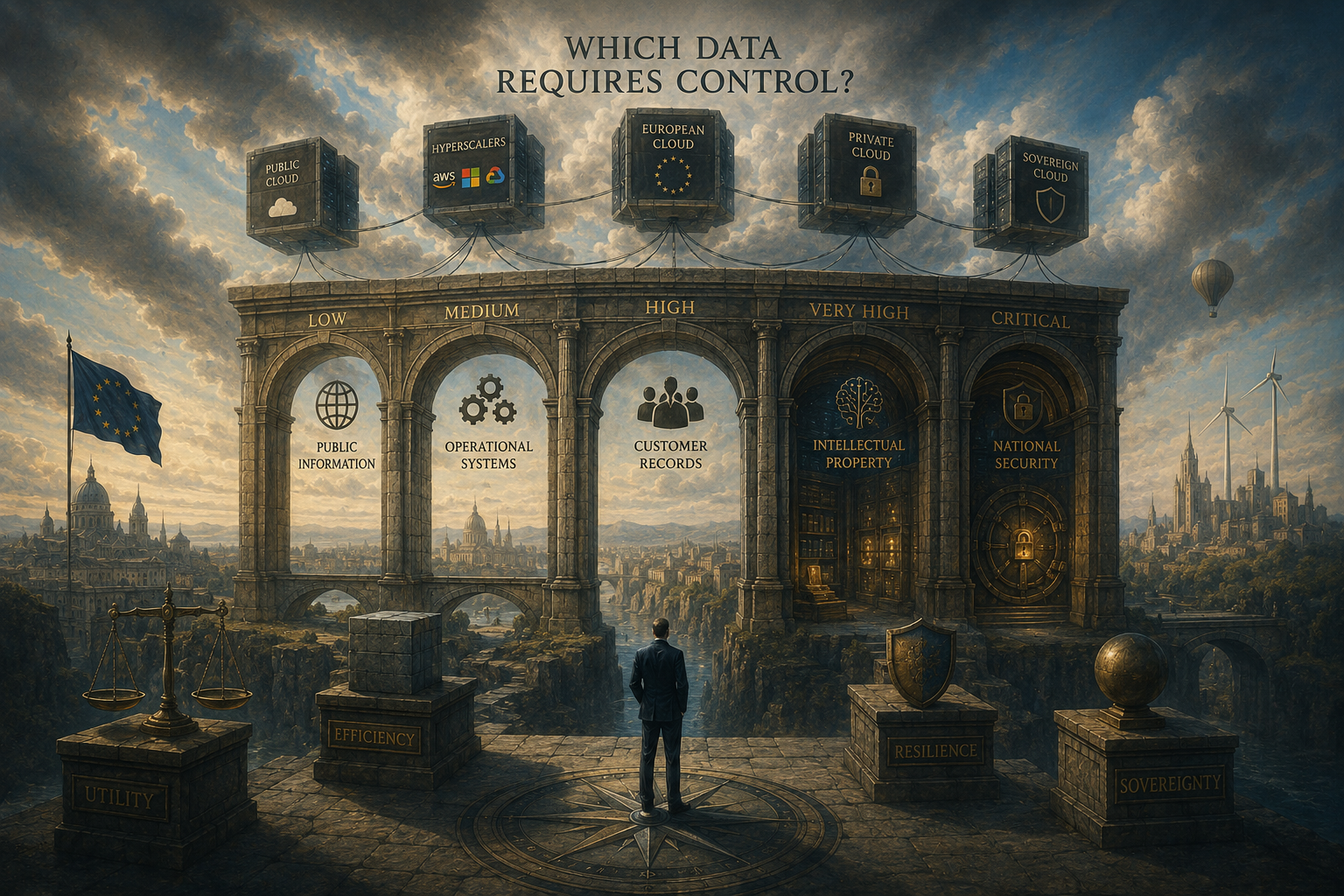
| Data Type | Strategic Value | Potential Environment |
|---|---|---|
| Public information | Low | Public cloud |
| Operational systems | Medium | Hyperscalers |
| Customer records | Medium–High | Hybrid cloud |
| R&D datasets | High | European cloud |
| Intellectual property | Very High | Private cloud |
| AI training datasets | Strategic | Controlled environments |
| National security information | Critical | Sovereign cloud |
| Democratic processes | Critical | Dedicated environments |
Not all data deserves sovereign treatment. But some data may define the future competitiveness of organisations, industries and nations.
Data as Capability
Historically, societies protected territory. Increasingly, they may need to protect capability. Semiconductor designs. Advanced manufacturing processes. Energy system models. Quantum algorithms. Biotechnological discoveries. Pharmaceutical research. Artificial intelligence training corpora.
These assets do not merely represent information. They represent accumulated knowledge. They represent productive capacity. They represent future optionality.
Control over data therefore becomes less about privacy. And increasingly about preserving the ability to innovate, produce, govern and compete.
The AI Dimension
Artificial intelligence changes the equation further. Data is no longer static. It becomes training material. Inference capacity. Institutional memory. Competitive advantage. A model trained upon decades of engineering expertise may itself become strategic infrastructure.
A digital twin of a national electricity grid may become critical capability. A biomedical dataset may embody billions in research investment. Data increasingly behaves like capital. Except that it learns. And generates new forms of knowledge.
The question therefore evolves. Who owns the model? Who owns the training data? Who controls the compute? Who determines access?
Beyond Compliance
For decades, governance focused primarily on regulation. Privacy. Security. Compliance. Residency. These questions remain important. But they are no longer sufficient.
Cloud sovereignty increasingly demands strategic judgement. Not every dataset requires sovereign infrastructure. But every organisation may need to identify which datasets define its future.
The New Infrastructure Question
Perhaps the cloud debate has always been framed incorrectly. The objective is not to control all data. Nor is it to localise everything.
The objective is to understand which capabilities societies cannot afford to externalise.
Because sovereignty rarely begins with total ownership. It begins with the clarity to recognise which capabilities a society simply cannot afford to externalise.
Strategic Assessment
Strategic Awareness ★★★★★
Data Classification ★★★★★
Institutional Resilience ★★★★★
Operational Flexibility ★★★★☆
Governance Complexity ★★★☆☆
European Alignment ★★★★★
Series Note
Building Europe’s Cloud Architecture explores the infrastructures, organisations and governance models shaping Europe’s computing future.
Phase III — Sovereignty examines how governments, institutions and organisations can balance openness, innovation and strategic control in an increasingly interconnected digital landscape.
Which Data Requires Control? forms the third briefing in this phase and shifts the discussion from cloud location toward cloud consequence, asking not where data resides, but which capabilities societies simply cannot afford to lose.
Credit
Artwork: Altair Media / AI-generated visualisation inspired by the classification of strategic data, digital sovereignty and Europe’s emerging cloud architecture.
Caption
A surreal interpretation of strategic data governance, where information is no longer treated as a homogeneous resource but as a hierarchy of capabilities requiring different levels of control, resilience and sovereignty. From public information to critical national assets, cloud architecture increasingly becomes an exercise in consequence, classification and strategic choice.
