The Private Cloud Returns
Why Control Is Becoming Competitive Again
Strategic Briefing
For more than a decade, cloud strategy appeared straightforward. Move workloads to the public cloud. Reduce costs. Increase flexibility. Scale globally.
The trajectory seemed inevitable. Everything would migrate. Everything would become a service. Everything would become someone else’s infrastructure. Yet infrastructure rarely follows linear paths. Maturity changes priorities. And cloud itself may now be entering a new phase.
The first cloud era optimised for efficiency through centralisation. The next cloud era may optimise for resilience through segmentation.
The Pendulum Swings Back
The early cloud era rewarded concentration. Elastic compute. Operational simplicity. Global reach.Rapid deployment. Hyperscalers transformed the economics of digital infrastructure. For many organisations, the benefits were profound.
Yet maturity introduces different questions. Artificial intelligence. Energy availability. Regulation. Institutional resilience. Data sovereignty. Strategic autonomy.
Cloud is no longer merely about efficiency. It is increasingly about preserving control.
Beyond Nostalgia
The return of private infrastructure is not a rejection of public cloud. Nor is it a return to server rooms hidden in corporate basements. Private cloud is becoming something else.
Dedicated AI clusters. Sovereign compute facilities. Specialised environments. Regional datacentres. Institutional infrastructures designed around specific capabilities.
This is not the private cloud of 2010. It is the private cloud of strategic selectivity.
Data Has Gravity
Public cloud works exceptionally well when workloads remain mobile. Yet not everything moves easily. Industrial datasets. Research archives. Energy system models. Semiconductor designs. Healthcare records. Institutional memory.
These assets possess inertia. Moving them may become expensive. Complex. Risky. Sometimes impossible.
As organisations accumulate knowledge, they increasingly discover that information behaves less like software and more like infrastructure.
Data attracts applications. Applications attract compute. Compute attracts energy. Energy attracts investment. Eventually ecosystems emerge.
Private cloud therefore becomes less a technological preference. And more an architectural consequence.
AI Changes Economics
Artificial intelligence introduces another dynamic. The economics of cloud are changing. Training advanced models requires sustained compute capacity.
Inference increasingly depends upon predictable performance. Specialised accelerators. Dedicated networking. Reliable energy supplies.
In the first cloud era, infrastructure shifted from capital expenditure toward operational expenditure. In the AI era, that logic may begin to reverse.
For organisations possessing highly valuable datasets, continuously renting compute may become economically irrational.
Owning capacity may once again become attractive. Not because public cloud failed. But because strategic capabilities increasingly justify direct investment.
Private infrastructure therefore becomes less a cost centre. And more an instrument for capitalising intellectual assets.
Sovereignty Through Segmentation
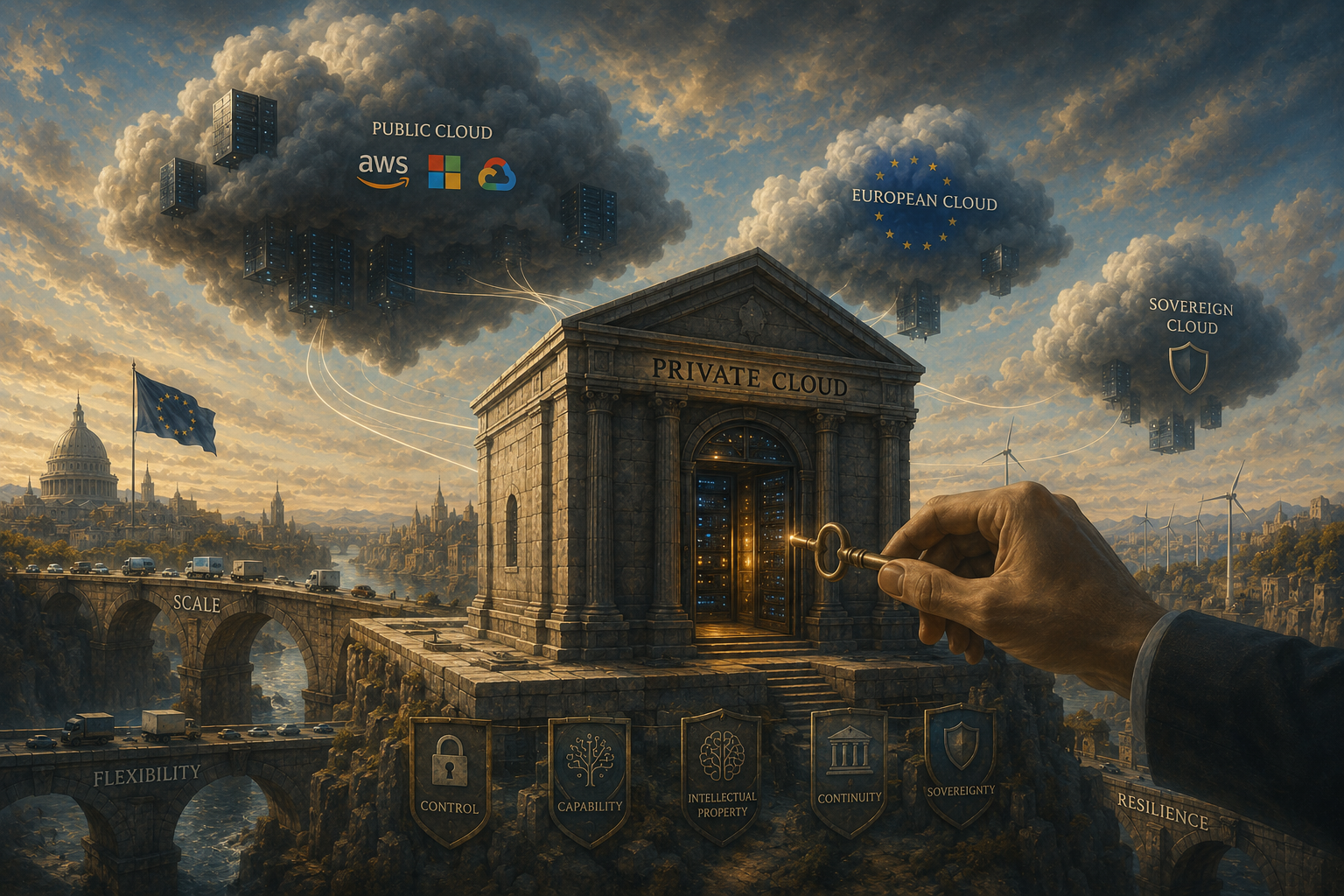
The future may therefore be hybrid. Hyperscalers for scale. European providers for optionality. Private cloud for continuity. Dedicated environments for critical capabilities.
Cloud architecture increasingly resembles portfolio construction. Different environments serving different purposes. Different levels of control for different categories of capability.
Private cloud may not replace hyperscalers. But it may become one of the essential components within a diversified digital architecture.
The Infrastructure Question
For years, cloud adoption was largely a procurement decision. Increasingly, it resembles institutional design.
What capabilities define an organisation? What information constitutes competitive advantage?What systems preserve societal resilience Which assets should remain external? Which assets should remain internal?
These are no longer technical questions. They are governance questions.
The Return of Choice
Perhaps the cloud debate has entered a new stage. Not public versus private. Not Europe versus America. Not sovereignty versus openness. But balance.
Control where control matters. Scale where scale matters. Experimentation where experimentation matters.
Because cloud maturity may ultimately mean recognising that resilience rarely depends upon a single architecture. It depends upon preserving alternatives.
Private cloud therefore returns not as technological nostalgia. But as a strategic capability.
Strategic Assessment
Strategic Control ★★★★★
Institutional Resilience ★★★★★
AI Readiness ★★★★★
Operational Flexibility ★★★★☆
Cost Efficiency ★★★☆☆
European Alignment ★★★★★
Series Note
Building Europe’s Cloud Architecture explores the infrastructures, organisations and governance models shaping Europe’s computing future.
Phase III — Sovereignty examines how institutions, governments and organisations can design resilient digital architectures that balance scale, innovation and strategic control.
The Private Cloud Returns is the fourth briefing in this phase, exploring why the next era of cloud computing may optimise less for efficiency through centralisation and more for resilience through segmentation, optionality and direct control over critical capabilities.
Credit
Artwork: Altair Media / AI-generated visualisation inspired by the return of private infrastructure, strategic control and resilient cloud architectures in the age of artificial intelligence.
Caption
A surreal interpretation of the emerging cloud landscape, where public hyperscalers, sovereign environments and private infrastructures coexist within a diversified ecosystem. As data gravity, artificial intelligence and institutional resilience gain importance, private cloud increasingly re-emerges as a strategic capability rather than a technological relic.
