The Cloud Portfolio Strategy
Managing Compute Like Strategic Capital
Strategic Briefing
For years, cloud adoption was framed as a destination. Move to the cloud. Modernise. Consolidate. Scale. Yet the emerging reality appears rather different.
As cloud infrastructure becomes increasingly intertwined with artificial intelligence, geopolitics and critical societal functions, concentration itself may become a source of vulnerability.
Perhaps organisations should not think about cloud as a platform. Perhaps they should think about cloud as a portfolio.
Beyond the Single Provider
Few investors allocate all assets to a single instrument. Central banks diversify reserves. Energy systems diversify supply. Supply chains diversify production. Cloud infrastructure may increasingly follow similar principles. Efficiency often rewards concentration. Resilience rarely does.
A single cloud provider may optimise procurement, operations and costs. Yet it may also increase exposure to technological dependence, regulatory uncertainty and geopolitical disruption.
The challenge is therefore changing.
Not:
Which cloud provider is best?
But:
Which cloud provider is best suited for which function?
Infrastructure Allocation
A portfolio approach recognises that not all workloads carry the same strategic significance. Some functions benefit primarily from scale. Others require control. Some prioritise experimentation. Others demand permanence.
| Function | Priority | Environment |
|---|---|---|
| Websites | Scalability | AWS |
| Productivity | Integration | Azure |
| AI experimentation | Intelligence | Google Cloud |
| Mission-critical databases | Continuity | Oracle Cloud |
| Research & development | European ownership | OVHcloud |
| Industrial systems | Industrial sovereignty | STACKIT |
| Public services | Jurisdiction | Sovereign cloud |
| Intellectual property | Control | Private cloud |
This is not fragmentation. It is diversification.
The Optionality Principle
Portfolio theory traditionally seeks to balance return and risk. Digital infrastructure increasingly seeks to balance capability and dependency.
Organisations that optimise exclusively for efficiency may inadvertently reduce resilience. Organisations that preserve alternatives may sacrifice some efficiency. Yet they gain optionality. And optionality may become one of the defining strategic assets of the AI era.
Cloud sovereignty therefore becomes less about exclusion. And more about maintaining choices. The ability to adapt. The ability to migrate. The ability to reorganise. The ability to continue operating despite uncertainty.
Concentration Risk
For decades, concentration was often perceived as an advantage. One provider. One architecture. One ecosystem. One contract.
Today, concentration increasingly resembles a systemic risk. Compute shortages. Energy constraints. Supply-chain disruptions. Regulatory divergence. Geopolitical tensions.
Cloud providers themselves increasingly recognise this reality. Multi-cloud environments, sovereign infrastructures and dedicated environments are becoming more common. Not because cloud has failed. But because cloud has matured. Mature infrastructures tend to diversify.
Digital Reserve Capacity
Perhaps societies should think about cloud capacity in much the same way they think about strategic reserves. Not every capability needs to remain active. But some capabilities may need to remain available.
Alternative providers. Local datacentres. Private environments. National compute facilities. Redundant systems.
Strategic autonomy ultimately depends upon maintaining capabilities that standard procurement models reject as inefficient during stable periods, but which institutional resilience demands as indispensable during moments of disruption.
Europe’s Plurality Advantage
Europe has often interpreted its fragmented cloud landscape as a weakness. Perhaps it is becoming a strength.
Unlike the United States, Europe is not dominated by a single technological ecosystem.
Unlike China, Europe does not rely upon a centrally orchestrated digital architecture.
Europe’s advantage may instead reside in plurality.
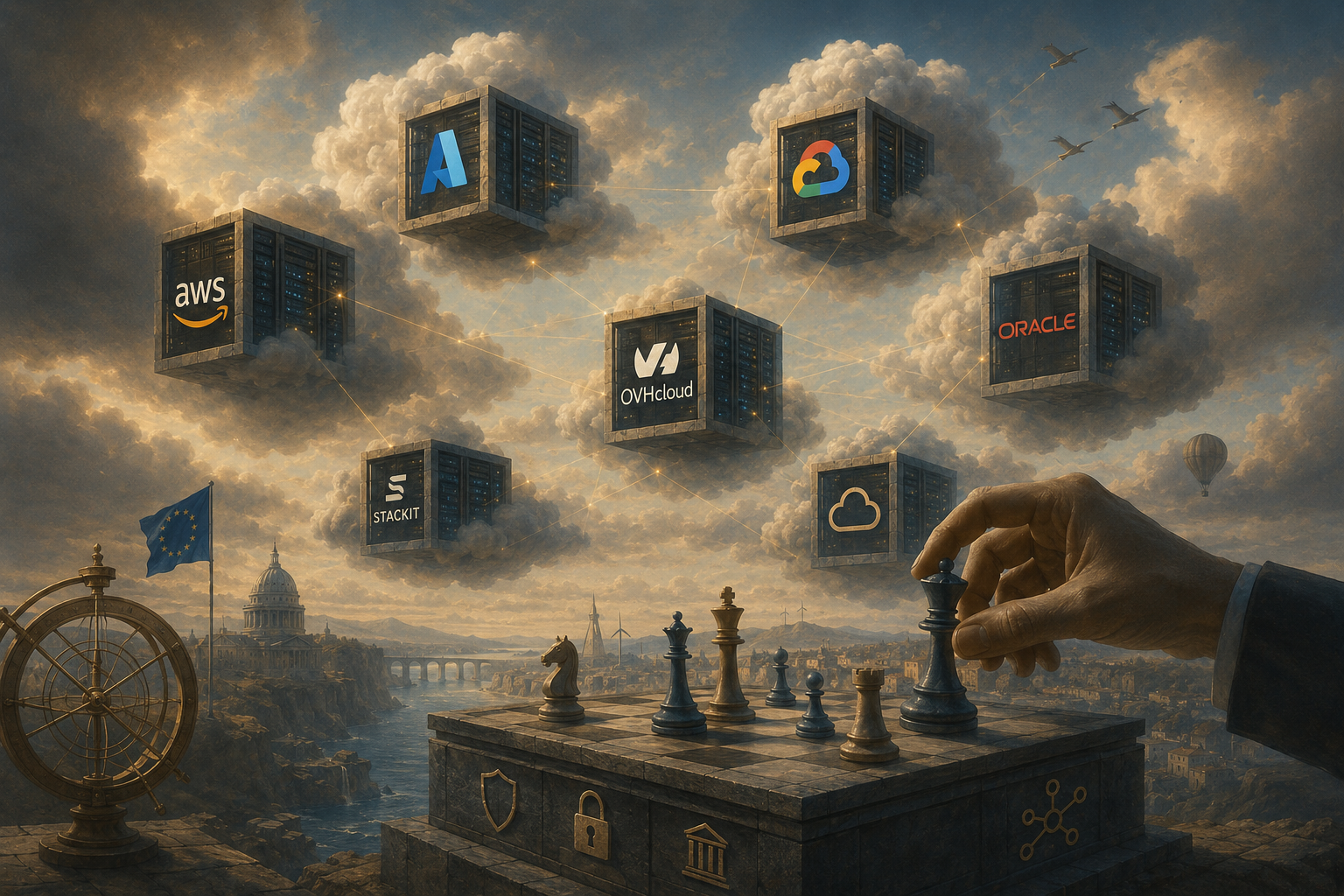
OVHcloud. IONOS. Scaleway. STACKIT. T-Systems. AWS. Azure. Google Cloud. Oracle.
Perhaps Europe’s cloud future will not be defined by replacing hyperscalers. But by orchestrating them.
From Ownership to Architecture
Ownership matters. Jurisdiction matters. Governance matters.
Yet architecture may matter even more. Redundancy. Segmentation. Interoperability. Diversification.
Because sovereignty ultimately depends not only upon what societies own. But upon the choices they preserve.
Cloud sovereignty is therefore not a fortress. It is a portfolio.
Strategic Assessment
Diversification ★★★★★
Resilience ★★★★★
Operational Flexibility ★★★★★
Scalability ★★★★☆
Complexity ★★★☆☆
European Alignment ★★★★★
Series Note
Building Europe’s Cloud Architecture explores the infrastructures, organisations and governance models shaping Europe’s computing future.
Phase III — Sovereignty moves beyond providers and platforms to examine how societies, governments and institutions can design resilient digital architectures. Rather than asking who owns the cloud, this phase asks which capabilities require control, which dependencies can be accepted and how optionality itself becomes a strategic asset.
Credit
Artwork: Altair Media / AI-generated visualisation inspired by Europe’s emerging cloud architecture and the principles of diversification, resilience and strategic choice.
Caption
A surreal interpretation of Europe’s evolving cloud landscape, where hyperscalers, sovereign providers, compute capacity and strategic autonomy coexist within a diversified architecture designed not for isolation, but for resilience through optionality.
