Signal | Europe Is Building Its Own Growth Capital Infrastructure
Why Europe may finally be treating capital as a strategic capability
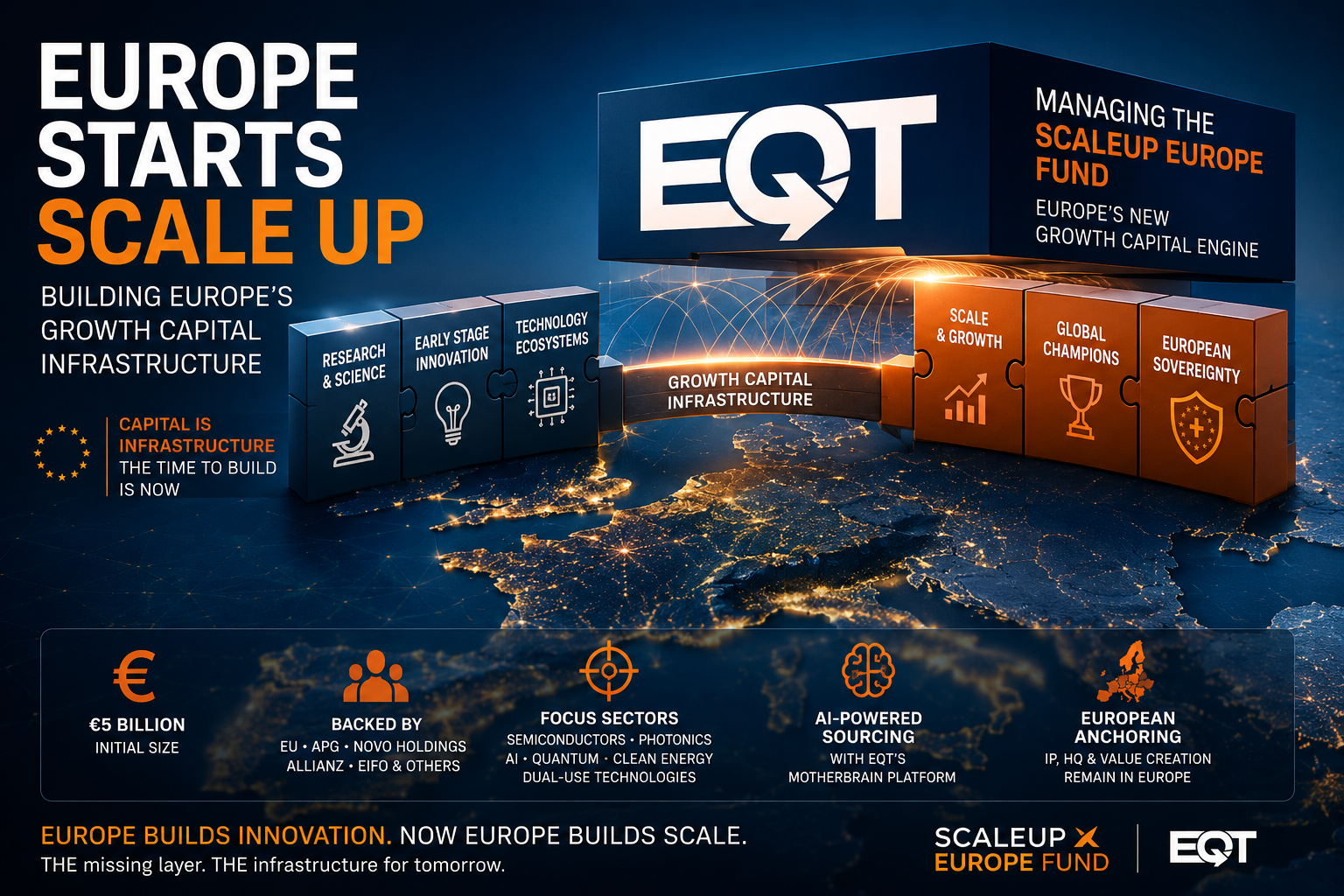
Europe has spent decades building laboratories, innovation programmes and world-class technology ecosystems. Yet many of its most promising companies still encounter the same obstacle once they reach maturity: the absence of sufficient growth capital. The Scaleup Europe Fund suggests Europe may finally be attempting to build the missing infrastructure layer.
🟦 Why does Europe produce innovation but struggle to produce scale?
Europe’s innovation ecosystem is often portrayed as a success story. Horizon Europe, the European Innovation Council, research universities and specialised clusters such as Brainport Eindhoven, imec and the European photonics ecosystem have created an impressive pipeline of technologies. Yet the paradox remains striking.
Europe finances discovery. Others finance expansion.
Many European deep-tech firms rely on American investors once they reach Series B rounds and beyond. Capital therefore becomes more than funding. It increasingly determines where intellectual property, strategic decision-making and long-term value creation ultimately reside.
Innovation was never Europe’s principal bottleneck. Scale may be.
🟦 Is Europe beginning to view capital as infrastructure?
The newly announced Scaleup Europe Fund appears to reflect a subtle but important shift in European thinking. For decades, capital was largely treated as a market outcome.
Today, policymakers increasingly discuss it as a strategic capability. Europe invests in electricity grids. Europe invests in semiconductor fabrication. Europe invests in telecommunications networks.
The emerging question is whether growth capital should be understood in the same way. Without financial infrastructure, technological infrastructure risks becoming incomplete.
Brainport can innovate. ASML can manufacture. imec can develop future technologies. But without sufficient pools of domestic growth capital, Europe remains vulnerable to exporting its most promising companies.
🟦 Why does the choice of EQT matter?
EQT is not simply an investor. It is becoming the operator of a new public-private architecture. Unlike traditional European subsidy mechanisms, the fund will be managed according to commercial principles and will seek large ownership positions in companies capable of becoming global leaders.
Equally revealing is EQT’s use of Motherbrain, its AI-driven sourcing platform. This suggests that even capital allocation itself is evolving into an infrastructural capability. The challenge is no longer merely finding capital. It is learning how to systematically direct capital towards strategic sectors.
🟦 Can Europe anchor technological sovereignty without anchoring capital?
One of the most significant elements of the initiative is its emphasis on European anchoring. The intention is not only to invest in companies.It is to retain intellectual property, headquarters, decision-making capacity and value creation within Europe.
This represents a broader shift in industrial policy. For decades Europe concentrated on generating knowledge. Today it increasingly appears focused on retaining the ecosystems capable of scaling that knowledge.
The ultimate question may therefore no longer be whether Europe can invent the future. It may be whether Europe can build the infrastructure required to keep that future at home.
Credit
Concept & Editorial Illustration: Altair Media (AI-generated)
Caption
Europe Starts Scale Up. The Scaleup Europe Fund represents an attempt to construct Europe’s missing infrastructure layer: growth capital capable of anchoring technology, talent and value creation within Europe.
