Norway and the Stewardship of Wealth
Can Resource Wealth Strengthen Future Generations Rather Than Weaken Them?
Few countries have benefited more from natural resources than Norway. Oil and gas transformed the country’s economy during the second half of the twentieth century, generating extraordinary levels of national wealth and helping create one of the world’s highest standards of living.
Yet Norway’s significance extends beyond the resources beneath the North Sea. The more interesting question is what Norway chose to do with that wealth. Many resource-rich countries struggle with a phenomenon often described as the resource curse. Commodity exports generate prosperity, but can also create economic dependence, political instability and long-term vulnerability.
Norway followed a different path. Its story is therefore not simply about natural resources. It is about stewardship.
From Natural Resources to National Strategy
Norway’s economic success did not begin with oil. Fishing, shipping and maritime industries have long connected the country to global markets.
When large offshore oil and gas reserves were discovered in the late twentieth century, Norwegian policymakers faced a strategic choice. Consume the wealth today. Or preserve part of it for tomorrow. The decision helped shape modern Norway.
Norway’s greatest resource may not be oil. It may be the discipline with which it manages it.
Rather than allowing resource revenues to dominate the domestic economy, Norway gradually developed institutions designed to manage wealth across generations.
The World’s Largest Sovereign Wealth Fund
At the centre of Norway’s model stands the Government Pension Fund Global. Built from oil and gas revenues, the fund has become the largest sovereign wealth fund in the world. Its purpose extends beyond investment returns. The fund acts as a mechanism for converting finite natural resources into long-term financial assets.
In effect, Norway transformed temporary resource wealth into a permanent source of national resilience. Rather than spending all revenues immediately, a significant portion was invested on behalf of future generations. This reflects a broader principle. Resource wealth belongs not only to current citizens. It also carries obligations toward those who come after them.
Norway demonstrates that resource wealth becomes an asset only when societies develop the institutions to govern it.
The fund is ultimately a reflection of trust. Citizens trust that today’s wealth will be preserved for tomorrow. Governments accept limits on how much can be spent in the present. Future generations are treated not as an abstraction, but as stakeholders in national decision-making.
In an era often dominated by short-term thinking, this may be one of Norway’s most remarkable achievements.
Energy and the Future Economy
Norway remains one of Europe’s most important energy producers. Oil and gas continue to play a central role in the economy. Yet Norway increasingly finds itself at the centre of another debate. What role should energy play in a low-carbon future Hydropower already supplies most domestic electricity. Offshore wind, carbon management technologies and new industrial initiatives are becoming increasingly important.
The country therefore occupies a unique position. Norway is both a major fossil fuel exporter and a potential contributor to Europe’s energy transition. This creates an unusual paradox. Norway has become one of the world’s most electrified societies while remaining a major exporter of oil and gas.
In many respects, the country finances parts of its own green transition through the sale of fossil fuels abroad.
Norway’s challenge is no longer creating wealth from energy. It is transforming energy wealth into future capabilities.
The question is not whether this contradiction exists. The question is how long it can be sustained.
The Infrastructure Behind Artificial Intelligence
As artificial intelligence expands, energy is becoming a strategic resource. Data centres, cloud infrastructure and advanced computing systems require vast amounts of reliable electricity. This creates new opportunities for countries capable of providing abundant and stable energy supplies.
Norway’s combination of renewable hydropower, technological expertise and political stability gives it advantages that extend far beyond traditional energy markets. In many respects, the country’s future may depend as much upon electricity as it once depended upon oil. The geography of intelligence increasingly follows the geography of energy.
For decades, Norway’s strategic advantage was measured in barrels of oil and cubic metres of natural gas. Increasingly, it may be measured in megawatts of clean electricity. As artificial intelligence, cloud infrastructure and advanced computing become more energy intensive, countries capable of providing stable and abundant power may acquire new forms of strategic relevance.
Norway’s energy resources could therefore play a role not only in Europe’s industrial economy, but also in its emerging intelligence economy.
Trust, Institutions and Long-Term Thinking
Like its Nordic neighbours, Norway benefits from high levels of institutional trust. The management of resource wealth relies upon public confidence that revenues are being used responsibly and transparently. This may be one of the country’s most important competitive advantages.
Natural resources alone do not create successful societies. Institutions determine how resources are governed. Norway demonstrates that economic wealth and social trust can reinforce one another when supported by strong governance.
Natural resources create opportunities. Institutions determine whether those opportunities endure.
The country’s success suggests that long-term prosperity depends not only on what a society possesses, but also on how effectively it governs those assets.
Prosperity and Pressure
Norway’s model is not immune to challenges. The economy remains connected to industries that many countries hope to reduce over time. Global energy markets remain volatile. Demographic change creates growing pressures on public finances and labour markets.
At the same time, questions are emerging about how quickly the country should diversify beyond hydrocarbons. Another challenge is less visible. Resource wealth can create stability, but it can also reduce urgency.
Societies that become accustomed to prosperity may find it more difficult to cultivate the risk-taking and experimentation that often drive future innovation. The challenge for Norway is therefore not only preserving wealth. It is ensuring that wealth does not become a substitute for renewal.
Unlike Sweden, where innovation has become a societal habit, Norway faces a different question. Can a society built upon successful resource management remain equally successful in creating the industries of the future?
Looking Ahead
Norway represents one of the most successful examples of resource management in modern economic history. Rather than consuming extraordinary wealth as quickly as it appeared, the country built institutions designed to preserve and extend its benefits across generations.
As societies confront new questions about energy, sustainability and technological transformation, Norway offers an important lesson. Wealth alone does not determine the future. The management of wealth does.
The true measure of Norway’s success is not how much wealth it created, but how much of that wealth it preserved for generations yet to come.
The central question facing Norway therefore remains:
Can resource wealth strengthen future generations rather than weaken them?
For much of the past half-century, Norway’s answer has been yes.
Series — Economic Europe: Northern Europe
This article is part of Economic Europe, a United Europe series exploring the economic architectures that shape modern Europe. The Northern Europe chapter examines how Denmark, Sweden, Norway, Finland and Iceland have built distinctive models of resilience through trust, innovation, institutional capacity and long-term adaptation.
Credit
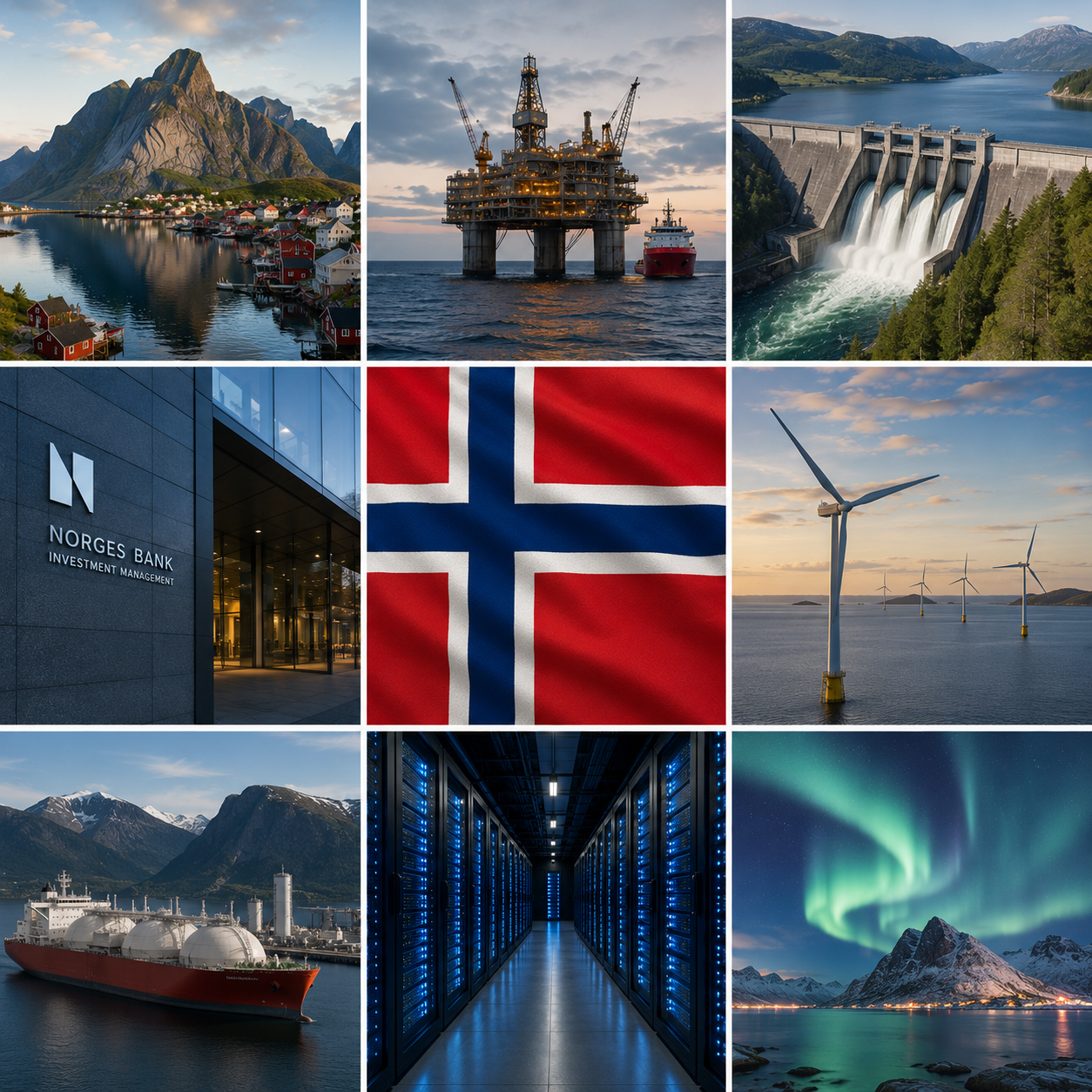
Illustration generated by OpenAI’s DALL·E for Altair Media Europe
Caption
Norway’s economic model is built upon more than natural resources alone. From offshore energy and hydropower to sovereign wealth management and emerging AI infrastructure, the country demonstrates how resource wealth can be transformed into long-term resilience through trust, stewardship and institutional discipline.
