Posted by Altair Media on October 19, 2026 · Leave a Comment
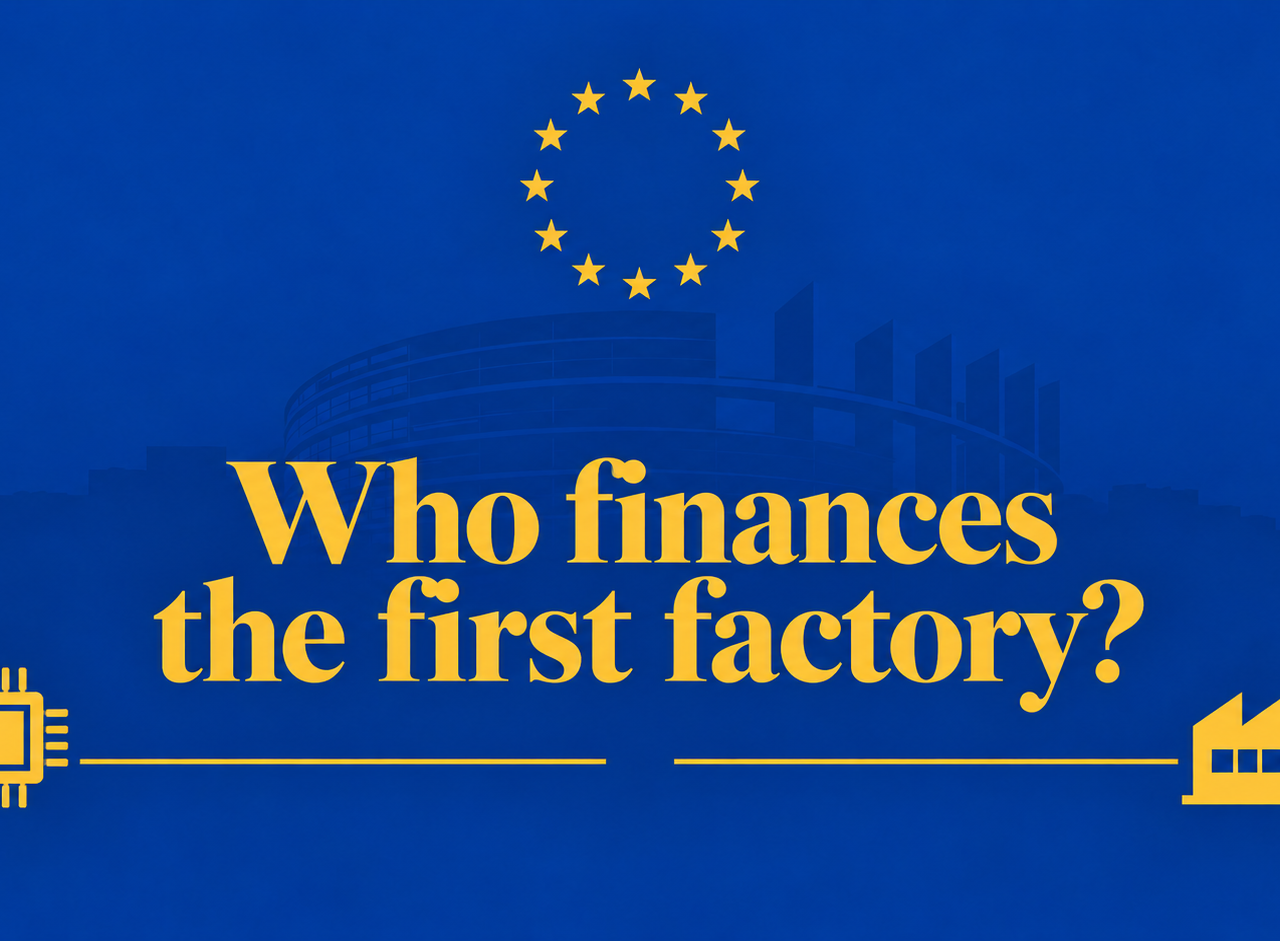
The difficult passage from pilot line to industrial production
A working technology is not yet a financeable manufacturing business. In photonics, the decisive test is whether production can deliver consistent quality at a sustainable cost. ABN AMRO’s financing of XIVER shows how industrial expansion can attract bank lending. The harder question concerns the capital needed before that manufacturing record and customer base exist.
The first Signal examined the gap between research spending and industrial results. Here, the question becomes concrete: who pays while production is still becoming commercially reliable?
🟦 What remains unproven after a successful pilot?
A pilot can validate devices and manufacturing processes. Volume production must establish repeatability, delivery performance and margins.
In photonics, packaging, optical connections and reliability testing introduce further engineering demands. The Photonic Integration Technology Center identifies production yield and testing throughput as important scaling challenges.
Yield determines how many devices meet specifications; testing speed influences how economically they can be verified. Both affect the cost of each saleable product.
A design can therefore work while its production economics remain unviable. The financing hurdle is demonstrating that performance can survive repetition at a price customers accept.
🟦 Why can industrial progress deepen the cash gap?
Equipment commitments become binding before customer revenues are secure. Qualification delays extend that exposure while salaries, materials and operating costs continue.
The factory, customer and financier follow different timetables. Process development may require further iterations; the buyer may withhold volume orders until validation is complete; repayment obligations follow the agreed financing schedule.
An installed production line can consequently coexist with a working-capital shortage. Funding the equipment does not automatically fund the period needed to turn it into reliable commercial output.
Customer interest offers a market signal. Purchase volumes, cancellation rights and payment terms determine how much financial certainty follows.
🟦 What does the XIVER transaction actually prove?
On 1 October, ABN AMRO announced €28 million in senior debt financing for XIVER within a €55 million investment programme, including an ASML DUV lithography system.
XIVER already has manufacturing operations and international customers. It emerged from Philips and was acquired by Dutch investors in early 2025. The transaction supports expansion of that industrial base.
This is meaningful evidence that a commercial bank can finance European semiconductor and photonics-related capacity. It leaves the first-factory question open: how does a younger manufacturer finance the production record that lenders and customers want to see?
The announcement discloses neither detailed lending terms nor the full financing mix. It establishes bank participation, without revealing a model that can simply be transferred to an unproven production business.
🟦 When does the financing instrument become part of the problem?
Repayment obligations can outpace the development of commercial cash flow. A development grant may leave production working capital uncovered. Equity can absorb uncertainty, but investors must accept the capital required and the time before returns become possible.
The central problem is matching funding terms to the risks still unresolved.
The EIB’s venture-debt model illustrates one approach: debt designed to complement equity investment in innovative growth companies. Debt need not wait until every uncertainty disappears, but its structure must accommodate a credible route towards repayment.
Guarantees can share financial exposure. They cannot make an unreliable process deliver or turn tentative demand into firm orders. Financing needs to survive a plausible ramp-up, including delays and production losses.
🟦 Does the first factory have to belong to the scale-up?
A company using external manufacturers may need to finance access to production, packaging and testing rather than construct a dedicated plant. That shifts part of the investment burden to specialist suppliers; it does not remove it.
XIVER describes its role as helping customers develop repeatable manufacturing. Expanding such capacity can support several businesses alongside the factory owner.
The relevant industrial-policy test is therefore usable capacity: can companies obtain the processes, expertise and production slots they need?
That capacity also needs demand. Staged orders, customer contributions to qualification and credible volume commitments can help connect a supplier’s investment decision with a buyer’s requirements. Without that connection, additional equipment can become underused capacity.
Signal
A proven technology still needs reliable production, credible demand and enough capital to reach customer payment.
XIVER demonstrates that commercial lending can support industrial expansion. The harder financing problem comes earlier, when manufacturing performance and customer commitments are still being established.
Europe needs capital whose terms can withstand the uncertainty of early production — and customers willing to help turn that production into a market.
Who finances the work required to make the first factory bankable?
This is the second Signal in Altair Media Europe’s four-part series, From European Science to European Industry, examining who finances the journey from breakthrough research to industrial scale and practical use.
Image credit
AI-generated illustration by OpenAI for Altair Media Europe.
Caption
From working chip to reliable production: who finances the capacity, qualification and working capital needed to cross the industrial funding gap?
Category: Signal, Capital, Digital Governance, European Governance, Featured, Governance, Infrastructure, Insights, Photonics, Physical Infrastructure, Strategy Governance · Tags: ABN AMRO, European Innovation, Industrial Finance, Photonics, Scaleup Finance, Semiconductor Manufacturing, Serie - From European Science to European Industry, Working Capital, XIVER
Posted by Altair Media on October 16, 2026 · Leave a Comment
Khaldoon Al Mubarak and the capital connecting Abu Dhabi to the world
For more than two decades, Khaldoon Al Mubarak has helped turn Abu Dhabi’s sovereign capital into more than a global investment portfolio. Under his leadership, Mubadala has invested across markets and technologies while building new capabilities at home. The model is distinctive: capital moves outward to generate returns, but the relationships it creates can also strengthen the economy that sent it abroad.
A different sovereign model
Al Mubarak has led Mubadala since its creation in 2002 and remains its Managing Director and Group CEO. At the end of 2025, the institution managed around $385 billion, after assets grew 17% during the year, while five- and ten-year annualised returns remained above 10%.
Mubadala’s formal mandate is commercial: generate sustainable, risk-adjusted returns for the Government of Abu Dhabi. Yet its role has always extended into economic development. Sheikh Mansour bin Zayed Al Nahyan chairs the board and provides the strategic framework; Al Mubarak’s task is to translate that mandate into investments, companies and partnerships across global markets.
PIF creates gravity. Mubadala builds bridges.
That creates a different model from Saudi Arabia’s PIF. Yasir Al-Rumayyan operates within a system in which sovereign capital is heavily deployed to create new industries and markets at home. Mubadala has often taken the opposite route: invest deeply in established global ecosystems, build relationships with companies and investors, and use those connections to strengthen Abu Dhabi’s own economic base.
Learning through global industries
Semiconductors provide an early example of how that model developed. In 2008, Abu Dhabi’s Advanced Technology Investment Company joined AMD in creating what would become GlobalFoundries, combining advanced manufacturing operations in Dresden with plans for a major fabrication plant in New York. Mubadala simultaneously deepened its investment relationship with AMD.
The important lesson was not that advanced semiconductor manufacturing could simply be transplanted wholesale to Abu Dhabi. Chip fabrication depends on extraordinarily complex ecosystems of engineers, equipment suppliers, research institutions, customers and infrastructure that take decades to build.
The asset abroad matters. But so does what the relationship makes possible at home.
But participation still mattered. Ownership created exposure to one of the world’s most strategic industries, along with experience of its technology cycles, capital requirements and international supply chains.
That distinction is fundamental to Al Mubarak’s model. A country does not need to reproduce every capability domestically in order to become more sophisticated. Sometimes the first step is gaining enough access and institutional knowledge to understand which capabilities are worth building at home and which are better accessed through global networks.
Turning relationships into capability
The same logic is now visible in life sciences. Mubadala has combined international investment with the construction of a domestic biopharma ecosystem. Mubadala Bio, launched in 2025, now brings together manufacturing and pharmaceutical logistics across ten facilities, six of them in the UAE. Earlier, Mubadala partnered with US-based Resilience to establish advanced biopharmaceutical manufacturing capabilities inside the Emirates.
Artificial intelligence takes the strategy further. Mubadala and G42 became founding partners of MGX, Abu Dhabi’s dedicated AI investment company, designed to invest across compute infrastructure, semiconductors, models and applications through partnerships with global technology companies.
Al Mubarak describes this increasingly connected world as one in which capital, talent, energy and infrastructure determine national competitiveness together. In his 2026 letter to partners, he argued that institutions able to operate across different systems, standards and alliances have a structural advantage.
Access only becomes capability when knowledge, talent and institutions begin to take root locally.
That is the essence of the sovereign bridge. Foreign investment provides financial exposure, but the deeper opportunity lies in the network created around it: executives, scientists, suppliers, investors and institutions that can connect Abu Dhabi to industries much larger than its domestic market.
When geopolitics reaches the bridge
That strategy also has limits. Advanced technology is becoming increasingly geopolitical. The UAE wants relationships across Asia, Europe and the United States, but in AI and semiconductors it cannot always treat those ecosystems as interchangeable.
The experience of G42 illustrates the tension. To deepen its relationship with Microsoft and gain greater access to American technology, the Abu Dhabi company removed Chinese hardware from its operations and reduced Chinese investments amid US security concerns. Washington explicitly welcomed the Microsoft partnership partly because it weakened G42’s links with Huawei.
For Abu Dhabi, this creates a new constraint on the bridge model. Sovereign capital can open doors, but it cannot eliminate export controls, security concerns or competition between technological blocs.
Being connected to everyone becomes harder when the networks themselves are separating.
The difference between access and dependence
There is also a financial discipline that matters. Almost any international investment can be described afterwards as strategically useful. Access, knowledge transfer and national capability are difficult to measure, which makes “strategic value” an easy justification for mediocre commercial performance.
Mubadala therefore needs two tests to remain valid at the same time. Individual investments must generate acceptable financial returns, while the wider portfolio should help create capabilities that strengthen Abu Dhabi’s long-term competitiveness.
Sovereign capital can open doors, but it cannot eliminate geopolitics.
Those objectives can reinforce one another, but they are not the same. Buying an advanced company does not automatically create engineers at home. A global partnership does not automatically produce a domestic supply chain. And foreign expertise remains dependency unless local institutions gradually become capable of absorbing and applying what those relationships provide. That is the real test of Al Mubarak’s model.
The sovereign bridge
Al Mubarak has spent more than two decades building an institution that allows a relatively small economy to participate in markets and industries far larger than itself.
Capital moves outward, but knowledge, partnerships and investment can move in both directions. Global relationships can become domestic companies; external expertise can become local capability; and an investor can gradually become part of the industrial ecosystems in which it invests.
The success of that model therefore cannot be measured by Mubadala’s portfolio size alone.
The deeper question is whether Abu Dhabi becomes capable of doing more of what it once had to access elsewhere.
A sovereign investor has truly imported capability when the relationship no longer depends solely on the capital that created it.
This article is part of The New Architecture of Gulf Capital, an Altair Media series examining how sovereign wealth, energy and private enterprise are shaping the region’s post-oil economy.
Credit
Illustration: Altair Media / OpenAI
Caption
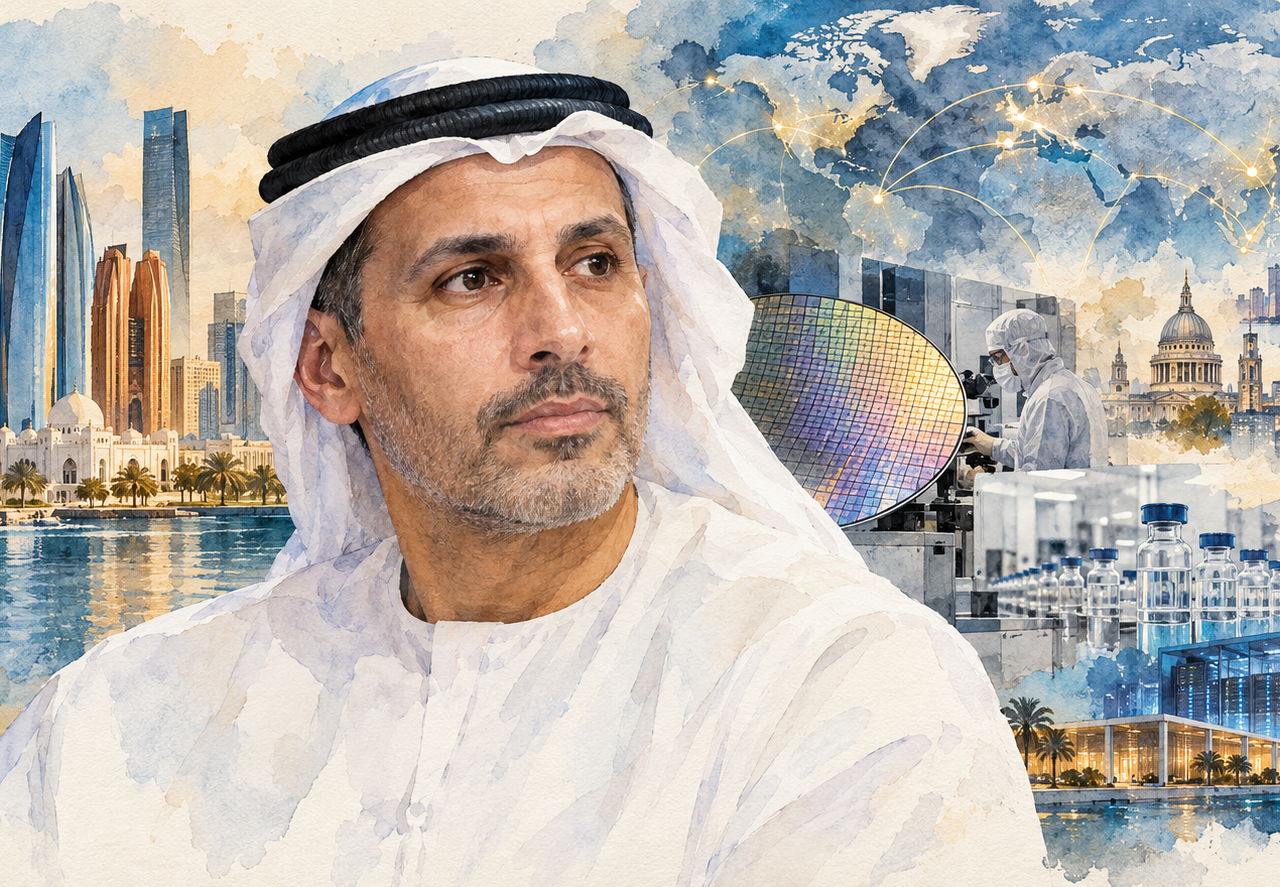
Khaldoon Al Mubarak, Managing Director and Group CEO of Mubadala. His model of sovereign investment connects Abu Dhabi to global technology, life sciences, advanced industry and capital markets — with the ambition of turning international relationships into domestic capability.
Category: Capital, Digital Infrastructure, Energy, Featured, Financial Infrastructure, Governance, Infrastructure, Insights, Strategy Governance · Tags: Abu Dhabi, GlobalFoundries, Gulf Capital, Khaldoon Al Mubarak, MGX, Mubadala, Serie - The New Architecture of Gulf Capital, Sovereign Capital, Strategic Investment