The Sovereign Bridge
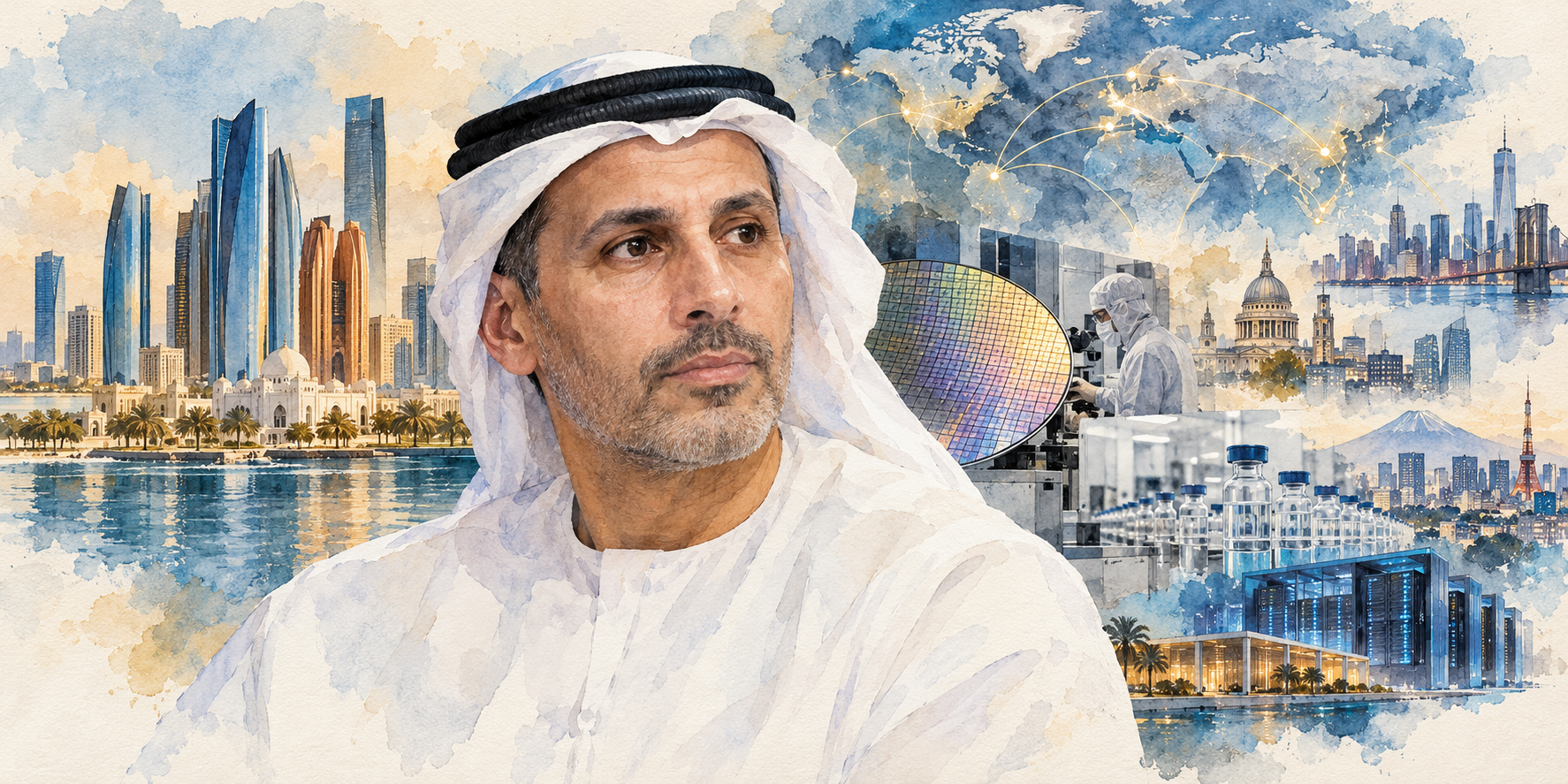
Khaldoon Al Mubarak and the capital connecting Abu Dhabi to the world
For more than two decades, Khaldoon Al Mubarak has helped turn Abu Dhabi’s sovereign capital into more than a global investment portfolio. Under his leadership, Mubadala has invested across markets and technologies while building new capabilities at home. The model is distinctive: capital moves outward to generate returns, but the relationships it creates can also strengthen the economy that sent it abroad.
A different sovereign model
Al Mubarak has led Mubadala since its creation in 2002 and remains its Managing Director and Group CEO. At the end of 2025, the institution managed around $385 billion, after assets grew 17% during the year, while five- and ten-year annualised returns remained above 10%.
Mubadala’s formal mandate is commercial: generate sustainable, risk-adjusted returns for the Government of Abu Dhabi. Yet its role has always extended into economic development. Sheikh Mansour bin Zayed Al Nahyan chairs the board and provides the strategic framework; Al Mubarak’s task is to translate that mandate into investments, companies and partnerships across global markets.
PIF creates gravity. Mubadala builds bridges.
That creates a different model from Saudi Arabia’s PIF. Yasir Al-Rumayyan operates within a system in which sovereign capital is heavily deployed to create new industries and markets at home. Mubadala has often taken the opposite route: invest deeply in established global ecosystems, build relationships with companies and investors, and use those connections to strengthen Abu Dhabi’s own economic base.
Learning through global industries
Semiconductors provide an early example of how that model developed. In 2008, Abu Dhabi’s Advanced Technology Investment Company joined AMD in creating what would become GlobalFoundries, combining advanced manufacturing operations in Dresden with plans for a major fabrication plant in New York. Mubadala simultaneously deepened its investment relationship with AMD.
The important lesson was not that advanced semiconductor manufacturing could simply be transplanted wholesale to Abu Dhabi. Chip fabrication depends on extraordinarily complex ecosystems of engineers, equipment suppliers, research institutions, customers and infrastructure that take decades to build.
The asset abroad matters. But so does what the relationship makes possible at home.
But participation still mattered. Ownership created exposure to one of the world’s most strategic industries, along with experience of its technology cycles, capital requirements and international supply chains.
That distinction is fundamental to Al Mubarak’s model. A country does not need to reproduce every capability domestically in order to become more sophisticated. Sometimes the first step is gaining enough access and institutional knowledge to understand which capabilities are worth building at home and which are better accessed through global networks.
Turning relationships into capability
The same logic is now visible in life sciences. Mubadala has combined international investment with the construction of a domestic biopharma ecosystem. Mubadala Bio, launched in 2025, now brings together manufacturing and pharmaceutical logistics across ten facilities, six of them in the UAE. Earlier, Mubadala partnered with US-based Resilience to establish advanced biopharmaceutical manufacturing capabilities inside the Emirates.
Artificial intelligence takes the strategy further. Mubadala and G42 became founding partners of MGX, Abu Dhabi’s dedicated AI investment company, designed to invest across compute infrastructure, semiconductors, models and applications through partnerships with global technology companies.
Al Mubarak describes this increasingly connected world as one in which capital, talent, energy and infrastructure determine national competitiveness together. In his 2026 letter to partners, he argued that institutions able to operate across different systems, standards and alliances have a structural advantage.
Access only becomes capability when knowledge, talent and institutions begin to take root locally.
That is the essence of the sovereign bridge. Foreign investment provides financial exposure, but the deeper opportunity lies in the network created around it: executives, scientists, suppliers, investors and institutions that can connect Abu Dhabi to industries much larger than its domestic market.
When geopolitics reaches the bridge
That strategy also has limits. Advanced technology is becoming increasingly geopolitical. The UAE wants relationships across Asia, Europe and the United States, but in AI and semiconductors it cannot always treat those ecosystems as interchangeable.
The experience of G42 illustrates the tension. To deepen its relationship with Microsoft and gain greater access to American technology, the Abu Dhabi company removed Chinese hardware from its operations and reduced Chinese investments amid US security concerns. Washington explicitly welcomed the Microsoft partnership partly because it weakened G42’s links with Huawei.
For Abu Dhabi, this creates a new constraint on the bridge model. Sovereign capital can open doors, but it cannot eliminate export controls, security concerns or competition between technological blocs.
Being connected to everyone becomes harder when the networks themselves are separating.
The difference between access and dependence
There is also a financial discipline that matters. Almost any international investment can be described afterwards as strategically useful. Access, knowledge transfer and national capability are difficult to measure, which makes “strategic value” an easy justification for mediocre commercial performance.
Mubadala therefore needs two tests to remain valid at the same time. Individual investments must generate acceptable financial returns, while the wider portfolio should help create capabilities that strengthen Abu Dhabi’s long-term competitiveness.
Sovereign capital can open doors, but it cannot eliminate geopolitics.
Those objectives can reinforce one another, but they are not the same. Buying an advanced company does not automatically create engineers at home. A global partnership does not automatically produce a domestic supply chain. And foreign expertise remains dependency unless local institutions gradually become capable of absorbing and applying what those relationships provide. That is the real test of Al Mubarak’s model.
The sovereign bridge
Al Mubarak has spent more than two decades building an institution that allows a relatively small economy to participate in markets and industries far larger than itself.
Capital moves outward, but knowledge, partnerships and investment can move in both directions. Global relationships can become domestic companies; external expertise can become local capability; and an investor can gradually become part of the industrial ecosystems in which it invests.
The success of that model therefore cannot be measured by Mubadala’s portfolio size alone.
The deeper question is whether Abu Dhabi becomes capable of doing more of what it once had to access elsewhere.
A sovereign investor has truly imported capability when the relationship no longer depends solely on the capital that created it.
This article is part of The New Architecture of Gulf Capital, an Altair Media series examining how sovereign wealth, energy and private enterprise are shaping the region’s post-oil economy.
Credit
Illustration: Altair Media / OpenAI
Caption
Khaldoon Al Mubarak, Managing Director and Group CEO of Mubadala. His model of sovereign investment connects Abu Dhabi to global technology, life sciences, advanced industry and capital markets — with the ambition of turning international relationships into domestic capability.
