Silicon Box: Europe’s €1.3 Billion Packaging Bet
Italy is funding a critical chip capability. Europe’s return depends on industrial depth and technological relevance.
On 1 October, Italy approved €1.3 billion in public support for Silicon Box’s planned €3.2 billion advanced semiconductor packaging facility in Novara. The Singapore-based company could strengthen a vulnerable part of Europe’s chip supply chain. The strategic test is whether the investment builds lasting capabilities that remain commercially competitive and technologically relevant when production reaches scale.
The significance begins inside the package — and extends to the knowledge, customers and decisions surrounding it.
🟦 Why does packaging deserve a billion-euro industrial bet?
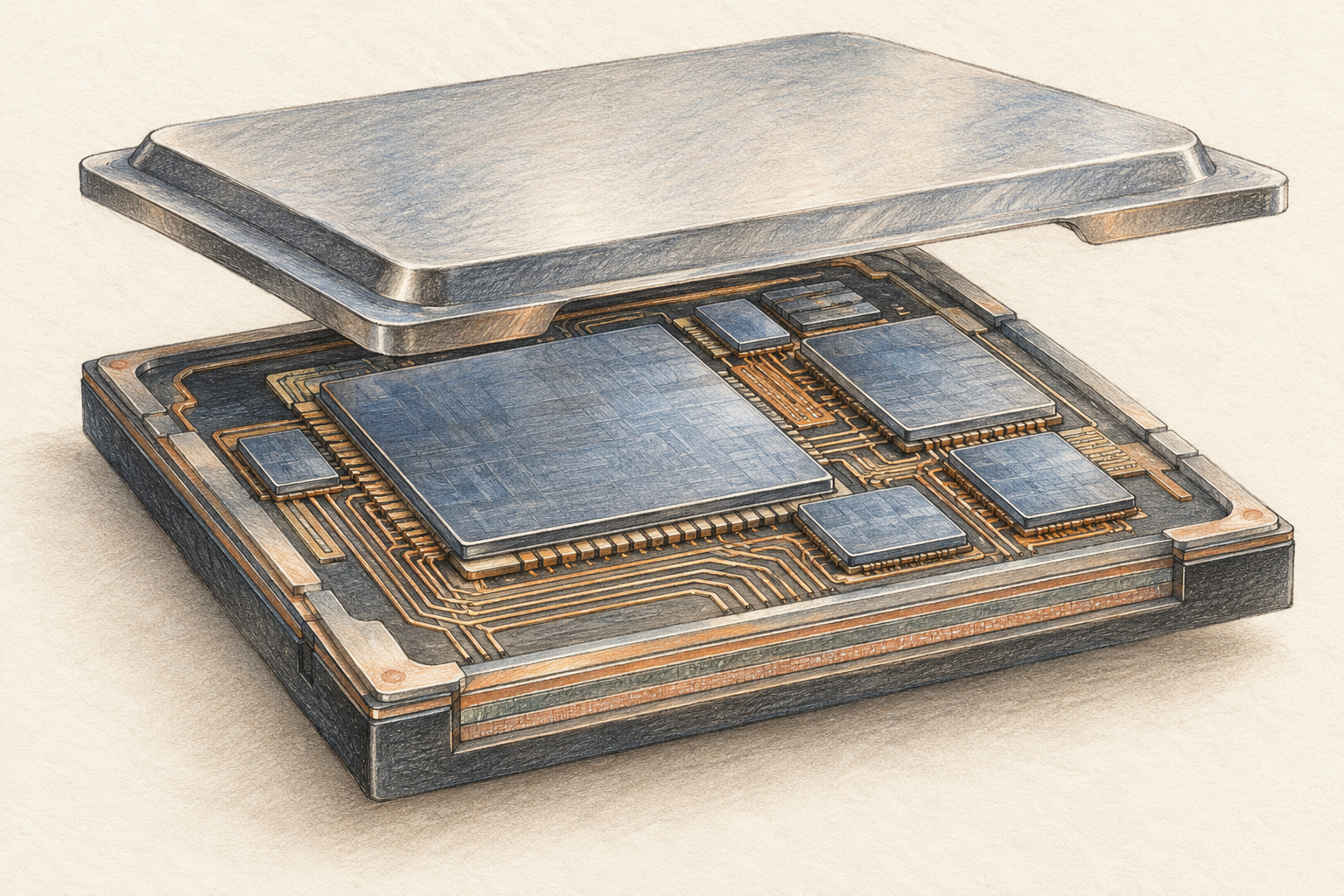
Advanced packaging connects separate chips or chiplets into a working system. Those connections help determine performance, power consumption and which combinations of technologies become commercially viable.
Novara will use panel-level packaging, processing components on large panels to improve manufacturing efficiency. Intended applications include AI, automotive systems, data centres and supercomputing.
Europe has research expertise and specialised packaging activities, while volume capacity remains concentrated in Asia. That leaves a structural exposure: European designs and manufactured chips can still depend on overseas integration before becoming usable systems.
Novara could reduce that exposure. Its strategic value will depend on whether it delivers the processes European customers actually need.
🟦 What does Italy gain beyond another subsidised factory?
Silicon Box expects approximately 1,600 direct jobs. The larger opportunity lies in the engineering expertise, supplier relationships and research activity that could develop around them.
The depth of that development matters. A facility operating processes developed elsewhere creates employment and output. A facility whose engineers also improve those processes, qualify new materials and help shape future products builds a stronger industrial position.
Italy’s task is to turn the investment into that wider capability. Local procurement, technical responsibility and sustained collaboration with research institutions will reveal how deeply the project becomes embedded in the economy.
🟦 Does €1.3 billion buy Europe strategic control?
The Italian support is a direct grant. Its roughly 40.6% share of the announced investment does not establish a corresponding public ownership stake.
There are substantive commitments: developing advanced packaging technology in the EU, training workers, implementing priority orders during supply crises and sharing potential profits above current expectations with Italy.
Under the Chips Act, priority orders can become binding Commission decisions during an activated crisis stage, backed by penalties. They remain a last-resort instrument, subject to technical feasibility and safeguards against unreasonable economic burdens.
The practical limit is clear. An order can redirect available production; it cannot create missing components or instantly qualify an incompatible process. Security of supply must be engineered before the crisis.
🟦 Can a Singapore-based company strengthen European autonomy?
Yes. Production in Europe can broaden supply options, develop skills and bring industrial capability closer to customers.
The harder question concerns how much capability accumulates locally. Where are process improvements developed? Which customers secure access? How much influence do European partners have over the technology roadmap?
Silicon Box’s participation in imec’s Automotive Chiplet Program provides a concrete connection to European research and automotive requirements.
That connection offers a route towards deeper industrial integration. Its value will grow if European companies can develop and qualify products with Silicon Box, creating relationships that extend beyond purchasing manufacturing capacity.
🟦 What changes for the global semiconductor industry?
Novara could add another geographical location for advanced integration, giving customers an additional option within an internationally connected supply chain.
Its competitive significance will depend on manufacturing economics, dependable yields and successful customer qualification. A subsidised facility still has to win production programmes against established alternatives.
For Europe, the potential gain is greater bargaining power through useful industrial capability. But the factory will continue to depend on international flows of chips, equipment and materials.
The investment can diversify one important stage of production. Its contribution to resilience will depend on how that stage connects to the rest of the chain.
🟦 Will the technology still be competitive when the factory reaches scale?
Construction is envisaged to begin in spring 2027. The Commission expects full capacity in 2033. That is a long industrial ramp across several semiconductor product cycles.
The risk extends beyond delays and construction costs. Customer requirements, interconnect technologies and competing packaging platforms will continue to evolve while Novara is being built and qualified.
The project therefore needs a credible path for upgrading processes, developing new capabilities and attracting successive generations of customer products.
A completed factory demonstrates execution. A factory that keeps winning demanding production programmes demonstrates lasting industrial value.
Signal
Novara could strengthen a vulnerable link in Europe’s semiconductor chain. The return on €1.3 billion will depend on whether European industry gains reliable access, accumulates knowledge and can keep advancing the technology. Reaching scale in 2033 is one milestone; remaining competitive beyond it is the strategic test.
Credit
Altair Media / AI-generated illustration with OpenAI.
Caption
Connecting chiplets, building capability: advanced packaging turns separate semiconductor components into an integrated system. Conceptual illustration; not a depiction of a specific Silicon Box product.
