BNP Paribas: Does European AI Mean Greater Control?
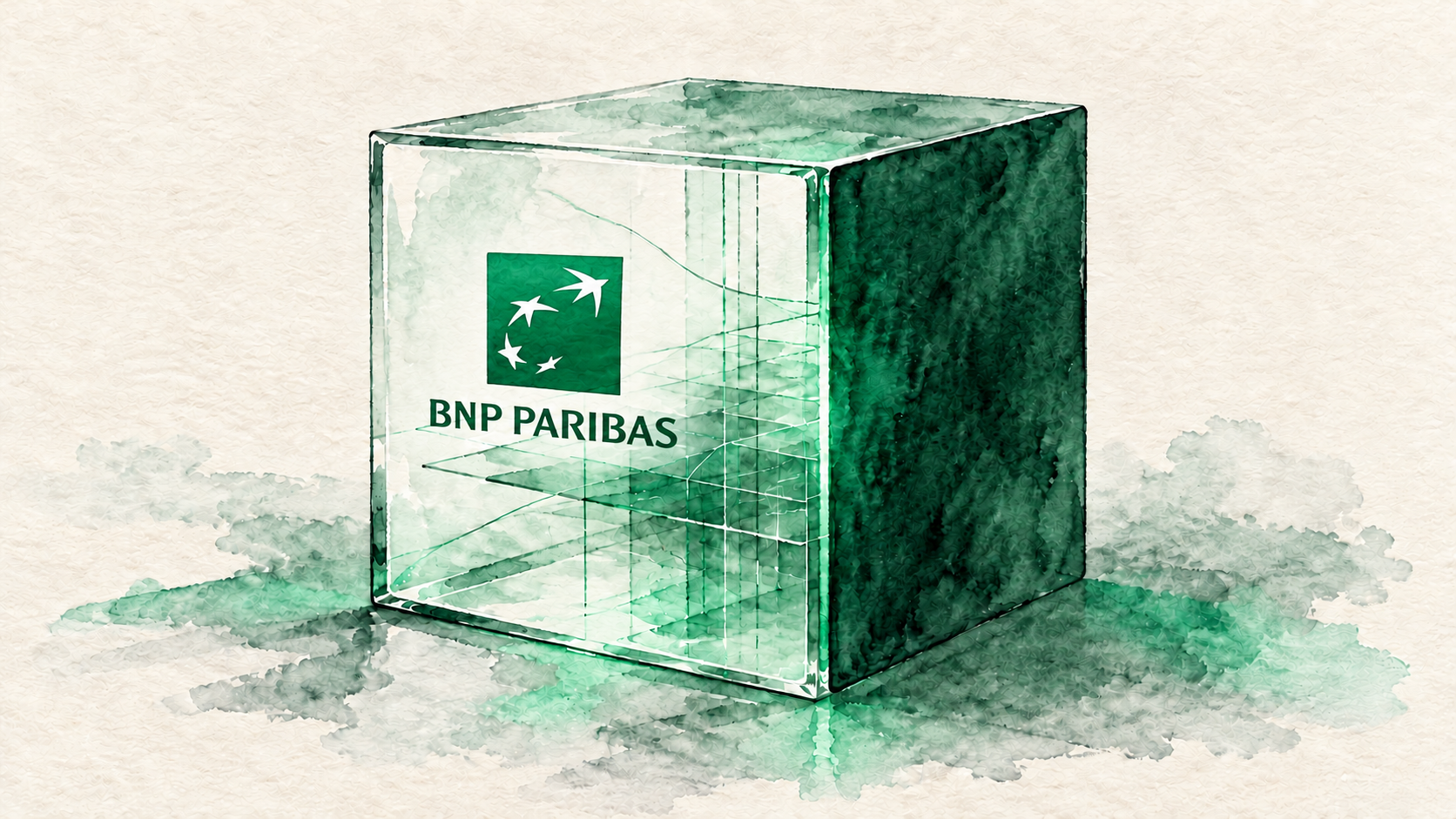
Choosing Mistral and Google Cloud broadens the bank’s options. Operational autonomy depends on whether it can investigate failures, challenge conclusions and change course.
BNP Paribas is expanding its Mistral AI partnership while adding Google Cloud capabilities to its technology mix. The strategy offers choice, efficiency and a European technology anchor. But autonomy faces a harder test when something goes wrong: can the bank reconstruct a flawed recommendation, establish responsibility and change the system without losing control of essential operations?
The distinction is practical: knowing where a model comes from does not establish whether its conclusions can be checked.
🟦 Does a European supplier deliver operational autonomy?
BNP Paribas renewed its Mistral partnership for three years in May 2026, extending cooperation to software, joint development and research. That can deepen expertise and expand the bank’s options. Effective autonomy still depends on documentation, contractual rights, internal skills and workable alternatives.
Can the bank investigate an output, control material changes and replace a component without dismantling the workflow?
Access to model weights alone would not answer those questions. Control must extend to the data, instructions, integrations and decisions surrounding the model.
A European supplier can strengthen autonomy. Its nationality cannot demonstrate it.
🟦 Can multiple providers leave responsibility fragmented?
The September Google Cloud agreement includes plans to support corporate credit-memo preparation and integrate Gemini into BNP Paribas CIB’s internal AI assistant.
Consider a hypothetical flawed credit assessment. The error could originate in source data, document extraction, workflow instructions, model output or the analyst’s interpretation.
Who can reconstruct the chain, and who must coordinate the correction?
Multiple providers offer options; their interfaces require clear ownership. The bank needs records and cooperation rights that allow an investigation to cross organisational boundaries.
Supplier choice has limited protective value if responsibility becomes harder to establish at each handover.
🟦 Does keeping data inside make the black box transparent?
The Mistral partnership includes developing on-premises solutions for sensitive processes such as Know Your Customer, with expert validation of risks and decisions.
Hosting choices can strengthen confidentiality and control over data processing. They do not, by themselves, explain a model’s output.
An internally hosted application can still omit relevant context or produce unsupported connections. Reviewers need to inspect source material, significant exclusions and the steps linking evidence to conclusions.
The decisive question is whether the bank can uncover and correct an inference that looks plausible but rests on weak evidence.
Local hosting and evidentiary transparency are separate safeguards.
🟦 Does the value calculation capture failures that emerge later?
BNP Paribas targets €750 million in AI-related value creation by the end of 2026, including additional revenue, efficiency gains and improved risk management.
Risk reduction is therefore explicitly part of the ambition. The harder question is how it is measured.
Time savings may appear immediately. The consequences of a weak credit assessment or incomplete customer investigation may emerge much later.
A credible assessment should connect benefits to subsequent losses, remediation costs, error rates and review effort. It should also revisit earlier estimates when outcomes change.
Otherwise, apparent value can be recognised before the full cost of correction becomes visible.
🟦 Can human reviewers reopen a decision already shaped by AI?
BNP Paribas says important decisions must remain understandable, subject to oversight and capable of correction.
For a consequential credit or customer-risk assessment, that requires more than approving a prepared document.
Can the reviewer obtain missing evidence, challenge an inference and pause the process? Does escalation reach someone with authority to change the assessment?
A second person reading the same incomplete summary may reproduce the original mistake.
Meaningful escalation requires a fresh route to the evidence — with enough time and institutional backing to reach a different conclusion.
🟦 What would demonstrate autonomy under pressure?
BNP Paribas describes model validation and independent reviews within its risk framework.
The strongest tests concern difficult moments: a model withdrawn, a provider unavailable, an unreliable application suspended.
Can essential work continue? Can records be retrieved, affected cases identified and customers protected while an alternative is introduced?
These are proposed tests, not findings that BNP Paribas lacks such capabilities. They distinguish an available alternative from one the bank can actually deploy.
Autonomy becomes credible when the institution can change course without abandoning its responsibilities.
Signal
BNP Paribas’s partnerships expand its technological options. Operational autonomy requires evidence that the bank can trace a failure, challenge a conclusion, allocate responsibility and replace a capability. European sourcing and local hosting can support that control. The decisive test is whether people can exercise it when commercial stakes are high.
Credit
Illustration: Altair Media / AI-generated with ChatGPT.
Caption
A glass cube in BNP Paribas green explores the tension between technological choice and operational control, with transparent layers meeting an opaque surface.
