France and the Return of Economic Sovereignty
How State Strategy Continues to Shape One of Europe’s Most Independent Economies
The French Economic Model
France has long occupied a distinctive position within Europe. While many advanced economies increasingly embraced market liberalisation and global integration, France retained a stronger belief in the strategic role of the state. From energy and transportation to aerospace, defence and industrial policy, public institutions have continued to play an active role in shaping economic development.
The result is an economy that appears both deeply globalised and uniquely national. France’s story is therefore not simply about markets or industry. It is about strategic capacity. Few European countries have maintained such a strong tradition of economic planning.
For decades, French governments viewed strategic sectors not merely as commercial activities but as national capabilities. Energy infrastructure, transportation networks, aerospace industries and telecommunications were often developed through close cooperation between the state, public institutions and industry.
This approach helped create national champions capable of competing globally while maintaining critical domestic capabilities.
“France has often viewed economic capacity not only as a source of prosperity, but as a foundation of national sovereignty.”
While other countries increasingly trusted markets to allocate resources, France remained committed to the idea that certain sectors required long-term strategic direction.
Infrastructure as Statecraft
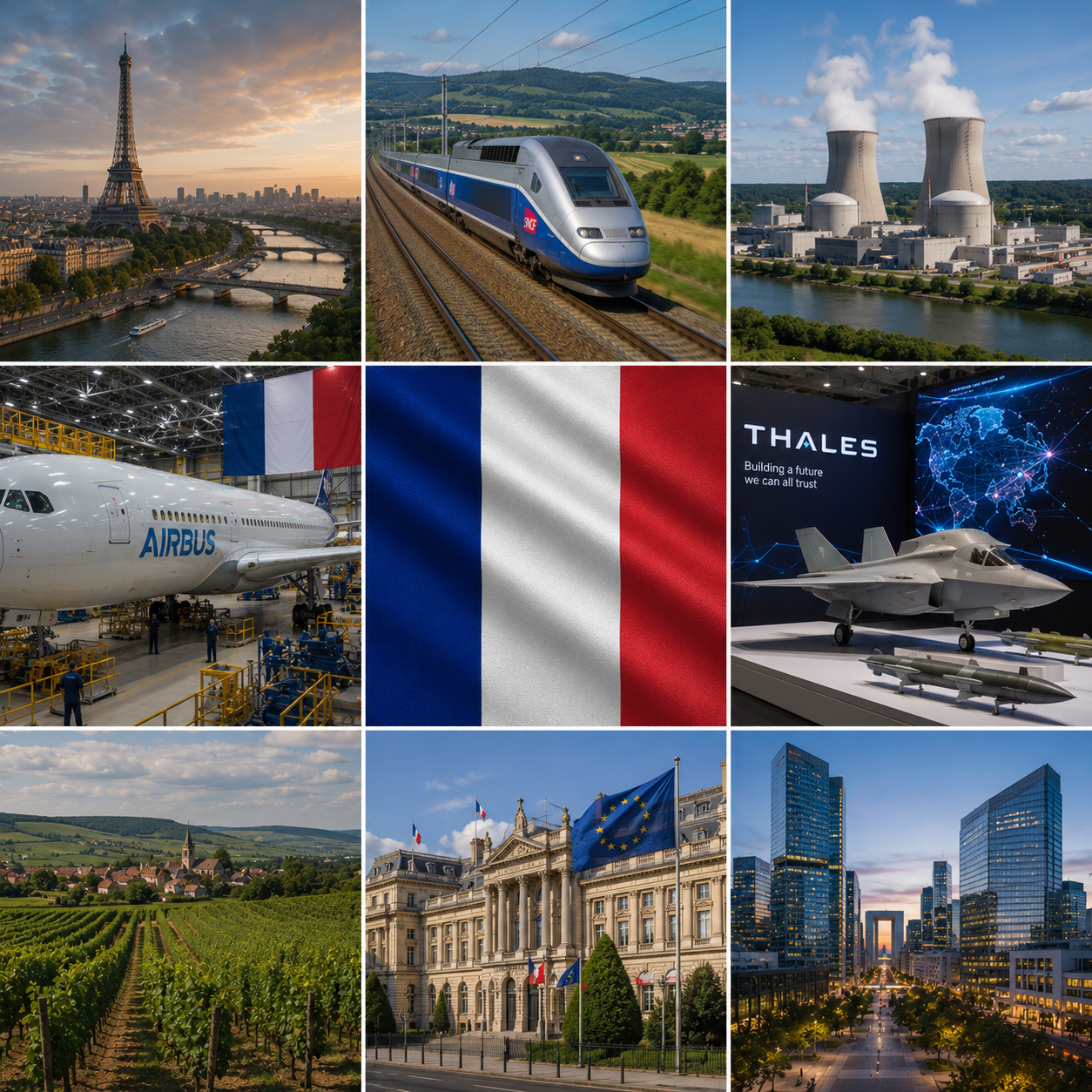
France possesses some of Europe’s most extensive infrastructure networks. High-speed rail, nuclear energy, airports, ports and digital networks form part of an economic architecture built over decades of public investment. These systems were not designed solely to maximise efficiency. They were also intended to strengthen national cohesion and strategic autonomy.
The country’s energy system illustrates this particularly clearly. While many European states became increasingly dependent on imported energy, France invested heavily in nuclear power, creating one of the continent’s most distinctive energy models. Although challenges remain, this decision continues to provide France with a unique strategic asset as Europe becomes increasingly electrified.
In an era shaped by artificial intelligence, data centres and industrial electrification, access to stable energy may become as important as access to transportation networks was during the industrial age.
National Champions and Strategic Industries
French influence extends far beyond its borders. Companies such as Airbus, Thales, Dassault Aviation and EDF operate in sectors that increasingly shape geopolitical as well as economic outcomes. Aerospace, defence, energy and advanced technologies remain closely linked to broader questions of national and European capability.
Yet France has also long understood the limits of acting alone. Airbus offers perhaps the clearest example. While often associated with France, Airbus is fundamentally a European project. It reflects an important French insight: some forms of sovereignty can only be achieved through cooperation at scale.
“France has long understood that sovereignty and cooperation are not necessarily opposites. In strategic industries, sovereignty may increasingly depend upon the ability to organise collective European capabilities.”
This logic increasingly shapes debates surrounding semiconductors, defence, energy and technological autonomy across Europe.
France Before the Return of Industrial Policy
Many of the economic debates now emerging across Europe have existed in France for generations. Industrial policy. Strategic autonomy. Energy security. National champions. Technological sovereignty.
While much of Europe spent decades prioritising efficiency, liberalisation and global integration, France continued to view economic capacity as a strategic concern.
Recent developments have brought these perspectives back into focus. The pandemic exposed supply chain vulnerabilities. Energy crises highlighted strategic dependencies. Growing geopolitical competition intensified concerns about critical technologies and industrial resilience.
As a result, ideas once considered uniquely French increasingly influence policy discussions across Europe.
Prosperity and Pressure
France remains one of Europe’s largest and most diversified economies. Yet significant challenges persist.
Public debt, labour market tensions, housing pressures and questions surrounding competitiveness continue to shape economic policy. The French model has proven highly effective at mobilising resources for large-scale projects and strategic industries. It has often been less successful at fostering the kind of agile entrepreneurial ecosystems that have flourished elsewhere.
The challenge is therefore not whether the state should play a role in economic development. The challenge is determining how strategic coordination can coexist with innovation, flexibility and long-term fiscal sustainability.
“The strengths of strategic planning and the strengths of economic dynamism do not always emerge from the same institutions.”
Balancing these competing demands may become one of France’s defining economic challenges.
Looking Ahead
France may be uniquely positioned for an era in which states are once again becoming active economic actors. Around the world, governments are increasingly intervening in energy, semiconductors, infrastructure, defence and advanced technologies. The distinction between economic policy and strategic policy is becoming less clear.
In this environment, France’s long-standing emphasis on state capacity appears less exceptional than it once did.
“France has long argued that sovereignty requires capacity. As Europe confronts a more fragmented and competitive world, that argument is no longer uniquely French.”
The defining question facing France may therefore extend beyond its own borders: Can national sovereignty survive the scale required for European strategic autonomy?Because the answer may help determine not only France’s future, but Europe’s as well.
France — Where Sovereignty Requires Capacity
Series — Economic Europe: Western Europe
This article is part of Economic Europe, a United Europe series examining the economic architectures that shape modern Europe. The Western Europe chapter explores how connectivity, finance, logistics, innovation and strategic capacity have transformed the Netherlands, Belgium, Luxembourg, France, Ireland and the United Kingdom into some of Europe’s most influential economic systems.
Credit
Illustration generated by OpenAI’s DALL·E for Altair Media Europe
Caption
France illustrates how infrastructure, energy, industry and statecraft can converge into a long-term strategy for economic resilience, technological capability and national influence.
