The Coalition Behind Europe’s Technology Future
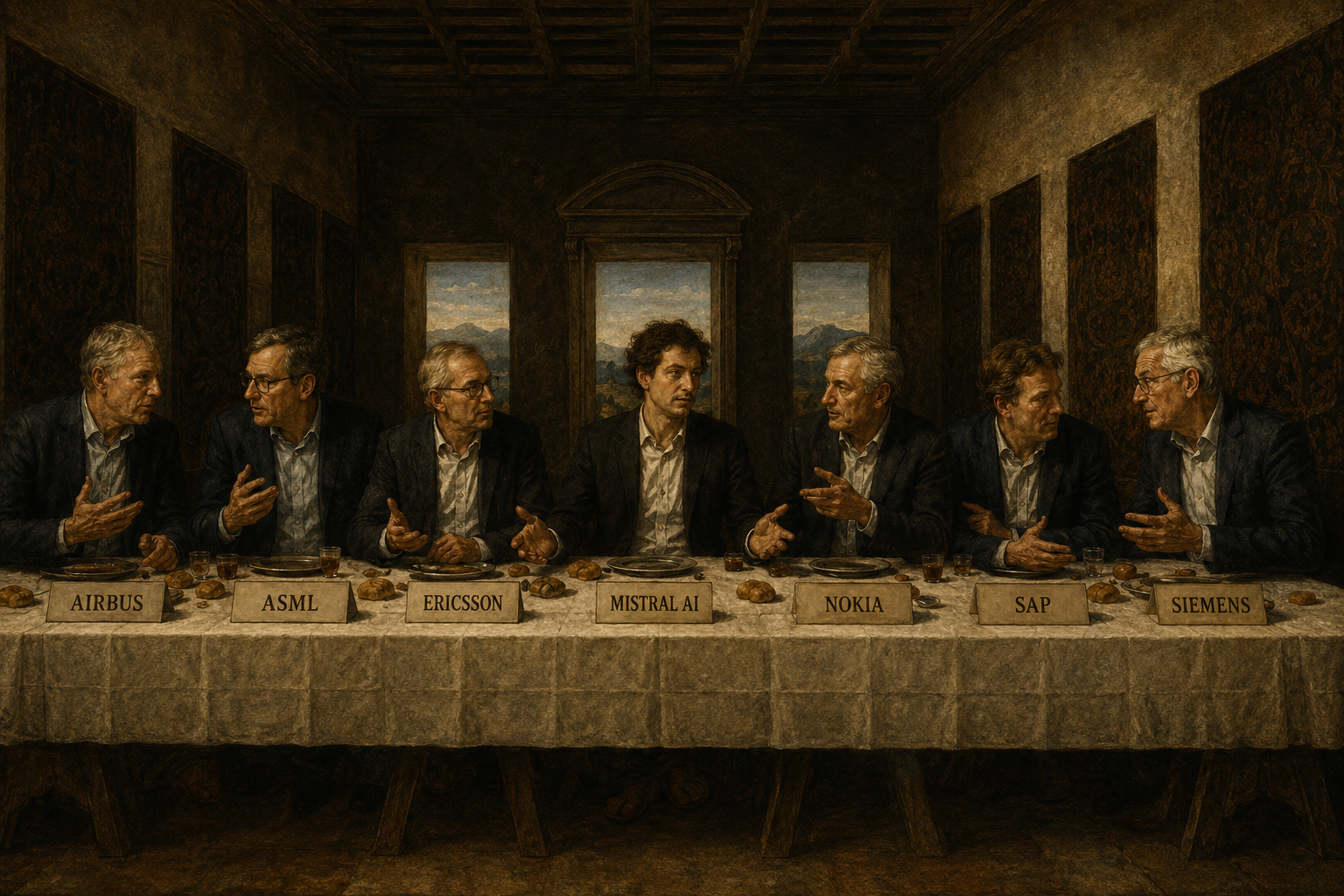
Why the joint statement from seven European technology leaders may have been less about regulation and more about coordination
When seven European technology leaders issued a joint call for action in May 2026, much of the public discussion focused on regulation. Headlines emphasized concerns about competitiveness, compliance burdens and Europe’s ability to keep pace with the United States and China.
Those concerns were certainly present. Yet a closer reading of the statement — and an examination of the companies behind it — suggests a different interpretation.
The most significant message may not have been about regulation at all. It may have been about coordination.
Beyond the Regulatory Debate
To many observers, the statement appeared familiar. Large companies often argue that excessive regulation slows innovation and reduces competitiveness. Seen through that lens, the joint appeal looked like another chapter in Europe’s long-running debate over economic growth and technological leadership.
The narrative was straightforward: Europe regulates while others scale. Yet this interpretation leaves an important question unanswered.
Why did these particular companies decide to speak together? The answer matters because the coalition itself was highly unusual.
The significance of the coalition may not lie in who signed the statement, but in what they collectively represent.
The signatories included ASML, Airbus, Ericsson, Mistral AI, Nokia, SAP and Siemens.
At first glance, these companies appear to operate in entirely different sectors. They serve different markets, face different competitors and operate within different parts of the economy.
They are not direct rivals. Nor do they belong to a single industry. Yet viewed from a broader perspective, they represent something far more significant.
A Technology Stack in Plain Sight
Together, the seven companies form multiple layers of a modern technology ecosystem.
| Layer | Company |
|---|---|
| Artificial Intelligence | Mistral AI |
| Enterprise Software | SAP |
| Telecommunications Infrastructure | Ericsson, Nokia |
| Industrial Systems | Siemens |
| Semiconductor Equipment | ASML |
| Aerospace and Defence | Airbus |
Seen in this way, the coalition begins to look less like a lobbying group and more like a map of Europe’s emerging technology architecture. That distinction matters.
For decades, Europe often discussed industrial policy sector by sector. Telecommunications belonged to one conversation. Semiconductors belonged to another. Aerospace, software and manufacturing each occupied their own policy domains.
The coalition suggests a different perspective. One in which these technologies are no longer separate industries but interconnected layers of the same system.
From Companies to Systems
For much of the twentieth century, economic power was associated with national champions and large corporations. Success was measured through the strength of individual firms.
Today’s technological landscape increasingly operates according to different rules. Artificial intelligence depends on cloud infrastructure. Cloud infrastructure depends on semiconductors. Semiconductors depend on advanced manufacturing equipment. Industrial systems depend on software. Defence capabilities depend on all of the above.
Technological power increasingly emerges from the interaction between specialised actors rather than from the dominance of any single company.
Technological power is increasingly created between organizations rather than within them.
The United States demonstrates this clearly. Its strength does not come solely from Microsoft, Nvidia, Amazon, Google or OpenAI as individual firms. It comes from the way those organisations reinforce one another within a larger ecosystem.
China has pursued a similar strategy through the integration of manufacturing, telecommunications, digital platforms, artificial intelligence and state-supported industrial policy.
In both cases, competitive advantage has become increasingly systemic. The coalition of European technology leaders may reflect a growing recognition that Europe faces the same reality.
The Physical Infrastructure of Intelligence
There is another dimension to this discussion that receives far less attention. Much of the public debate still treats technology as something largely digital. Artificial intelligence appears as software. Cloud computing appears as a virtual service. Data appears weightless.
The reality is considerably more physical. Every AI model depends on data centres. Data centres require electricity, cooling systems and advanced networking equipment. Networks require semiconductors. Semiconductors require highly specialised manufacturing tools. Industrial systems connect these layers to the wider economy.
Behind every digital service stands a physical infrastructure stack. This is precisely why the composition of the coalition is so revealing. ASML represents one of the most critical bottlenecks in global semiconductor production. Siemens occupies strategic positions in industrial automation and engineering systems. Ericsson and Nokia provide the networks upon which digital economies depend. Airbus operates at the intersection of advanced manufacturing, aerospace and defence.
Together, they represent significant parts of the physical substrate that underpins modern technological power.
Intelligence may be digital, but the infrastructure that enables it remains profoundly physical.
Europe’s Coordination Challenge
Europe’s challenge is often described as an innovation problem. Yet Europe continues to produce world-class technologies. It remains a global leader in areas such as lithography, photonics, industrial engineering, advanced materials and scientific research. The issue may not be the absence of capability. The issue may be the absence of coordination.
Europe’s strengths are distributed across multiple countries, funding mechanisms, regulatory frameworks and industrial ecosystems. The result is a continent rich in assets but often fragmented in execution.
This fragmentation matters because many of Europe’s most valuable technologies occupy critical positions within global value chains. They are not merely successful products. They are increasingly becoming strategic control points.
ASML provides the most visible example, but similar dynamics exist across industrial systems, telecommunications infrastructure and specialised engineering technologies.
The challenge therefore extends beyond efficiency or competitiveness. It concerns Europe’s ability to connect individual areas of technological indispensability into a broader strategic capability.
Without coordination, many of these strengths risk becoming isolated assets that ultimately reinforce the ecosystems of others. With coordination, they could form the foundations of a distinctly European technological architecture.
Technological indispensability does not emerge from isolated strengths. It emerges when critical capabilities become part of a coordinated system.
From Regulation to Architecture
The timing of the coalition is therefore unlikely to be accidental. It coincides with a broader shift in European thinking. The semiconductor debate is evolving beyond simple discussions of self-sufficiency.
Cloud infrastructure is increasingly viewed as a strategic asset rather than merely a commercial service. Artificial intelligence is becoming inseparable from energy systems, computing capacity and industrial infrastructure. Defence considerations are returning to the centre of economic policy.
Across multiple sectors, policymakers are beginning to think less in terms of individual technologies and more in terms of interconnected systems.
The appearance of a coalition spanning semiconductors, software, telecommunications, industry, artificial intelligence and aerospace reflects that same transition.
The conversation is gradually moving from regulation toward architecture. The central question is no longer whether Europe possesses technological capabilities. The central question is whether Europe can organise those capabilities into a coherent system.
The Emergence of a European Technology Ecosystem
Whether the coalition ultimately succeeds remains uncertain. Europe’s structural challenges are complex. National interests remain powerful. Industrial priorities differ across member states. Coordination is often difficult even when objectives are shared.
Yet the significance of the statement may lie elsewhere. For years, Europe’s technology debate was framed largely through the language of sovereignty, competitiveness and regulation.
The appearance of these seven companies together suggests another discussion may now be emerging. A discussion about how technological capabilities connect. How infrastructure layers reinforce one another. How critical control points interact. And how specialised strengths can become part of a larger system.
Europe already possesses many of the technologies that underpin the modern economy. It controls critical positions in semiconductors, industrial systems, telecommunications and advanced engineering.
Yet technological indispensability does not emerge from isolated strengths. It emerges when those strengths become part of a coordinated architecture.
The coalition of seven technology leaders may therefore represent something larger than a policy intervention. It may represent one of the first visible signs that Europe is beginning to think in ecosystems rather than sectors.
In a world increasingly shaped by technological blocs, that distinction may prove decisive.
Caption
Seven leaders. One table. One emerging realization: Europe’s future technological strength may depend less on individual champions and more on the ability to connect critical capabilities into a coordinated ecosystem.
Credit
Image concept: Altair Media
AI-generated editorial illustration inspired by Renaissance composition and European technology ecosystem themes.

Lets hope so
” It may represent one of the first visible signs that Europe is beginning to think in ecosystems rather than sectors.”