Sunday, June 7, 2026

When seven European technology leaders issued a joint call for action, much of the discussion focused on regulation. Yet the significance of the coalition may lie elsewhere. By bringing together companies from semiconductors, telecommunications, industrial systems, software, artificial intelligence and aerospace, the statement reveals a broader shift in European thinking: from individual sectors toward interconnected technology ecosystems.
Read More
Tuesday, April 14, 2026

Enterprise systems no longer just support organizations—they define how they operate. As SAP standardizes processes across Europe, a shared logic emerges, shaping decisions, limiting variation and quietly structuring the economic reality beneath visible strategy and control.
Read More
Monday, April 13, 2026
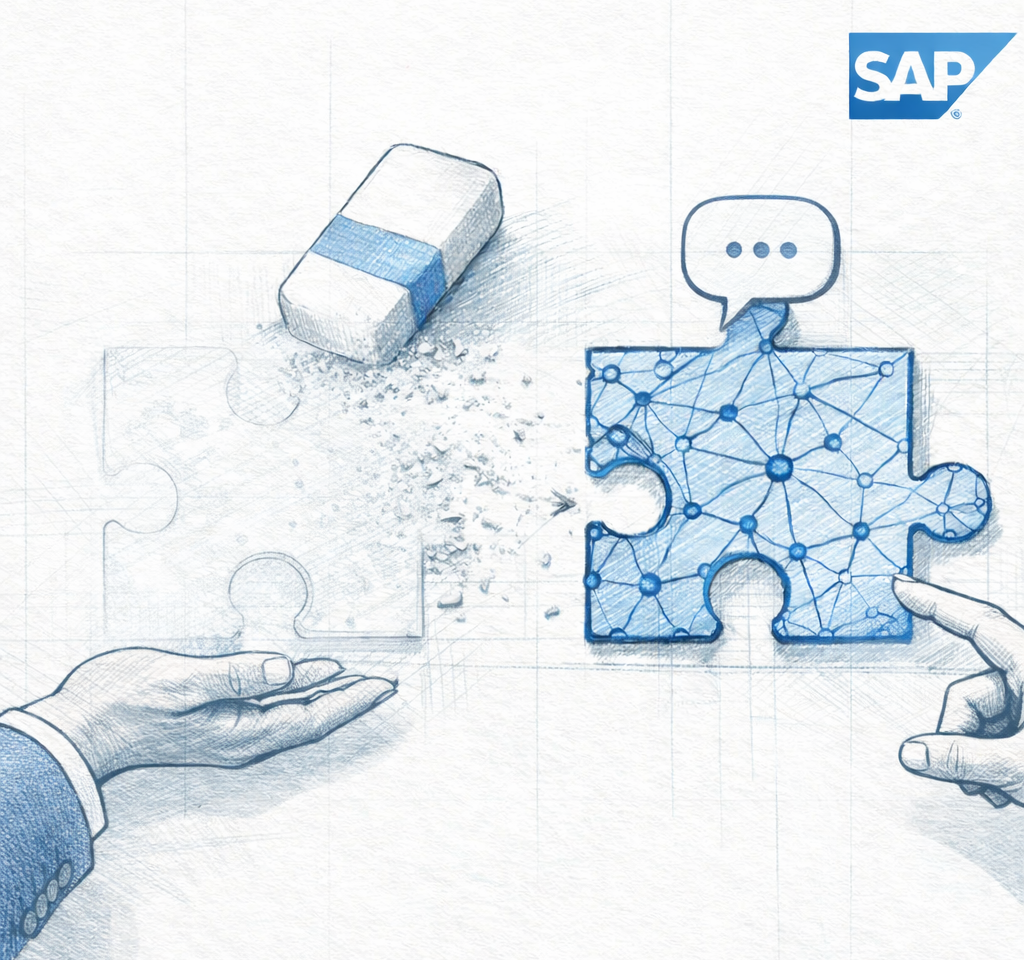
As interfaces disappear, interaction shifts from navigation to intent. What feels like simplicity masks a deeper change: processes become invisible, decisions harder to trace and control increasingly abstract within systems that now act on our behalf.
Read More
Sunday, April 12, 2026

The shift at SAP is not about fewer jobs, but different logic. As AI reshapes enterprise systems, work is no longer simply performed—it is structured, interpreted and increasingly defined by the systems themselves.
Read More
Sunday, April 12, 2026

As AI becomes embedded in enterprise systems, work is no longer just executed—it is defined. SAP’s transformation reveals a deeper shift: not who does the work, but how reality itself is structured, governed and increasingly automated.
Read More
Thursday, January 29, 2026

Innovation is easy to promise. Delivering it while millions of businesses, governments and public institutions rely on your systems is another story. SAP’s challenge is not creating flashy solutions that attract attention, but ensuring that those solutions actually keep the world running, every day.
Read More
Tuesday, January 27, 2026

Europe may be SAP’s home, but it is no longer the place where its future will be decided. That future is shaped elsewhere — in the boardrooms of American multinationals, in the industrial corridors of Asia and in innovation hubs stretching from Silicon Valley to Bangalore. For a company born in Walldorf, Germany, global presence is no longer a strategic option. It is an existential condition.
Read More
Monday, January 26, 2026

Europe speaks confidently about its digital future. About strategic autonomy, technological sovereignty and the ambition to reduce dependency on foreign platforms. In policy papers the language is convincing. In conferences it sounds even stronger.
Read More
Monday, January 19, 2026

Most discussions about artificial intelligence begin with innovation. This one should begin with power. SAP is not a visible technology giant in the public imagination. It does not shape culture, consumer behaviour or daily communication. Yet few companies exert more influence over the functioning of the global economy. An estimated 87 percent of worldwide trade touches SAP systems somewhere along its journey. Orders, invoices, customs declarations, supply chains and public-sector processes move through SAP’s logic layers every second of the day.
Read More

 Available here: