Europe’s New Technology Geography
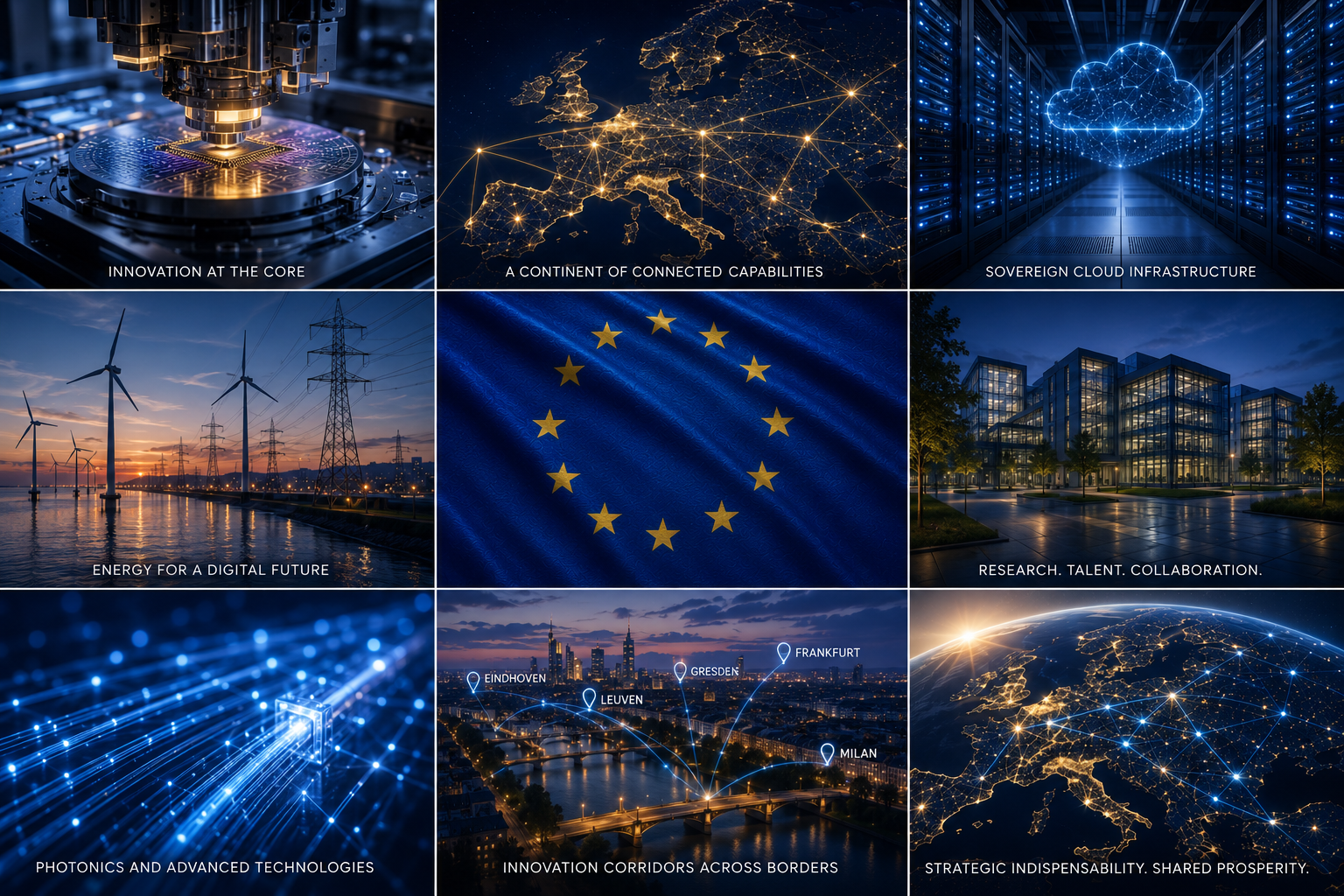
Why Europe’s future competitiveness may depend on networks of specialised ecosystems rather than national champions
For decades, discussions about economic competitiveness often revolved around nations. Countries competed against countries. Industrial strategies were designed at the national level. Economic success was frequently measured through national champions, national industries and national policies.
Yet the geography of technological innovation increasingly tells a different story.
Many of Europe’s most important technological capabilities are not concentrated within individual countries. They are distributed across a network of highly specialised regions, research institutions and industrial clusters.
As Europe seeks to strengthen its position in semiconductors, artificial intelligence, cloud infrastructure and advanced manufacturing, the challenge may no longer be how to create national champions.
The challenge may be how to connect ecosystems.
Europe’s technological future may depend less on scale and more on coordination.
Beyond the Nation State
The semiconductor industry provides a useful example. No single European country controls the entire value chain. The Netherlands contributes world-leading lithography systems. Belgium hosts one of the world’s most influential semiconductor research centres. Germany plays a critical role in manufacturing and industrial applications.
Other regions contribute advanced materials, packaging technologies, photonics, software and specialised engineering expertise. Individually, these capabilities are impressive. Collectively, they form something far more significant.
An ecosystem. This is increasingly becoming Europe’s competitive model.
The Rise of Specialised Clusters
Across Europe, innovation is often concentrated within highly specialised regional hubs. Eindhoven. Leuven. Dresden. Grenoble. Stockholm. Milan. Each has developed unique strengths. Some focus on semiconductors. Others specialise in photonics, artificial intelligence, advanced manufacturing or digital infrastructure.
What makes these regions important is not simply the presence of technology companies. Their strength lies in the interaction between universities, research institutes, investors, suppliers, manufacturers and public institutions.
Innovation rarely emerges from isolated organisations. It emerges from networks.
The most valuable infrastructure in a knowledge economy may not be physical. It may be the relationships between institutions.
The Ecosystem Advantage
Europe has often viewed its diversity as a challenge. Different languages. Different legal systems. Different industrial traditions. Different national priorities. Yet these same characteristics can also create resilience.
Unlike more centralised innovation systems, Europe’s capabilities are distributed across multiple regions and sectors. This makes coordination more difficult. But it also reduces dependence on any single location.
The question is therefore not whether Europe should imitate Silicon Valley. The question is whether Europe can turn its network of specialised ecosystems into a strategic advantage. Increasingly, Brussels appears to believe it can.
From Projects to Corridors
One of the most interesting developments in European industrial policy is the growing emphasis on cross-border cooperation. Technology is increasingly being viewed through the lens of ecosystems rather than individual projects.
The objective is no longer simply to support a factory, a laboratory or a university. The objective is to strengthen entire innovation corridors. Semiconductor ecosystems. Photonics ecosystems. Artificial intelligence ecosystems. Cloud ecosystems. Energy ecosystems. The logic is becoming increasingly clear.
Competitiveness emerges not from isolated investments, but from the connections between them. A lithography system developed in Eindhoven may support manufacturing in Dresden. The resulting technologies may contribute to cloud infrastructure in Frankfurt or Grenoble.
The electricity required to power those systems may increasingly flow through energy networks that stretch across multiple European countries. Individually, these capabilities matter. Together, they form a European technology ecosystem.
The future of European competitiveness may be determined not by the strength of individual nodes, but by the quality of the networks that connect them.
A Different Model of Power
The United States often competes through financial scale and digital concentration.
China often competes through central coordination and industrial direction.
Europe may ultimately compete through distributed specialisation.
Its strength lies not in concentrating power within a single region or under a single institution, but in connecting highly specialised capabilities across an entire continent.
Where others may see fragmentation, Europe increasingly sees resilience. It does not compete as a single mega-factory. It competes as an interconnected network.
This approach is more complex. It requires coordination. It requires long-term investment. It requires trust between institutions, governments and industries. But it may also be better suited to Europe’s economic and political reality.
The Geography of Sovereignty
The Tech Sovereignty Package reflects more than a collection of policies. It reflects a different understanding of competitiveness. Semiconductors require ecosystems. Cloud infrastructure requires ecosystems. Artificial intelligence requires ecosystems. Energy systems require ecosystems.
Europe’s objective is therefore not technological isolation. It is technological indispensability. By mastering highly specialised capabilities within a wider network, Europe strengthens its position within the global technology economy while remaining deeply connected to it.
Europe’s competitive advantage may not lie in controlling every layer of technology. It may lie in connecting the layers better than anyone else.
Technological sovereignty therefore depends not only on technology itself, but on the ability to connect the regions, institutions and industries that make technology possible.
This may be the most important lesson of all. Europe’s future competitiveness may not be built by a single company. A single country. Or a single technology.
It may be built by a continent learning how to connect its strengths.
This article concludes the series Europe’s Sovereignty Moment: Chips, Cloud, AI and the Infrastructure of Independence.
Across four articles, the series explored a simple but increasingly important idea: Europe’s technological future may depend less on self-sufficiency and more on strategic indispensability. From semiconductors and cloud infrastructure to energy systems and innovation ecosystems, competitiveness increasingly emerges from the ability to connect critical capabilities across an interconnected continent.
Credit
Illustration created for Altair Media using AI-assisted editorial artwork inspired by European innovation ecosystems, semiconductor technologies, cloud infrastructure, energy systems and cross-border technological collaboration.
Caption
Europe’s technological competitiveness is increasingly shaped by networks rather than individual actors. By connecting specialised strengths in semiconductors, cloud infrastructure, energy systems and research ecosystems, the continent is building a model based on coordination, resilience and strategic indispensability.

The challenge may be how to connect ecosystems
This is the most important point. Distributed networks across Europe working on solutions that need increasing speciality and technical support Refraning Europe as a distributed network offers a working model to challenge Chiba and America.