Posted by Altair Media on September 16, 2026 · Leave a Comment

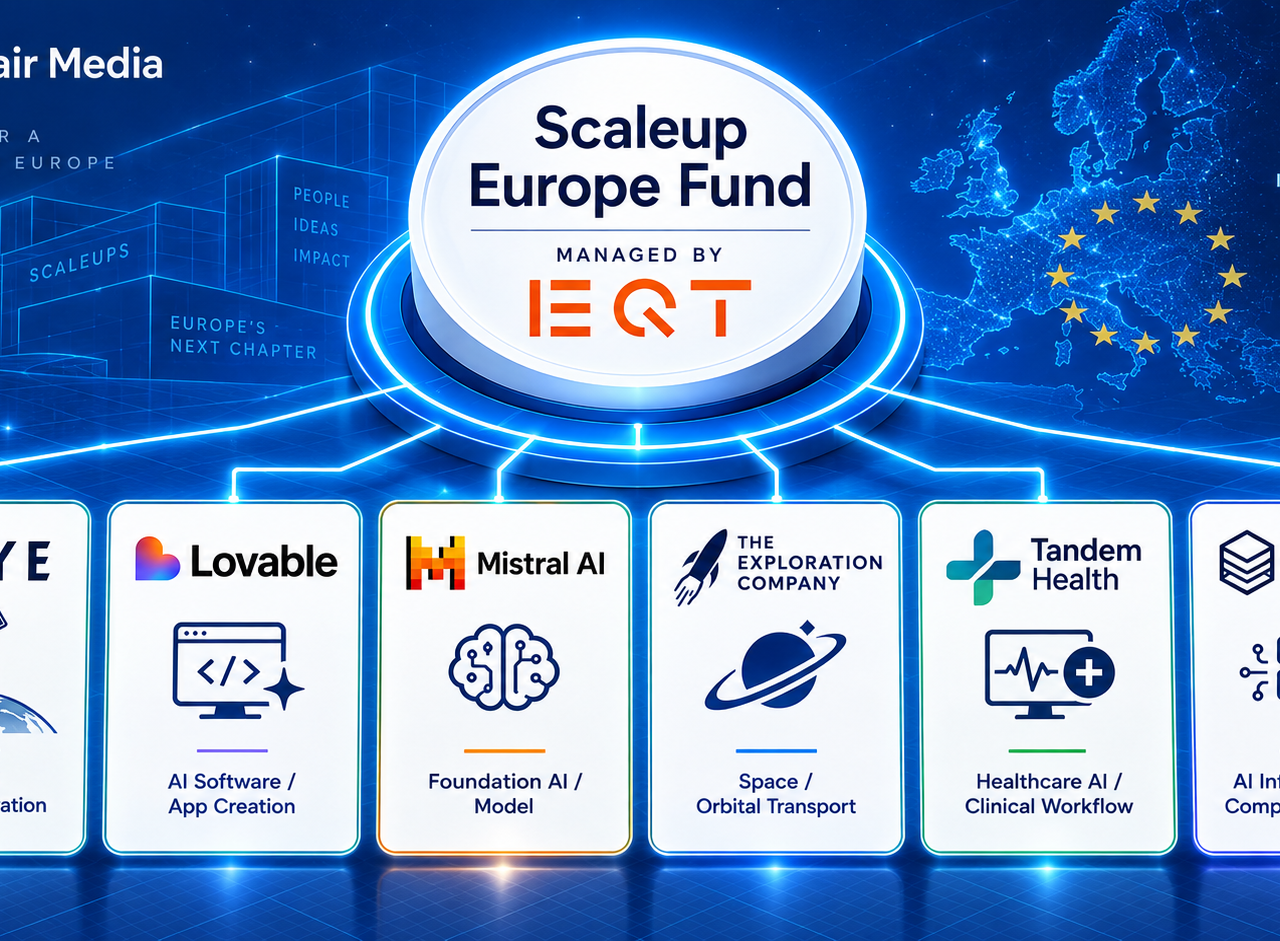
Six investments are visible. More than 100 companies were already in the pipeline when EQT took the mandate. The question is no longer only who comes next — but whether Europe is creating a late-stage capital market of its own.
A month ago, the Scaleup Europe Fund was still mostly an institutional proposition. Today it has a portfolio. ICEYE. Lovable. Mistral AI. The Exploration Company. Tandem Health. EUCLYD. Six companies across satellite intelligence, software, frontier AI, space transportation, healthcare and AI infrastructure. The obvious question is who becomes number seven. The more important number may be 100.
When EQT was selected to manage the fund in May, it said it already had more than 100 companies in its pipeline. The underlying investment framework targets funding rounds of €100 million to €500 million or more, with the fund generally aiming to deploy at least €100 million per company over the life of an investment. That changes the scale of the experiment.
This is no longer simply about whether Europe can create another investment fund. It is about whether a recognisable late-stage capital layer is beginning to form.
Read More
Category: Signal, Capital, European Governance, Featured Headlines, Financial Governance, Financial Infrastructure, Governance, Infrastructure, Insights · Tags: EQT, European capital, European Technology, innovation finance, scale-ups, Scaleup Europe Fund, Strategic Autonomy, venture capital
Posted by Altair Media on September 15, 2026 · Leave a Comment

How national promotional banks, the EIB Group and private investors are quietly building a European capital architecture
Europe presents the Savings and Investments Union as a financial system still waiting to be built. Parts of it already exist. In February 2026, five major national promotional institutions — Caisse des Dépôts, KfW, Cassa Depositi e Prestiti, BGK and ICO — met with the European Investment Bank Group in Munich.
Together, they had provided more than €300 billion in financing during the previous year.
Their agreement was not limited to general cooperation. It explicitly covered the Savings and Investments Union, including market-based instruments, securitisation, stronger exit mechanisms and connections between European and national investment programmes.
Five months later, all 27 EU governments, the EIB Group and private institutional investors backed ETCI 2.0. The initiative aims to mobilise up to €80 billion for European technology companies.
Europe may therefore be building its investment union through institutions that already exist. The central question is whether their cooperation can become a European market.
Read More
Category: Signal, Capital, European Governance, Featured Headlines, Financial Governance, Financial Infrastructure, Governance, Infrastructure, Insights · Tags: European capital markets, European economy, European Investment Bank, European Investment Fund, institutional investors, National Promotional Banks, Savings and Investments Union, Strategic Investment
Posted by Altair Media on September 14, 2026 · Leave a Comment

What Cassa Depositi e Prestiti reveals about Europe’s attempt to turn savings into strategic investment
Europe is trying to solve a problem Italy has been working on since 1850. The European Commission’s Savings and Investments Union is intended to connect Europe’s vast household savings more effectively with companies, infrastructure and strategic technologies. Italy already has an institution built around remarkably similar logic: Cassa Depositi e Prestiti or CDP.
Drawing heavily on Italian postal savings, CDP uses its balance sheet to finance public infrastructure, enterprises, innovation and strategic assets. As of June 2026, it reported €502 billion in total assets, supported by €301 billion in postal funding. Its balance sheet included €130 billion in loans and €39 billion in equity investments and funds.
This does not make CDP a miniature European Savings and Investments Union. CDP is a national promotional institution operating through a publicly anchored balance sheet. The European project seeks deeper capital markets, broader participation by citizens and more investment across borders.
Yet CDP turns Europe’s abstract debate into a concrete institutional test.
Read More
Category: Financial Infrastructure, Capital, European Governance, Featured Headlines, Financial Governance, Governance, Infrastructure, Insights, Signal · Tags: Cassa Depositi e Prestiti, European capital markets, European economy, Household Savings, National Promotional Banks, Public Finance, Savings and Investments Union, Strategic Investment
Posted by Altair Media on September 12, 2026 · Leave a Comment

Wonderful has raised $550 million to build an enterprise AI layer that can use whichever AI model performs best. If that works, the strategic moat may move from owning intelligence to deciding how intelligence is used.
Wonderful has raised $550 million at a $5 billion valuation, with Insight Partners leading the round, Salesforce joining as a new investor, and Index Ventures, IVP, Vine Ventures, 9Yards and Bessemer returning. Since March, the Amsterdam-based company has expanded to more than 35 markets and 650 employees. But the real signal is architectural: Wonderful does not want enterprises to depend on one AI model.
Its bet is not that frontier AI models stop improving. It is that enterprises should remain free to use whichever AI model works best for each task. If intelligence becomes selectable, the contest moves upward — toward the layer that routes, governs, integrates and learns from it.
🟦 If AI models are selectable, who controls the decision?
Wonderful describes itself as model-agnostic. Its AI Gateway can route simple requests to lighter models, complex ones to more powerful AI models, enforce security and cost policies, and control which teams can use which providers. The company states the proposition unusually clearly: model providers benefit when customers consume more; Wonderful wants to optimise what the enterprise consumes. That is more consequential than simply supporting several LLMs.
OpenAI, Mistral, Anthropic and Google may continue competing furiously to provide the best intelligence. Wonderful is trying to occupy the layer that decides which intelligence enters the organisation, where and at what cost.
It is therefore not technologically neutral. Wonderful develops its own orchestration, evaluation, governance and agent-building technology, while using specialist models where others are stronger. Its AI Agent Builder, for example, turns experience from more than 100 production AI agents and thousands of evaluations, regressions and fixes into a system that can build, test and improve new AI agents. In voice, it partners with specialists such as Gradium rather than insisting that every layer must be proprietary. The distinction matters.
Wonderful is not trying to win the AI model race. It is trying to become the allocator of intelligence inside the enterprise. That could become a powerful position precisely because the underlying models remain competitive.
🟦 Can deployment labour become software leverage?
There is an uncomfortable economic question underneath Wonderful’s $5 billion valuation.
The company sends forward-deployed engineers and deployment strategists into customer environments, sometimes physically on-site, to connect AI with systems, data, permissions, governance and workflows. Wonderful itself says deployment is where enterprise AI succeeds or fails.
That sounds less like frictionless SaaS and more like consulting. And venture investors do not normally award software valuations to businesses whose growth requires a roughly proportional increase in expensive human implementation.
Wonderful therefore has to make a second bet work: human deployment must become reusable software knowledge.
This is where AI Agent Builder becomes strategically important. Wonderful says the system encodes production experience that previously lived largely in engineers’ heads. Failures become evaluations; improvements become reusable logic; deployment experience feeds the next agent rather than disappearing into another consulting project.
The economic test is simple. If every new customer requires another large bespoke team, Wonderful becomes an extremely sophisticated services company.
If every implementation makes the platform faster, more automated and better at deploying the next one, then services become a learning mechanism for software. The $5 billion valuation ultimately depends on the second outcome.
🟦 Can Wonderful build depth without building lock-in?
Deep enterprise integration normally creates another advantage: customers find it increasingly painful to leave. Wonderful says it deliberately does not want that moat.
AI Agents, skills, applications and governance configurations can be exported. Customers can run external AI agents inside Wonderful, Wonderful AI agents elsewhere, use different cloud providers and replace AI models when something better appears. The company explicitly says leaving should be easy. That creates an interesting contrast with the traditional enterprise software model.
Palantir demonstrated how powerful software can become when it maps deeply into the operational reality of an organisation. Wonderful also wants that operational depth, but combines it with an explicit promise of portability. That is commercially attractive — and strategically dangerous.
If switching costs are deliberately reduced, Wonderful cannot rely on captivity. It has to outperform continuously. Its moat therefore has to come from accumulated context, execution speed, reusable integrations and the growing record of how the organisation actually operates. Wonderful calls this compounding intelligence: each decision passing through the platform adds knowledge that competitors do not automatically possess.
In other words, Wonderful is trying to replace a structural moat of lock-in with an operational moat of velocity. If leaving is painless, staying must remain overwhelmingly advantageous.
🟦 Could fragmentation become the advantage?
Wonderful’s international expansion also points to a less obvious strategic advantage.
Europe usually treats fragmentation as a technology problem: too many languages, too many markets, too many regulations and too many legacy systems compared with the scale available in the United States.
Wonderful is building almost directly into those differences. Its deployment model relies on locally embedded teams, while its platform is designed to operate across AI models, clouds, workflows and organisational environments. The company initially gained traction adapting AI agents to non-English markets and now operates across more than 35 markets.
That does not make fragmentation inherently good. But it changes the question. American technology became extraordinarily powerful by standardising enormous markets. There is nothing wrong with that model, nor does Europe need to define itself in opposition to it.
Enterprise AI may simply reward a different capability. A multinational bank does not become one homogeneous institution because it adopts an LLM. A European manufacturer does not lose its legacy systems. Languages, regulations, internal permissions and organisational histories remain.
The model can be global. Implementation remains stubbornly local. Wonderful is effectively betting that companies trained inside complexity can learn to scale complexity rather than eliminate it.
For Europe, that is a more interesting ambition than trying to reproduce Silicon Valley. The continent’s weakness may not always be fragmentation itself. It may be its failure to design for fragmentation.
Signal
Wonderful’s funding round matters because of what is being financed. Insight Partners is doubling down. Index Ventures, IVP, Vine Ventures, 9Yards and Bessemer remain involved. And Salesforce — one of the companies that helped define the enterprise software era — has now joined the cap table.
The bet is not that OpenAI, Mistral, Anthropic or Google become less important. It is almost the opposite. The faster AI models improve, the more valuable an architecture may become that can continuously select between them while retaining the enterprise context around them. That places Wonderful in an unusual position.
Model companies are moving upward into AI agents, applications and customer workflows. Wonderful is moving downward from the enterprise toward whichever models provide the best intelligence.
The collision point is the layer in between. That is where routing happens, where governance sits, where organisational context accumulates and where AI becomes operational rather than merely available.
Wonderful still has to prove that human-heavy deployment can compound into software economics and that an open architecture can retain customers without relying on lock-in.
But if it succeeds, the moat does not disappear when models become interchangeable.
It moves to the company that decides how intelligence enters the organisation.
There is another European dimension to Wonderful’s rise. Its $550 million round is largely international, led by Insight Partners and joined by Salesforce, yet the company remains headquartered in Amsterdam. That distinction matters. Europe does not necessarily need to finance every successful technology company exclusively with European capital. The harder test is whether global capital can accelerate companies while their strategic centre — talent, knowledge, decision-making and future value creation — remains anchored in Europe.
Credit
AI-generated illustration by Altair Media / OpenAI
Caption
Wonderful is betting that enterprises will not organise around one AI model. The value may increasingly sit in the layer that selects, routes and embeds the best intelligence for each task.
Category: Signal, Capital, Financial Infrastructure, Governance, Infrastructure, Insights · Tags: AI Agents, AI infrastructure, Artificial Intelligence, enterprise AI, European Technology, Salesforce, Wonderful