Europe’s Scaleup Fund Is Beginning to Acquire a Shape
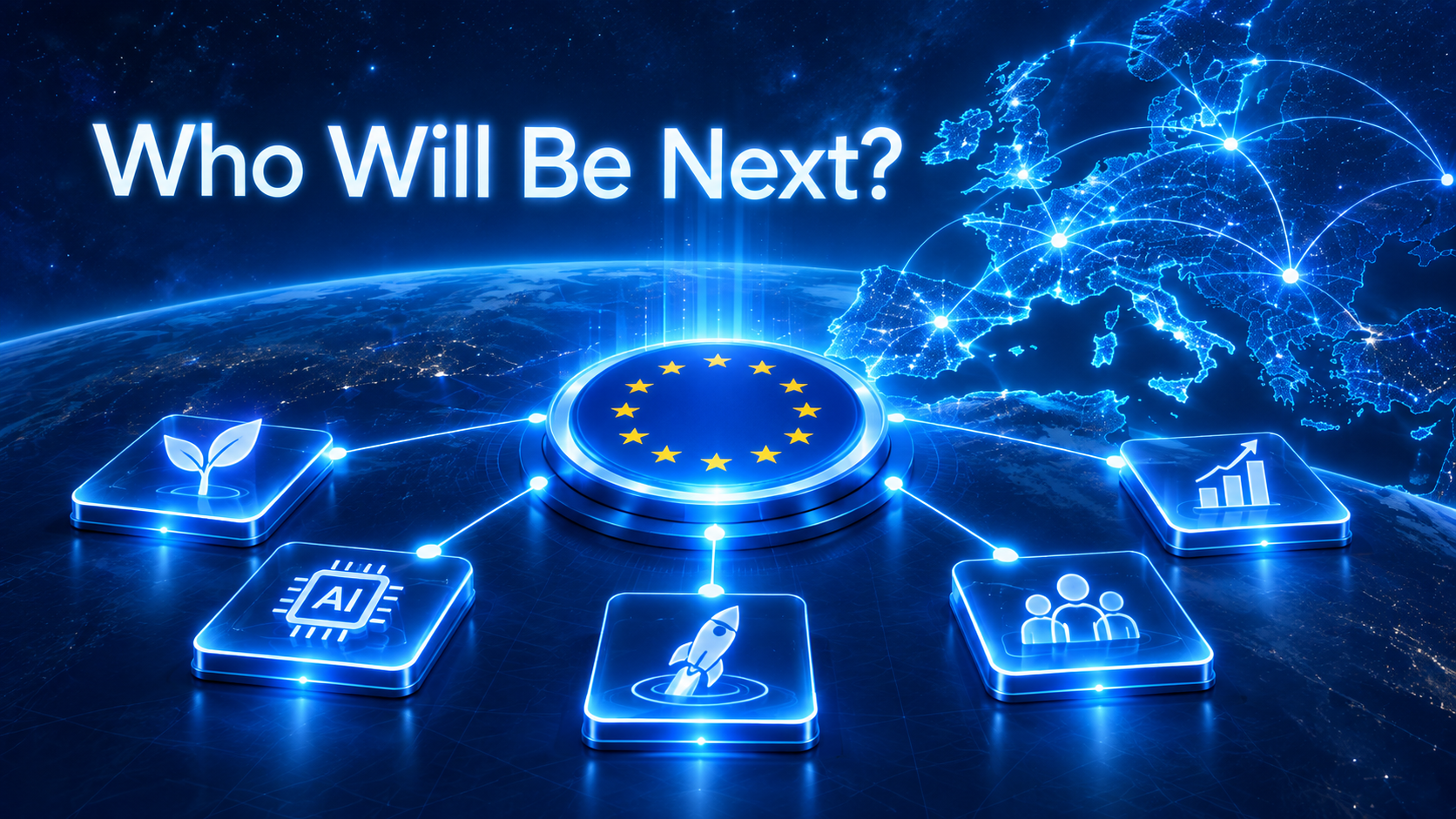
Six investments are visible. More than 100 companies were already in the pipeline when EQT took the mandate. The question is no longer only who comes next — but whether Europe is creating a late-stage capital market of its own.
A month ago, the Scaleup Europe Fund was still mostly an institutional proposition. Today it has a portfolio. ICEYE. Lovable. Mistral AI. The Exploration Company. Tandem Health. EUCLYD. Six companies across satellite intelligence, software, frontier AI, space transportation, healthcare and AI infrastructure. The obvious question is who becomes number seven. The more important number may be 100.
When EQT was selected to manage the fund in May, it said it already had more than 100 companies in its pipeline. The underlying investment framework targets funding rounds of €100 million to €500 million or more, with the fund generally aiming to deploy at least €100 million per company over the life of an investment. That changes the scale of the experiment.
This is no longer simply about whether Europe can create another investment fund. It is about whether a recognisable late-stage capital layer is beginning to form.
🟦 Is EQT investing in companies — or organising capital around them?
The first six deals suggest that the distinction matters. ICEYE’s financing amounted to €1 billion, including €450 million in primary capital at a valuation above €10 billion. Lovable raised $400 million at a $13.3 billion valuation. Mistral AI followed with €3 billion. The Exploration Company raised $450 million. Tandem Health secured $100 million. EUCLYD has now announced a Series A of more than €200 million.
Put differently: the financing rounds surrounding the first six Scaleup Europe investments already represent more than €4.2 billion plus $950 million in announced transactions. That is roughly the order of magnitude of the fund’s entire €5 billion target size. But that money is not coming from the Scaleup Europe Fund alone.
General Atlantic, Menlo Ventures, Samsung, PSG Equity, Bessemer Venture Partners, Atomico, Kinnevik, Northzone, Somerset Capital Partners and Innovation Industries are among the investors appearing beside it. That may be the more consequential mechanism.
The fund is not replacing private capital. It is helping organise larger pools of capital around European companies.
🟦 Is this still public funding?
Only partly. The European Commission has committed €1 billion to the fund. But it sits alongside institutional investors including Novo Holdings, EIFO, CriteriaCaixa, Santander/Mouro Capital, APG on behalf of ABP, Allianz and several Italian financial institutions. EQT has also committed to invest its own capital.
The investment decisions themselves are made independently by EQT on commercial and merit-based grounds. That distinction is important. Europe is not simply distributing another €5 billion through an EU programme.
Public capital is being used as an anchor inside a commercially managed investment structure, which in turn participates in much larger private financing rounds. The experiment therefore sits somewhere different in Europe’s financial architecture.
Not subsidy. Not traditional venture capital. Not yet a mature European growth-capital market. But potentially a bridge between them.
🟦 Is the portfolio beginning to acquire an identity?
Yes — although it is still narrow. The first six investments already reveal a preference for companies where technological scale and European strategic capacity overlap. Space-based intelligence. Foundation models. Software creation. Space transportation. Healthcare AI. AI compute infrastructure.
EQT has said the broader mandate extends to AI, robotics, semiconductors, energy, biotechnology, space and advanced industrial systems. The original investment guidelines also envisage a balanced portfolio across technologies and themes.
That makes numbers seven, eight and nine more interesting than ordinary portfolio additions. They will start to show whether the emerging pattern broadens. Quantum remains open. So do significant parts of robotics, energy, industrial decarbonisation, biotechnology and advanced manufacturing. There are no confirmed names. But there are clues to the universe from which future investments could emerge.
Sifted has previously asked European investors which companies might fit the Scaleup Europe mandate, with names including companies such as Quantum Systems appearing in that exercise. And EQT itself already has relationships with companies across several of the still-empty categories: Scaleup Europe co-head Ted Persson’s existing investment record includes evroc, Heart Aerospace, SEEQC and robotics company 1X, alongside The Exploration Company. None should be read as a prediction.
The more interesting point is the map they describe. Cloud infrastructure. Quantum. Robotics. Aviation. Energy. Materials. Biotechnology. If future deals begin filling those spaces, the fund will stop looking like a collection of large European technology investments. It will start looking like a portfolio of European technological capability.
🟦 Does “Scaleup Europe-backed” begin to mean something?
Possibly. This is where the first six deals become more interesting collectively than individually.
A large late-stage investor does more than provide money. It helps establish valuations, brings institutional investors into rounds, supports governance, provides follow-on capacity and signals that companies can continue scaling without immediately needing a different financial ecosystem. The Exploration Company is instructive.
EQT Ventures had already invested in the company before the Scaleup Europe Fund joined its $450 million Series C. The relationship therefore spans the transition from venture investment into much larger growth capital.
That could become one of the fund’s defining functions. Not discovering Europe’s technology companies. But keeping financing them as they become expensive. Europe has developed a substantial startup ecosystem. The harder question has always come later.
What happens when the required cheque is no longer €10 million or €30 million, but €200 million, €500 million or more? The Scaleup Europe Fund has been designed precisely for that corridor.
🟦 Does that also move an IPO closer?
Not automatically. But it changes the route towards one. A company preparing eventually for public markets needs more than technological promise. It needs scale, revenue, governance, institutional shareholders, international operations and sufficient capital to survive the years before a listing becomes attractive. Late-stage private capital buys that time.
Mistral illustrates the distinction. Its latest €3 billion financing valued the company at roughly €21 billion, placing it among Europe’s largest privately held technology companies. Yet the company has said it has no immediate plans for an IPO. That is precisely the point.
The Scaleup Europe Fund does not need to push companies quickly onto public markets. Its more useful role may be to give them enough financial depth that a future listing becomes a choice rather than a financing necessity. And eventually another question follows.
If Europe succeeds in building companies of this size, can its own public capital markets keep them? That will be a different test.
🟦 Why did ICEYE suddenly matter in the State of the Union?
Because today Ursula von der Leyen effectively described the company as a model of the European innovation chain. In her State of the Union address on 16 September, she first argued that Europe needs greater capacity and appetite for risk capital and then turned directly to the Scaleup Europe Fund.
Her example was ICEYE. Its founders met through Erasmus. Their technology received Horizon funding. It was subsequently developed and commercialised with private investment. ICEYE is now valued above €10 billion and became the first investment of the Scaleup Europe Fund.
The sequence is revealing. Erasmus. Horizon. Private capital. Scale capital. Global expansion.
Europe has possessed most of these components for years. What it has struggled to build is continuity between them.
That is why ICEYE matters beyond ICEYE. It gives the Scaleup Europe Fund something more valuable than a first investment. It gives it a prototype.
Signal
Six deals are not yet a capital market. But they are beginning to reveal the architecture of one.
At launch, EQT already had more than 100 potential companies in its pipeline. Its first six investments now sit inside financing rounds representing billions of euros of European and international institutional capital.
The question around investment seven is therefore becoming less important than what happens by investment twenty.
If the portfolio expands from AI and space into quantum, robotics, energy, biotechnology, materials and industrial technology, the Scaleup Europe Fund will begin to acquire a distinct economic function.
Not picking European winners. Not replacing global capital. But creating a place where European companies can remain European while becoming very large.
If that happens, “Scaleup Europe-backed” may eventually describe more than the source of a cheque. It may describe a new stage in the European company lifecycle.
Image credit
Illustration: Altair Media / OpenAI
Caption
Who will be next? With six investments announced and more than 100 companies reportedly in the pipeline, Europe’s Scaleup Fund is beginning to shape the continent’s late-stage capital landscape.
