Europe’s Investment Union Already Exists — In Pieces
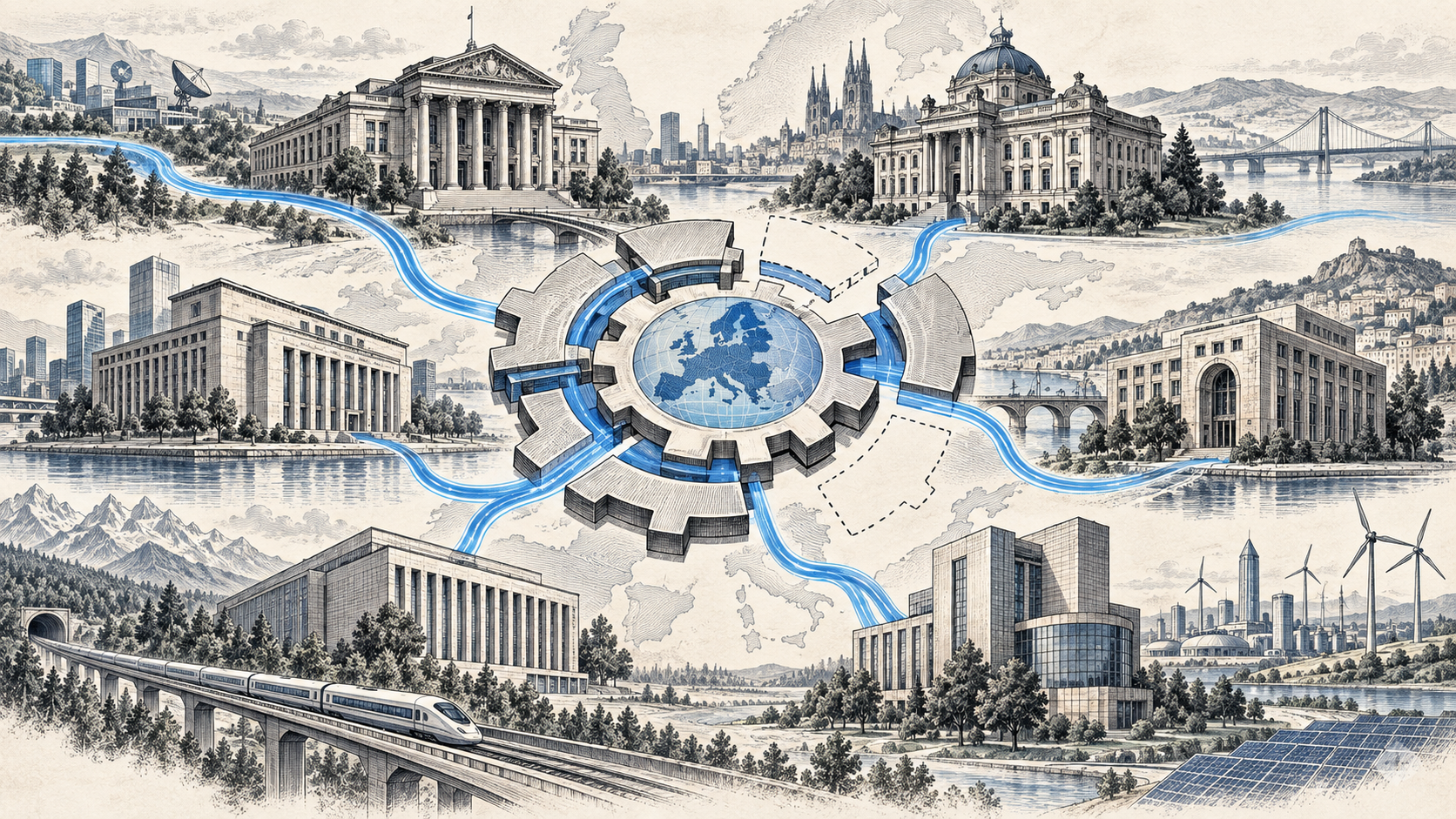
How national promotional banks, the EIB Group and private investors are quietly building a European capital architecture
Europe presents the Savings and Investments Union as a financial system still waiting to be built. Parts of it already exist. In February 2026, five major national promotional institutions — Caisse des Dépôts, KfW, Cassa Depositi e Prestiti, BGK and ICO — met with the European Investment Bank Group in Munich.
Together, they had provided more than €300 billion in financing during the previous year.
Their agreement was not limited to general cooperation. It explicitly covered the Savings and Investments Union, including market-based instruments, securitisation, stronger exit mechanisms and connections between European and national investment programmes.
Five months later, all 27 EU governments, the EIB Group and private institutional investors backed ETCI 2.0. The initiative aims to mobilise up to €80 billion for European technology companies.
Europe may therefore be building its investment union through institutions that already exist. The central question is whether their cooperation can become a European market.
🟦 Does Europe already have the institutions it needs?
Europe does not lack public financial capacity. Germany has KfW. France has Caisse des Dépôts and Bpifrance. Italy has Cassa Depositi e Prestiti. Poland has BGK and Spain has ICO. The EIB finances infrastructure and large strategic projects, while the EIF supports companies through guarantees, securitisation and investments in funds.
These institutions emerged from different national histories. Their mandates, funding models and political responsibilities remain different. Yet they are increasingly connected.
The 5+1 Group brings five major national promotional institutions together with the EIB. The European Long-Term Investors Association provides a wider network. InvestEU links European guarantees to national implementing partners, while joint initiatives already cover areas such as the circular economy, defence, housing and innovation.
The institutional layer is therefore not hypothetical. It already identifies projects, shares risks and moves capital. The friction lies in its mandate.
National institutions remain accountable primarily to national governments and economies. Their cooperation may be European, but their legitimacy is still largely national.
Europe has built the institutions. It has not yet resolved whose priorities they should serve when national and European interests diverge.
🟦 Does €300 billion make this a European system?
More than €300 billion in annual financing represents formidable capacity. But it is not a common European investment fund. It is the combined financing of several institutions operating through separate balance sheets, programmes and national mandates. Adding their financing together demonstrates scale, not integration. That distinction becomes important when investments cross borders.
A semiconductor facility may strengthen the entire European supply chain while creating most of its direct jobs in one member state. An electricity interconnector benefits several markets, but its costs and revenues may be distributed unevenly. A scale-up can receive public backing in one country and later move its headquarters or production elsewhere.
European governments support cross-border investment in principle. The political calculation changes when one country provides the capital and another receives the most visible benefits.
National institutions can coordinate their activities without surrendering control over allocation. The €300 billion therefore reveals both Europe’s strength and its weakness. The financial capacity already exists. The shared decision-making architecture does not.
🟦 Is ETCI 2.0 the bridge to private capital?
The European Tech Champions Initiative is the clearest attempt to move beyond coordination. Its first phase used commitments from participating countries and the EIB Group to anchor large European growth funds. By July 2026, it had supported 15 mega-funds and contributed to the development of 12 EU-based unicorns.
ETCI 2.0 expands that model. It aims to create a fund of funds of up to €15 billion and mobilise as much as €80 billion for more than 1,500 European scale-ups. The EIB Group intends to contribute up to €1.25 billion. All 27 EU governments support the initiative, while banks, asset managers and other institutional investors are joining the public partners. Its structure matters more than its headline size.
National contributions, European risk capacity, private fund managers and institutional investors are being connected through one pan-European platform. ETCI 2.0 will also operate alongside national initiatives and the Scaleup Europe Fund.
This is what an investment union looks like in practice: different sources of capital entering a shared pipeline without being placed under one central institution. But public participation can create the appearance of a market before a self-sustaining market exists.
If private investors participate mainly because public institutions absorb the most difficult risks, Europe may create larger funds without changing the underlying willingness of pension funds, insurers and other investors to finance technological growth.
The test is not whether ETCI 2.0 reaches €80 billion. It is whether the funds and investors it attracts return without requiring the same public intervention.
🟦 Can institutions integrate faster than markets?
The emerging architecture has moved further than Europe’s capital markets. Promotional banks can sign cooperation agreements. The EIB and EIF can create common instruments. Governments can commit resources to a European fund of funds. But investors still encounter different tax systems, insolvency laws, supervisory practices and pension structures across the Union.
Exit markets remain fragmented as well. Europe can improve the financing of privately held companies, but investment capital must eventually be released. Without deeper stock markets, acquisitions and secondary transactions, investors remain committed for longer and returns cannot easily flow into the next generation of funds. This explains why exits and securitisation appeared explicitly on the Munich agenda.
The institutions recognise that Europe’s constraint is no longer only the amount of capital available. It is the ability of capital to complete a cycle: from savings to investment, from investment to growth, and from growth to returns that can be invested again.
Public institutions can help build that cycle. They can also postpone the reforms needed to make it independent of them.
If every market failure is answered with another guarantee, public fund or co-investment platform, Europe may become increasingly effective at navigating fragmentation without removing it.
Institutional cooperation can construct the bridges. Only market integration can make crossing them routine.
SIGNAL
Europe’s Savings and Investments Union is usually described as a future project intended to connect household savings with productive investment. That description is becoming outdated.
National promotional institutions and the EIB Group already coordinate investment, share risks and pursue common European priorities. Together, the largest participants provide more than €300 billion in annual financing.
ETCI 2.0 adds a direct connection to private institutional capital and aims to mobilise up to €80 billion for European technology companies.
The Savings and Investments Union is therefore not starting from zero. Its institutional architecture already exists in pieces. But the system remains incomplete. National mandates still influence where capital goes. Markets remain separated by regulation, taxation and supervision. European investment still depends heavily on public institutions creating routes around those barriers.
Europe’s next challenge is not to create another financial engine. It is to turn cooperation between existing engines into a market that can circulate capital on its own.
The investment union is beginning to exist.
The market beneath it is not yet European.
Caption
Europe’s national investment institutions are increasingly connected by shared capital flows. The architecture is emerging, even as crucial gaps in the underlying European market remain.
Credit
Illustration: Altair Media / OpenAI
