Six Deals In: Is Europe’s Scaleup Fund Starting to Make a Market?
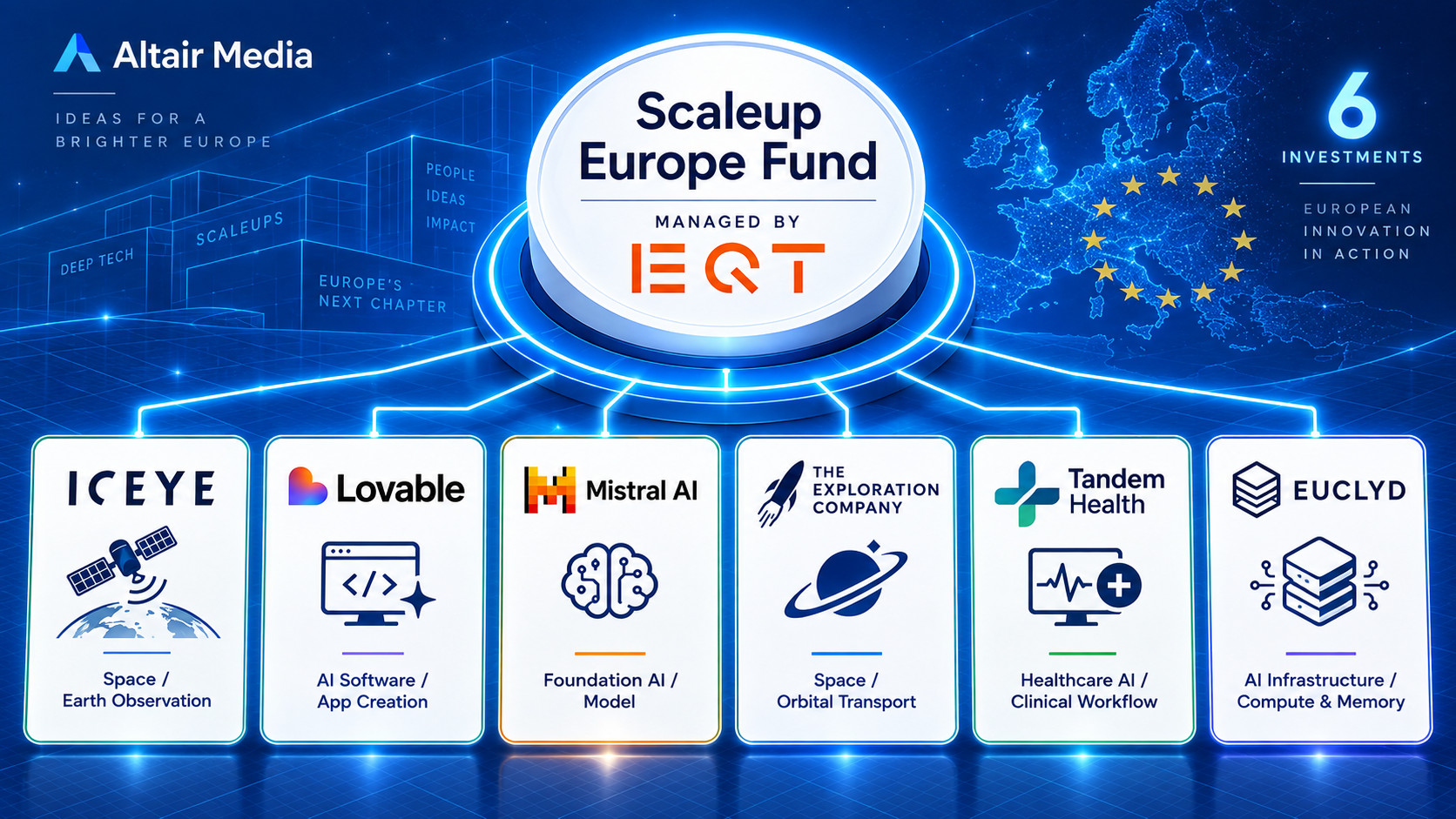
Europe’s flagship scale-up vehicle is moving fast. Six deals in, the harder question is whether it is beginning to change the market around it.
Europe’s Scaleup Europe Fund has crossed an important threshold. It is no longer primarily a policy instrument waiting to prove that it can invest; six deals in — and with three announced within eight days — capital is moving at something approaching market speed. The Exploration Company, Tandem Health and EUCLYD have joined ICEYE, Lovable and Mistral AI.
That changes the test. The question is no longer whether Europe can create a large scale-up vehicle. It is whether that vehicle can address the structural failure it was designed for: European companies reaching technological maturity, only to find that the capital required for industrial scale is deeper elsewhere.
After six deals, the first contours are becoming visible.
🟦 What do deals four, five and six actually tell us?
More than their headline round sizes suggest. The Exploration Company raised $450 million in Series C financing to accelerate Nyx, its reusable orbital spacecraft, and the Storm propulsion programme; Tandem Health secured $100 million in Series B financing to expand its healthcare AI platform across European clinical workflows; and Eindhoven-based EUCLYD closed more than €200 million in Series A financing to develop AI compute, memory and datacentre infrastructure.
These are very different companies, but they encounter the same structural problem: the challenge is no longer invention, but crossing from technological capability into industrial scale. Spacecraft demand prolonged hardware cycles and manufacturing capacity, healthcare platforms must navigate fragmented national systems, and semiconductor architectures require massive upfront investment before commercial revenues appear.
That is precisely the gap the Scaleup Europe Fund was built to enter. Deals four, five and six suggest it is doing so.
🟦 Is the portfolio following the mandate — or becoming too concentrated?
For now, both can be true. The fund was designed around strategic European technology spanning digital and intelligent systems, industrial technologies and life sciences. Its first six investments fit remarkably well: ICEYE and The Exploration Company cover the space layer; Lovable and Mistral represent software and frontier AI; Tandem Health introduces healthcare; and EUCLYD anchors semiconductor and compute infrastructure.
The portfolio has clear strategic logic, but it is also developing a pronounced centre of gravity. AI, space and technologies with an obvious strategic-autonomy dimension dominate. Important parts of Europe’s wider industrial transition — clean technologies, advanced materials, industrial biotechnology and quantum systems — are not yet visible.
Six investments are too few to call this a structural bias. But they reveal an early pattern: the fund is building strategic density before portfolio breadth. Whether that remains a strength depends increasingly on what comes next.
🟦 Is the €5 billion fund actually €5 billion yet?
Not yet. That distinction matters as deployment accelerates. The European Commission committed €1 billion as the public anchor, joined by major institutional investors including Novo Holdings, EIFO, CriteriaCaixa, Allianz and APG on behalf of ABP. But €5 billion remains the target size and fundraising continues. The Scaleup Europe Fund is therefore simultaneously raising capital and deploying it.
That is normal in private markets. Politically, however, the distinction is important. Europe increasingly talks about the vehicle as a €5 billion intervention, while the capital base behind that number is still being assembled.
The reality is more fluid: an active investment engine is already operating while the balance sheet behind it continues to grow. The test is therefore not only how quickly EQT deploys capital. It is whether institutional investors continue to enlarge the vehicle behind it.
🟦 Is the fund attracting private capital — or simply investing beside it?
This may be the most important unanswered financial question. The fund was designed to be catalytic: to help create financing rounds large enough that European companies no longer have to look elsewhere simply because European growth capital runs out.
The syndicates are clearly assembling. Bessemer and Atomico invested alongside the Scaleup Europe Fund in The Exploration Company. Innovation Industries, Somerset Capital Partners and Samsung joined it in EUCLYD. Mistral assembled an even larger international investor group around its €3 billion financing. Yet the true multiplier remains opaque.
Total round sizes are public, but the Scaleup Europe Fund’s individual ticket sizes generally are not. Without those numbers, the market cannot calculate how much additional capital is being mobilised for every euro the fund commits — or how much of that capital might have entered the rounds anyway. That distinction is fundamental.
Participating in large rounds is one thing. Making larger European rounds possible is another. After six deals, we can see the former. We cannot yet measure the latter.
🟦 Samsung keeps appearing. Does that weaken the European logic?
Only if sovereignty is confused with autarky. Samsung played a central role in Mistral’s €3 billion financing and reappeared days later as a co-lead in EUCLYD. At first sight, having a South Korean technology giant repeatedly alongside Europe’s flagship scale-up vehicle creates an obvious tension. But technological sovereignty cannot be built by isolating European companies from global industrial systems.
Samsung brings capabilities that venture capital cannot manufacture: enormous semiconductor scale, memory expertise, industrial relationships and access to global hardware ecosystems.
The critical distinction is therefore not between European and foreign capital. It is between a Europe that depends on foreign capital because its own institutions cannot participate at scale and a Europe capable of bringing global industrial players to the table while substantial European capital remains there too. That is a very different form of openness.
Samsung does not automatically weaken the model. Its presence tests whether European capital can hold its position as companies scale.
🟦 So has the Scaleup Europe Fund started to work?
Operationally, yes. Structurally, the verdict remains open.
Six deals demonstrate that EQT can identify companies, assemble large syndicates and deploy capital at market tempo. But changing the structural conditions around European scale-ups requires more than fast execution.
It requires continued institutional fundraising. It requires a portfolio that eventually broadens beyond the first concentration around AI, space and strategic deep tech. And it requires evidence that public-anchored European capital is genuinely multiplying private investment rather than merely joining rounds that would have happened anyway.
That is the distinction between building a successful fund and changing a market.
Signal
The Scaleup Europe Fund has moved from institutional design to market execution. Six deals do not prove that Europe has solved its scale-up capital gap. They prove that it has finally built an instrument capable of entering it. The harder test begins now.
Deals seven, eight and nine will matter not because three more companies receive capital, but because they will begin to show whether a portfolio is actually becoming a market.
Credit
Illustration: Altair Media / generated with OpenAI
Caption
The Scaleup Europe Fund now has six portfolio companies spanning space, AI, healthcare and semiconductor infrastructure. The emerging question is no longer whether the fund can invest, but whether it can begin reshaping Europe’s scale-up capital market.
