Belgium and the Art of Balancing Europe
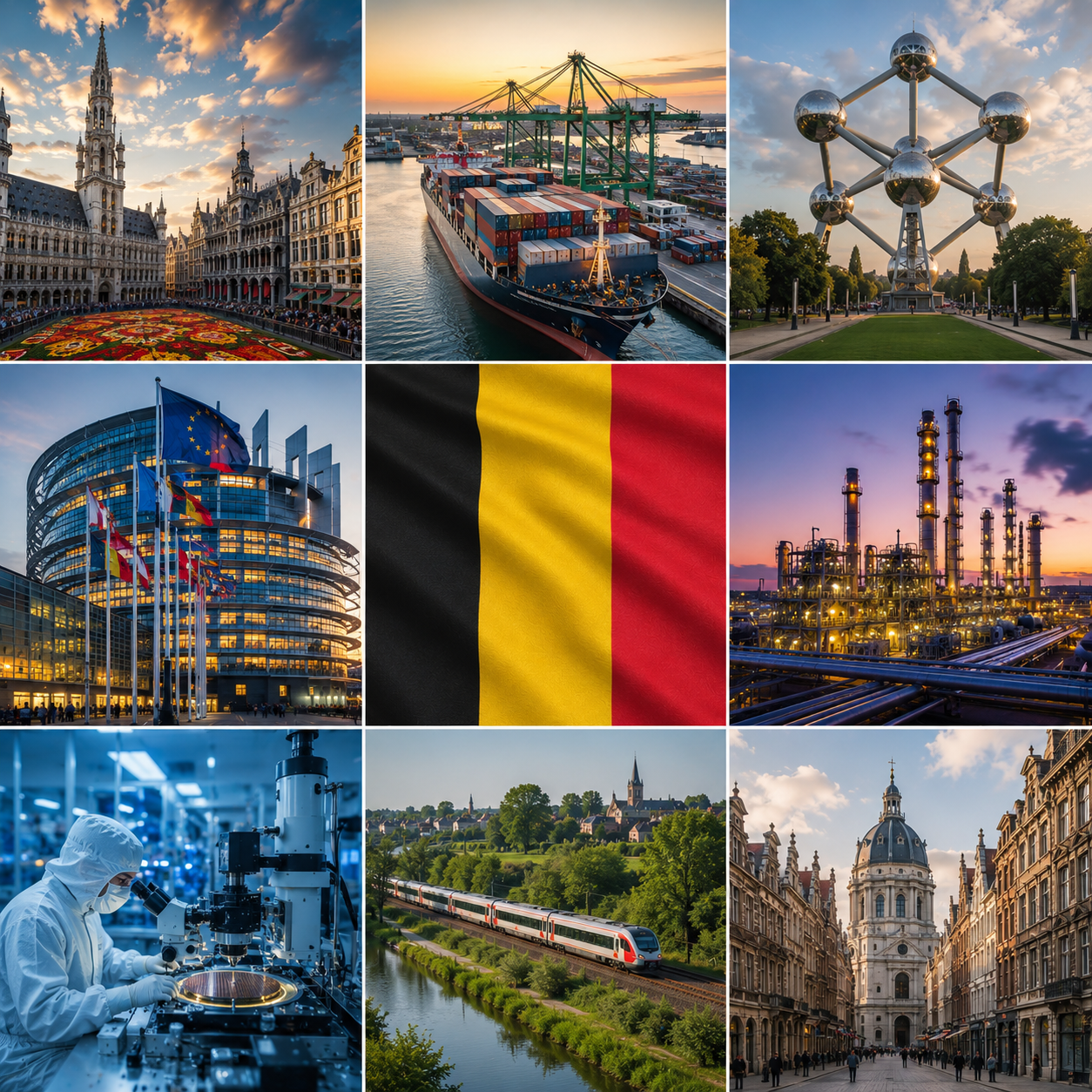
How a Small Country Became a Crossroads of Trade, Industry and European Governance
Belgium is often overshadowed by larger neighbours such as Germany, France and the United Kingdom. Yet few countries occupy a more strategic position within Europe.
Situated between some of the continent’s largest economies, Belgium combines industrial production, international trade, scientific research and European governance within a remarkably compact territory. Its economy reflects the broader European project itself: interconnected, multilingual, highly integrated and constantly balancing competing interests.
The story of Belgium is therefore not merely one of geography. It is a story about how economic relevance can emerge from connection, coordination and compromise.
A Country at the Centre of Europe
Belgium occupies one of the most advantageous locations in Europe.
Major transport corridors connecting Northern and Southern Europe pass through its territory. Germany, France, the Netherlands and the United Kingdom all lie within close reach. This position has helped transform Belgium into a major hub for trade, logistics and international business.
The Port of Antwerp-Bruges ranks among Europe’s most important maritime gateways, while extensive rail, road and inland waterway networks connect industries across the continent.
Belgium’s location has long made it a meeting point between European economies.
“Belgium’s importance is not derived from size, but from position. It sits where some of Europe’s most important economic corridors intersect.”
Industry Beyond the Headlines
Unlike many post-industrial economies, Belgium retains a substantial industrial base.
Chemicals, pharmaceuticals, advanced materials, food production and logistics continue to play important roles within the national economy. The Antwerp region has developed into one of Europe’s largest petrochemical clusters, while pharmaceutical production and life sciences remain deeply embedded within both Flemish and Walloon economic ecosystems.
Belgium’s industrial strength often attracts less attention than Germany’s manufacturing sector or France’s global corporations, yet it remains deeply integrated into European supply chains.
Belgium does not simply produce. It integrates. Its chemical, pharmaceutical and manufacturing ecosystems depend on the constant exchange of knowledge, materials and international partnerships, making them vital nodes within the wider European economy.
The country’s economy therefore combines industrial capability with service-sector sophistication, creating a balance that relatively few European economies have maintained successfully.
Knowledge, Innovation and European Networks
Belgium’s role as a crossroads increasingly extends beyond trade and logistics.
Research institutions such as Imec in Leuven have helped position the country within Europe’s advanced technology ecosystem, connecting universities, industry and semiconductor innovation. At the same time, Belgium’s life sciences sector has become one of the continent’s most internationally connected research and production networks.
These knowledge ecosystems illustrate a broader reality. Belgium’s strategic value increasingly lies not only in moving goods, but also in facilitating the exchange of ideas, expertise and innovation across borders.
Brussels and the European Dimension
Belgium’s influence extends well beyond economics.
Brussels hosts major European institutions, international organisations, diplomatic missions and multinational headquarters. Decisions made within the city influence regulation, competition policy, digital governance and economic strategy across an entire continent.
This concentration of institutions has created a unique environment where politics, economics and international business continuously intersect.
Belgium therefore functions not only as a participant in European integration, but increasingly as one of its physical and institutional anchors.
“Belgium is more than a country located at the centre of Europe. In many respects, it functions as one of the places where Europe meets itself.”
Complexity as an Economic Asset
Belgium is often portrayed through the lens of complexity.
Different languages, regional governments and political traditions have produced one of Europe’s most intricate governance systems. While critics sometimes view this as inefficiency, the Belgian experience also demonstrates a remarkable capacity for negotiation, adaptation and coexistence.
In an era where many systems prioritise speed and efficiency, Belgium offers a different perspective. Complex systems may appear cumbersome, yet they can also provide flexibility, redundancy and resilience when confronted with unexpected shocks.
Economic activity increasingly depends on cooperation across regions, sectors and institutions. In this respect, Belgium’s internal complexity mirrors many of the challenges facing Europe itself.
“Belgium’s greatest export may not be a product, but a method: the ability to manage diversity within a shared system.”
Pressures and Challenges
Like much of Western Europe, Belgium faces significant pressures.
Housing affordability, ageing populations, labour shortages and the transition toward sustainable energy systems are reshaping long-term economic planning. At the same time, global competition continues to challenge traditional industries while increasing demands for innovation and technological investment.
Belgium’s institutional complexity can be a source of resilience, but it can also create difficulties when rapid decisions are required. As geopolitical competition intensifies and economic strategies become increasingly strategic, the challenge is ensuring that coordination remains a strength rather than becoming a source of delay.
The challenge is therefore not simply growth, but adaptability.
Looking Ahead
Belgium’s future will likely depend on its ability to preserve the strengths that have long defined its success: openness, connectivity, industrial capability, innovation and institutional cooperation.
As Europe navigates a period of geopolitical uncertainty and economic transformation, Belgium may offer an important lesson. Prosperity does not always emerge from scale or power alone. Sometimes it emerges from the ability to connect different worlds and reconcile competing interests.
“Belgium’s importance lies not in what passes through it, but in what comes together within it.”
Belgium stands at the intersection of Europe’s economies, institutions and cultures. Its future may therefore reveal something important about Europe itself: whether complexity can become a source of resilience in an increasingly uncertain world.
Belgium — Where Europe Meets Itself
Series — Economic Europe: Western Europe
This article is part of Economic Europe, a United Europe series examining the economic architectures that shape modern Europe. The Western Europe chapter explores how connectivity, finance, logistics, innovation and global networks have transformed the Netherlands, Belgium, Luxembourg, France, Ireland and the United Kingdom into some of Europe’s most internationally connected economies.
Credit
Illustration generated by OpenAI’s DALL·E for Altair Media Europe
Caption
Belgium connects European industry, trade, research and governance through a unique combination of logistics networks, innovation ecosystems and international institutions at the heart of Europe.
