Beyond the Municipality
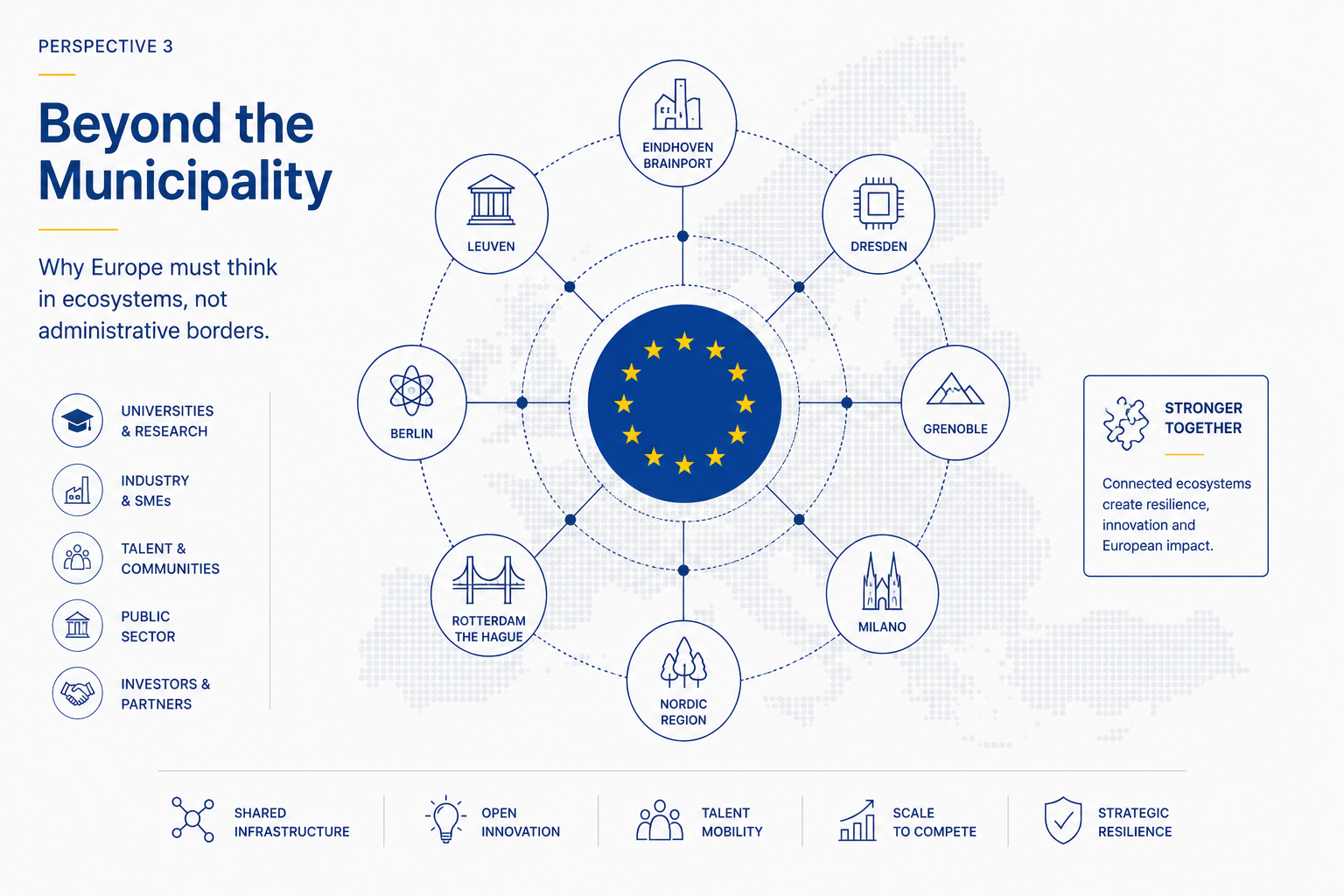
Why Europe’s semiconductor future depends on ecosystems rather than regions
As Europe continues reshaping its semiconductor strategy through Chips Act 2.0, another realization is quietly emerging beneath the industrial debate: Europe can no longer afford to think in isolated regions. Not in semiconductors. Not in AI. Not in energy. Not in defense infrastructure. And increasingly, not in innovation itself.
For decades, Europe approached industrial development largely through local and national competition. Cities, provinces and regional clusters competed for subsidies, prestige projects, research campuses and corporate headquarters.
But semiconductor ecosystems do not function according to municipal borders. They function through interconnected systems. That reality may become one of the most important strategic implications of Chips Act 2.0.
The European mesh
Europe possesses extraordinary technological depth. But much of that strength remains fragmented across separate clusters:
- Eindhoven and Brainport,
- Leuven,
- Dresden,
- Grenoble,
- Milan,
- Nordic photonics and telecom ecosystems,
- semiconductor packaging initiatives across Southern Europe,
- and advanced industrial manufacturing clusters spread throughout the continent.
Individually, many of these regions are globally competitive. But globally integrated semiconductor systems increasingly reward scale through coordination rather than isolated excellence alone.
That creates a dilemma for Europe. Because while the United States increasingly organizes innovation through hyperscale capital ecosystems and China coordinates industrial strategy through centralized state planning, Europe still often approaches innovation through fragmented regional logic.
The result is not a lack of innovation. It is a lack of architectural integration.
Europe’s semiconductor future may therefore increasingly depend on what could be described as a European mesh: a network of deeply specialized ecosystems whose strength emerges not from centralization alone, but from their ability to function as an integrated continental system.
If the links between those ecosystems weaken, the entire architecture becomes more vulnerable.
From clusters to continental systems
The semiconductor ecosystem is becoming too technologically complex for isolated regions to operate independently. Advanced AI infrastructure now connects:
- semiconductors,
- energy systems,
- cloud infrastructure,
- photonics,
- telecommunications,
- advanced materials,
- defense technologies,
- and industrial software.
No single city or cluster can master all those layers alone. The future therefore increasingly belongs to interconnected ecosystems operating across borders. That may explain why institutions like imec are becoming strategically important far beyond Belgium itself.
Imec increasingly functions less like a regional research center and more like a European coordination layer connecting universities, suppliers, industrial partners and governments across multiple countries.
In many ways, it already resembles a blueprint for the type of continental coordination Europe may increasingly require under Chips Act 2.0. The same logic increasingly applies to ecosystems surrounding:
- ASML,
- ASM International,
- photonics pilot lines,
- packaging initiatives,
- industrial AI research,
- and European cloud infrastructure projects.
Under Chips Act 2.0, the question may no longer simply be:
Which region wins?
Instead:
How do Europe’s specialized ecosystems become interoperable parts of a larger technological architecture?
Europe’s innovation challenge is often misunderstood as a lack of technology. In reality, Europe frequently produces world-class research, engineering and industrial systems.
Europe’s hidden scaling problem
The deeper problem is scaling coordination across fragmented governance structures. A semiconductor ecosystem now depends simultaneously on:
- universities,
- energy infrastructure,
- skilled labor,
- advanced manufacturing,
- cloud infrastructure,
- logistics,
- defense policy,
- financing,
- and long-term industrial planning.
But those layers are still often governed separately: by municipalities, regions, nation states and disconnected EU frameworks.
Europe’s technological ambitions increasingly collide with fragmented governance structures. A cluster such as Brainport may help shape the future of advanced computing, yet its physical expansion can still depend on local zoning decisions, energy permits, housing shortages and regional infrastructure planning.
In that sense, Europe’s geopolitical position may sometimes be shaped as much by municipal planning procedures as by semiconductor strategy itself. As semiconductor systems become more infrastructure-intensive, fragmentation itself increasingly becomes a strategic vulnerability.
That may be one of the deeper messages behind Chips Act 2.0: Europe no longer needs isolated excellence alone. It needs continental coordination.
The return of infrastructure thinking
This is also why the semiconductor debate increasingly overlaps with:
- Horizon Europe,
- Digital Europe Programme,
- energy policy,
- defense coordination,
- AI governance,
- and industrial strategy.
Because semiconductors are no longer just products. They are infrastructure. And infrastructure changes how scale works.
• A datacenter depends on energy grids.
• AI systems depend on semiconductors.
• Industrial automation depends on connectivity.
• Photonics depends on advanced research ecosystems.
• Defense increasingly depends on compute infrastructure.
The boundaries between industries are dissolving.
The location of future AI infrastructure may therefore increasingly depend less on branding or campus prestige and more on access to electricity grids, cooling capacity and energy resilience.
Semiconductor strategy can no longer be separated from Europe’s wider infrastructure questions surrounding energy, cloud architecture and industrial electrification.
Europe therefore faces a different strategic challenge than simply “building more fabs”. It must learn how to think systemically across interconnected technological layers.
Beyond the municipality
This may ultimately require a cultural shift as much as an industrial one. For decades, European innovation was often framed through local pride: the regional campus, the science park, the national champion, the local subsidy race. But semiconductor infrastructure increasingly operates at continental scale.
The future competitiveness of Eindhoven may depend partly on Leuven. Leuven may depend on Dresden. Dresden may depend on Nordic telecom ecosystems. Photonics initiatives in the Netherlands may connect directly to packaging ecosystems in Italy or industrial AI infrastructure in Germany.
The emerging semiconductor architecture of Europe is therefore not a collection of isolated regions. It is a network. And perhaps that is the deeper strategic transition now quietly unfolding inside Europe itself.
Not merely the construction of new factories. But the gradual emergence of a continent learning to think in ecosystems rather than municipalities.
In many ways, that may also become the deeper role of initiatives such as Horizon Europe, Digital Europe and cross-border industrial alliances: not simply funding isolated innovation projects, but functioning as connective infrastructure between Europe’s fragmented technological ecosystems themselves.
Because in the emerging semiconductor era, Europe’s strength may no longer depend solely on what individual regions can build alone. But on how effectively the continent learns to connect them together.
This article is part of Europe’s Semiconductor Reset — a four-part Perspective series by Altair Media Europe exploring how Chips Act 2.0 is reshaping Europe’s technological, industrial and geopolitical strategy.
The series examines Europe’s emerging semiconductor architecture through the lens of ecosystems, infrastructure, photonics, Industrial AI, advanced packaging and technological indispensability.
Credit
Illustration by Altair Media Europe
Caption
A conceptual visualization of Europe’s emerging semiconductor ecosystem, showing how interconnected regional clusters — from Brainport Eindhoven and Leuven to Dresden, Milan and the Nordics — increasingly function as part of a larger continental technology infrastructure.
