Sweden and the Innovation Society
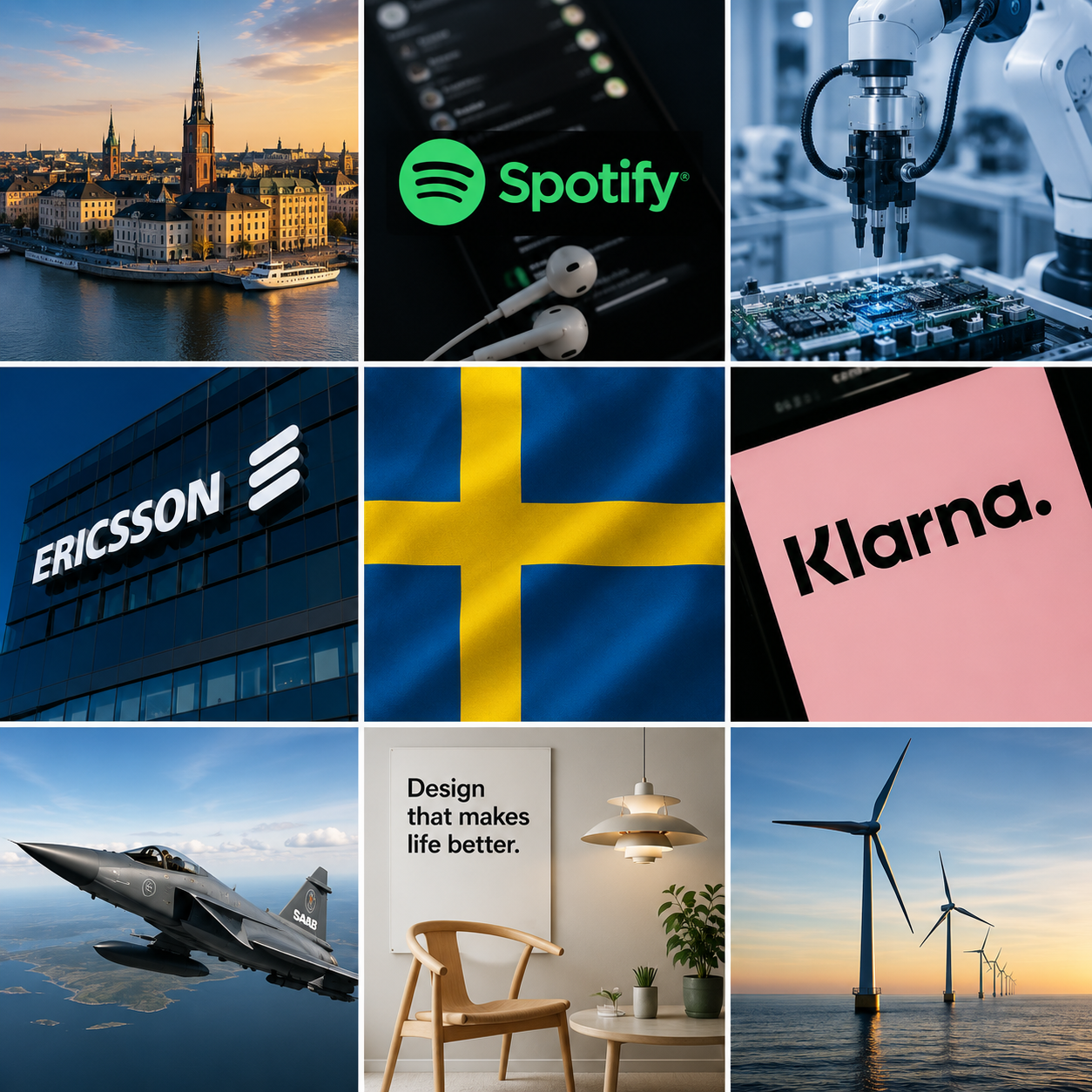
Can Innovation Remain a Source of Prosperity in a Rapidly Changing World?
Sweden is a relatively small country. Yet its influence on the global economy extends far beyond its population size. From IKEA and Ericsson to Spotify, Klarna and Saab, Swedish companies have helped shape industries ranging from furniture and telecommunications to digital services, financial technology and advanced manufacturing.
Yet Sweden’s success cannot be explained by a handful of well-known companies alone. Its deeper strength lies in the systems that repeatedly generate innovation.
For decades, Sweden has invested in education, research, entrepreneurship and institutional trust. Together, these elements have created an environment where ideas can emerge, scale and compete globally.
The Swedish story is therefore not simply about technology. It is about innovation as a societal system.
Innovation Beyond Individual Companies
When people think of Swedish innovation, they often think of successful firms. IKEA redefined global furniture retail through design, logistics and affordability. Ericsson helped build global telecommunications networks. Spotify transformed music streaming. Klarna became one of Europe’s most prominent fintech companies. Saab remains an important player in aerospace and defence technologies.
Together, these companies illustrate something important. Swedish innovation is not concentrated in a single sector. It appears across the economy. Consumer products. Telecommunications. Digital platforms. Financial services. Defence technologies. Industrial systems.
Yet these companies emerged from a broader ecosystem. Education. Research. Entrepreneurship. Public institutions. Private investment. Together they create an environment where ideas can move from laboratories and classrooms into global markets.
Sweden’s strength lies not in any single company, but in a society built to innovate.
Sweden’s innovation capacity is not accidental. It reflects decades of cooperation between universities, government institutions and private enterprise.
Education and Human Capital
Sweden has long viewed education as a strategic investment. Universities, research institutes and lifelong learning programmes play a central role in maintaining competitiveness. Public investment in knowledge creation has helped support a highly skilled workforce capable of adapting to technological change.
Innovation therefore begins long before a company is founded. It begins with people. In many respects, Sweden’s most important resource is not a natural resource at all. It is human capital.
The country’s innovation model reflects a broader belief that economic prosperity depends upon continuously developing the capabilities of its citizens.
Deep-Tech and Industrial Strength
Sweden’s innovation model is not limited to software and digital services. The country has also built internationally competitive capabilities in advanced manufacturing, telecommunications, defence technologies, life sciences and clean technology.
Companies such as Ericsson and Saab illustrate the connection between technological innovation and industrial capability. More recently, battery technologies, artificial intelligence and advanced materials have become important areas of investment and research.
Sweden increasingly occupies an important position at the intersection of digital innovation and physical infrastructure. From advanced batteries and clean energy technologies to data centres powered by abundant renewable electricity, the country demonstrates how future competitiveness may depend upon combining software, industry and energy systems.
Innovation is most powerful when ideas can be translated into real-world capabilities.
Innovation is no longer confined to the digital economy. It increasingly depends upon the physical foundations that enable it. This combination of industrial depth and technological ambition has helped Sweden remain relevant through multiple waves of economic change.
Design as a Competitive Advantage
Innovation in Sweden extends beyond technology. The country has developed a global reputation for design, engineering and user-centred problem solving. IKEA may be the most visible example. The company’s success was built not only upon products, but upon rethinking how products are designed, manufactured, transported and assembled.
Sweden demonstrates that innovation is not merely an economic activity. It is an institutional capability.
This emphasis on practical problem-solving can be found throughout Swedish society. From consumer products and public services to digital platforms and industrial systems, Swedish innovation often emphasises simplicity, functionality and accessibility.
The objective is often not to create complexity. It is to make complexity easier to navigate.
Digital Transformation and Trust
Like its Nordic neighbours, Sweden embraced digitalisation early. Digital services, cashless payments, online banking and digital public infrastructure have become deeply embedded within everyday life. Yet technology alone does not explain this success. Trust plays an equally important role.
Swedish innovation often succeeds not by inventing entirely new problems to solve, but by making existing solutions more accessible, efficient and human-centred.
Citizens are generally willing to adopt new technologies because they maintain relatively high levels of confidence in institutions, businesses and public administration. This relationship between innovation and trust has become one of Sweden’s defining characteristics.
Technology can accelerate innovation. Trust determines how widely innovation is embraced.
In many respects, Sweden demonstrates that technological adoption depends not only upon technical capability, but also upon social legitimacy.
Prosperity and Pressure
Sweden’s model faces growing challenges. Global competition is intensifying. Technological cycles are accelerating. Geopolitical tensions are reshaping supply chains and strategic industries.
At the same time, demographic pressures, skills shortages and increasing international competition for talent create new demands on the innovation ecosystem.
Sweden’s innovation economy has historically benefited from openness. International talent, global markets and cross-border research collaboration have all contributed to its success.
Yet growing geopolitical competition is creating new questions about how open advanced innovation economies can remain while also protecting strategic technologies and capabilities. Balancing openness and resilience may become one of Sweden’s defining challenges during the coming decade.
The challenge is therefore not whether Sweden can innovate. The challenge is whether innovation can continue generating broad-based prosperity while preserving social cohesion.
Looking Ahead
Sweden’s future will likely depend upon its ability to sustain the institutions that have supported innovation for generations. This means continuing to invest in education, research, entrepreneurship and technological capability. It also means recognising that innovation is not simply an economic activity. It is a societal capacity.
Innovation is not Sweden’s industry. It is Sweden’s culture.
As artificial intelligence, advanced manufacturing, energy systems and emerging technologies reshape the global economy, Sweden may be particularly well positioned to adapt. Because Sweden demonstrates that innovation is not only about creating new technologies. It is about building a society capable of continuously generating new ideas.
The central question facing Sweden therefore remains:
Can innovation remain a source of prosperity in a rapidly changing world?
For decades, Sweden has shown that it can. The challenge now is sustaining that advantage in an increasingly competitive and uncertain future.
Series — Economic Europe: Northern Europe
This article is part of Economic Europe, a United Europe series exploring the economic architectures that shape modern Europe. The Northern Europe chapter examines how Denmark, Sweden, Norway, Finland and Iceland have built distinctive models of resilience through trust, innovation, institutional capacity and long-term adaptation.
Credit
Illustration generated by OpenAI’s DALL·E for Altair Media Europe
Caption
Sweden’s innovation ecosystem extends far beyond technology alone. From IKEA’s design philosophy and Ericsson’s telecommunications infrastructure to Spotify’s digital platforms, Saab’s advanced engineering and world-class research institutions, Sweden demonstrates how innovation can become a societal capability rather than simply an economic activity.
