Part I — The Missing Layer
Why Europe’s semiconductor strategy is shifting from manufacturing scale to systems integration
CHIPS ACT 2.0 — The New European Semiconductor Architecture
For years, Europe’s semiconductor ambitions largely revolved around fabs, production capacity and technological scale. But as AI infrastructure rapidly expands, a different reality is emerging: without advanced packaging and OSAT capabilities, semiconductor sovereignty remains structurally incomplete.
When the European Union launched the original Chips Act in 2022, the political objective appeared relatively straightforward. Europe wanted to reduce its dependence on foreign semiconductor production and strengthen its position within the global chip industry.
At the time, much of the public debate focused on attracting large fabrication plants. Advanced manufacturing became the symbolic centrepiece of Europe’s technological ambitions. New fabs promised jobs, geopolitical resilience and the possibility of rebuilding industrial strength inside Europe itself.
But over the past two years, the global semiconductor landscape has quietly changed.
Artificial intelligence, high-performance computing and advanced data infrastructure have transformed the industry’s priorities. Increasingly, semiconductor performance no longer depends solely on the power of individual chips. It depends on how different components are physically connected, integrated and packaged together into larger computational systems.
And that is precisely where Europe discovered a critical weakness.
The overlooked part of the semiconductor chain
Much of the semiconductor industry still depends on a global division of labour that emerged decades ago. While Europe developed strengths in areas such as lithography, industrial equipment and semiconductor research, the final assembly and integration layers increasingly concentrated in Asia.
This back-end segment of the industry is commonly referred to as OSAT: Outsourced Semiconductor Assembly and Test.
“Advanced packaging is becoming a critical differentiator for next-generation semiconductor innovation.”
European Chips Joint Undertaking (Chips JU)
For years, OSAT was often perceived as a lower-margin industrial activity compared to chip design or front-end manufacturing. But the rise of AI infrastructure has fundamentally altered that perception.
Modern AI processors increasingly rely on advanced packaging technologies capable of combining multiple chiplets, memory modules and interconnect layers into one integrated computing architecture. In practice, packaging has become a strategic performance layer rather than a simple manufacturing step.
Without advanced packaging, even the world’s most sophisticated chips cannot function as integrated AI systems.
As demand for AI compute continues to accelerate, packaging capacity has quietly become one of the semiconductor industry’s largest bottlenecks.
That creates a growing paradox for Europe.
Even if new semiconductor fabs are built inside Europe, the wafers themselves may still need to travel abroad for assembly, packaging and integration before they become usable computing systems. In practice, this creates a vulnerable industrial dependency chain that stretches far beyond the fabrication plant itself.
The semiconductor debate is therefore no longer simply about where chips are manufactured. Increasingly, it is about who controls the infrastructure layers that transform chips into functioning systems.
From chips to systems
The shift now unfolding inside Europe reflects a broader transformation in how technological power is understood.
Semiconductor competition is no longer simply about producing the largest number of chips. It increasingly revolves around controlling the critical infrastructure layers that enable entire computational ecosystems to function.
Lithography and advanced optics define the patterns at microscopic scale. New substrate materials and integrated photonics increasingly determine how rapidly information can move through systems. Advanced packaging technologies physically connect these separate elements into a singular computing architecture.
In many ways, the semiconductor industry is evolving from a manufacturing sector into a systems integration industry.
“No region can realistically achieve complete semiconductor self-sufficiency across the entire value chain.”
European Court of Auditors — Special Report on the Chips Act
This creates an uncomfortable reality for Europe.
The continent remains exceptionally strong in several foundational semiconductor layers. Dutch company ASML dominates extreme ultraviolet lithography. Europe maintains world-class research ecosystems through institutions such as imec and Fraunhofer. Companies across Germany, France, Italy and the Netherlands continue to play major roles in industrial equipment, automotive semiconductors and power electronics.
Yet much of the physical integration layer — the place where advanced chips become functioning computational systems — still remains concentrated outside Europe.
That dependency matters far more in the AI era than many policymakers initially anticipated.
Why packaging suddenly matters
The growing strategic importance of advanced packaging is directly connected to the physical limits of semiconductor scaling.
For decades, the industry largely depended on Moore’s Law: the ability to place ever more transistors onto a single chip while improving performance and reducing cost. But that model is becoming increasingly difficult to sustain. Physical, thermal and economic constraints now make it far harder to continue scaling monolithic processors indefinitely.
As a result, the semiconductor industry is shifting toward heterogeneous integration: combining multiple specialised chiplets into larger modular systems.
Rather than building one enormous processor, future computing increasingly relies on interconnected components optimised for different functions. Some chiplets handle AI acceleration. Others manage memory, communication or power efficiency. Advanced packaging technologies then integrate these separate elements into one functioning architecture.
This dramatically increases the importance of packaging systems capable of handling:
- thermal management,
- ultra-fast interconnects,
- power efficiency,
- and three-dimensional integration.
In other words, packaging is no longer peripheral infrastructure. It is becoming computational architecture itself.
This is one reason why companies such as Nvidia and TSMC now depend heavily on highly specialised packaging technologies like CoWoS to scale AI systems. The bottleneck is no longer always the chip design. Increasingly, it is the physical integration process surrounding it.
Europe’s policymakers have begun to recognise that semiconductor sovereignty without packaging capacity creates an incomplete industrial ecosystem.
The emerging philosophy behind Chips Act 2.0
This realization appears to be gradually reshaping the broader philosophy behind the upcoming Chips Act 2.0 discussions.
The first Chips Act was largely framed around manufacturing scale and strategic autonomy. But Europe is now confronting a more complicated geopolitical reality.
Complete semiconductor self-sufficiency may simply be unrealistic.
Instead, a different strategic doctrine seems to be emerging: technological indispensability.
Under this approach, Europe does not necessarily need to dominate every layer of the semiconductor supply chain. But it does need to control enough critical infrastructure layers that the global ecosystem cannot easily function without European participation.
That shift has profound implications. It moves the debate away from symbolic megafabs alone and toward infrastructure coordination, advanced integration, industrial ecosystems, energy systems, AI compute capacity and technological interdependence.
The semiconductor industry is therefore becoming a mirror of a much larger geopolitical transformation.
Modern power increasingly flows through systems, standards and infrastructure layers — not only through territorial scale or manufacturing volume. And in that emerging architecture, Europe may be searching for a different role than originally imagined.
This article is part of the series CHIPS ACT 2.0 — The New European Semiconductor Architecture, in which Altair Media Europe examines how semiconductors are evolving from an industrial sector into a foundational layer of modern infrastructure, AI systems and geopolitical power. Across four articles, the series explores advanced packaging, OSAT, AI infrastructure and Europe’s growing search for technological indispensability.
Credit
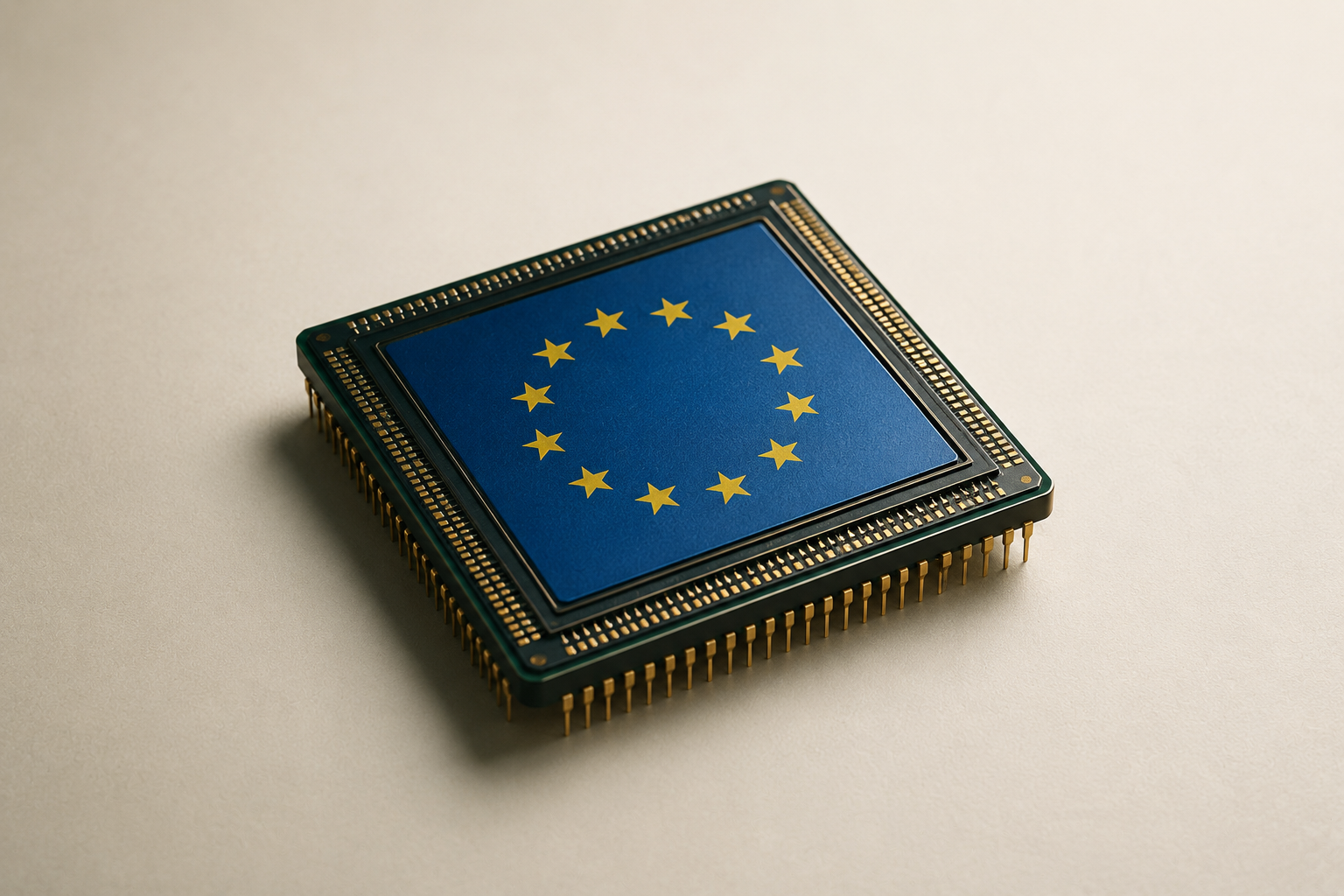
Artwork generated with AI for Altair Media Europe
Caption
A minimalist semiconductor object inspired by Europe’s emerging semiconductor strategy. The image symbolizes the transition from traditional chip manufacturing toward advanced integration, packaging and infrastructural control in the AI era.
