Hydrogen Technologies — Coordinating Matter
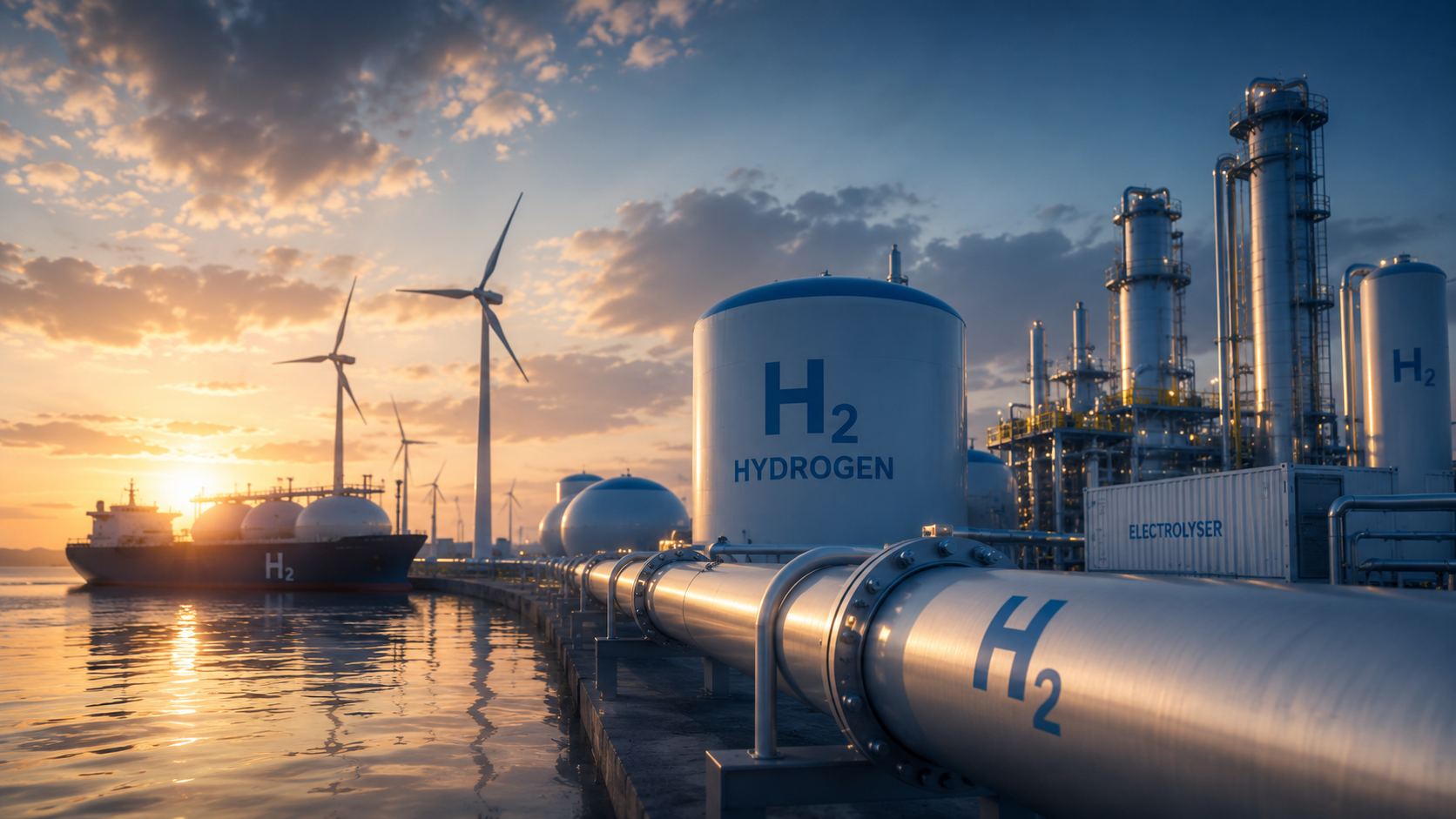
Why molecules may become Europe’s material infrastructure
Electricity moves instantly, obeying the immediate laws of the wire. Molecules move differently. They can be stored, accumulated, transported and traded across seasons, industries and continents. As Europe electrifies its economic foundations, hydrogen is emerging not simply as another energy carrier, but as a structural mechanism for coordinating matter itself.
■ THE LIMITS OF ELECTRONS
Electrification has become Europe’s dominant energy narrative. From heat pumps and electric vehicles to smart grids and distributed batteries, much of the transition remains centred on the wire. Yet the physical reality of heavy industry suggests that electrons, while powerful, are not universal.
Steel production requires extreme temperatures that static currents struggle to deliver efficiently. Chemical industries depend upon molecular feedstocks rather than raw electricity, while maritime transport and aviation continue to rely on dense energy carriers capable of moving vast quantities of energy across oceans.
Electrons move instantly. Molecules move civilisation.
Hydrogen therefore exposes a deeper reality. Energy transitions are not only about producing electrons; they are also about redesigning molecules.
■ STORING MATTER
Batteries are exceptionally effective at balancing hours and, in some cases, days. Hydrogen operates at an entirely different scale. It enables societies to preserve energy across weeks, months and even seasons.
Through this lens, storage ceases to be merely temporal infrastructure and becomes material infrastructure. Hydrogen transforms fleeting electricity into a substance that can be accumulated, transported, traded and integrated into industrial supply chains.
Energy becomes inventory. Energy becomes logistics. Energy becomes trade.
Hydrogen may therefore matter less because it is another energy technology and more because it introduces a new mechanism for coordinating matter itself.
■ BEYOND ENERGY
The strategic significance of hydrogen extends far beyond its role as an alternative fuel. It forms the basis for ammonia, methanol, synthetic aviation fuels and sustainable fertilisers. These sectors remain difficult to decarbonise precisely because they do not merely consume energy; they consume molecules.
Electrons cannot manufacture fertilisers. They cannot replace carbon feedstocks in industrial chemistry, nor can they cross oceans inside the fuel tanks of commercial aircraft or container vessels.
Hydrogen therefore reveals another layer of the transition. Europe is not simply redesigning an energy system. It is redesigning a material economy.
■ BUILDING MOLECULAR INFRASTRUCTURE
Producing molecules is only the first step in a much broader challenge. Just as electricity depends upon grids, hydrogen requires an architecture of electrolysers, storage caverns, pipelines, compression systems and strategic maritime gateways.
Rotterdam. Antwerp. Hamburg. Southern Europe. North Africa. Norway. These locations are emerging as nodes within a new molecular geography.
Hydrogen demonstrates that matter possesses its own spatial logic. Electricity moves through wires. Molecules move through corridors, ports and industrial clusters.
The hydrogen transition is therefore not simply technological. It is industrial. Spatial. And geopolitical.
■ THE ARCHITECTURE OF MATTER
This structural challenge is not theoretical. It is a physical sequence that becomes visible through several companies emerging from Europe’s innovation ecosystem.
At the intersection between electrons and molecules stands Sunfire, whose high-temperature electrolysers integrate hydrogen production directly into the thermal heart of European industry. Yet once produced, the molecule immediately encounters the friction of its own physics: hydrogen is light, volatile and difficult to contain.
This material challenge is addressed by Hydrogenious LOHC Technologies, which chemically binds hydrogen to liquid organic carriers, transforming a volatile gas into a stable substance capable of circulating through Europe’s existing logistical networks.
Hydrogen may matter less because it stores energy and more because it stores energy as matter.
The geography of production also changes. Energy abundance does not necessarily coincide with demand. Companies such as Lhyfe offer a window into this spatial realignment by producing hydrogen directly at sea, converting renewable electricity into molecules before congested terrestrial grids become a constraint.
Yet the architecture remains vulnerable without control over its technological foundations. Elcogen illustrates this dependency through its manufacturing of solid-oxide cells and stacks, the microscopic components at the centre of the molecular economy. Without domestic capabilities at this level, Europe risks exchanging dependence on imported fossil fuels for dependence on imported industrial technologies.
Finally, the cycle closes with EH Group, whose compact, high-density fuel cells demonstrate how molecules can once again be converted into physical work, powering heavy transport, maritime applications and industrial systems that electrons alone still struggle to sustain.
Europe may replace dependence on imported gas with dependence on imported hydrogen components unless it masters the material layer itself.
■ WHEN MOLECULES BECOME STRATEGY
Hydrogen also introduces a geopolitical dilemma. Europe seeks greater energy sovereignty, yet large-scale hydrogen production depends upon abundant land, water and renewable resources—conditions often found beyond Europe’s borders. North Africa. The Middle East. Australia. Chile.
Europe may therefore not be escaping dependency altogether. It may simply be redesigning dependency.
Yesterday’s gas pipelines could become tomorrow’s hydrogen corridors. The question is no longer whether Europe can produce molecules, but whether it can shape the standards, institutions and trade routes through which they circulate.
Like semiconductors, rare earths and advanced batteries, hydrogen has become a question of technological sovereignty.
■ CONCLUSION — COORDINATING MATTER
The twentieth century coordinated resources. The twenty-first century may increasingly coordinate molecules. Storage technologies coordinate time. Grid technologies coordinate space. Hydrogen technologies coordinate matter.
Together, they reveal that energy transitions are rarely only about energy. They are ultimately about reorganising the physical foundations of society.
Hydrogen matters because it preserves capabilities that electrons alone cannot provide: seasonal resilience, industrial continuity and the ability to move energy not only through time and space, but through matter itself.
Building Europe’s Energy Architecture is an ongoing series within the Innovation & Technology Lab, exploring how Europe’s emerging energy technologies are evolving into an interconnected system of strategic capabilities.
From energy storage and hydrogen to smart grids, digital energy and industrial decarbonisation, each article examines one essential building block of Europe’s future energy architecture.
Building Europe's Energy Architecture

A continuing series within the Innovation & Technology Lab

✓ Part I — What Is Europe's Energy Architecture Becoming?

✓ Part II — Why Energy Storage Is Becoming Europe's Temporal Infrastructure

✓ Part III — Grid Technologies — Coordinating Space

✓ Part IV — Hydrogen Technologies — Coordinating Matter

✓ Part V — Renewable Energy Integration — Coordinating Complexity

✓ Part VI — Digital Energy Systems — Coordinating Decisions

✓ Part VII — Industrial Transformation — Coordinating Production

✓ Part VIII — Europe's Emerging Energy Architecture
Credit
Altair Media / OpenAI Image Generation
Caption
Hydrogen may become more than an alternative fuel. By transforming electricity into transportable molecules, it enables energy to be stored, traded and circulated across industrial corridors, maritime routes and emerging hydrogen networks, turning matter itself into strategic infrastructure.
