What Is Europe’s Energy Architecture Becoming?
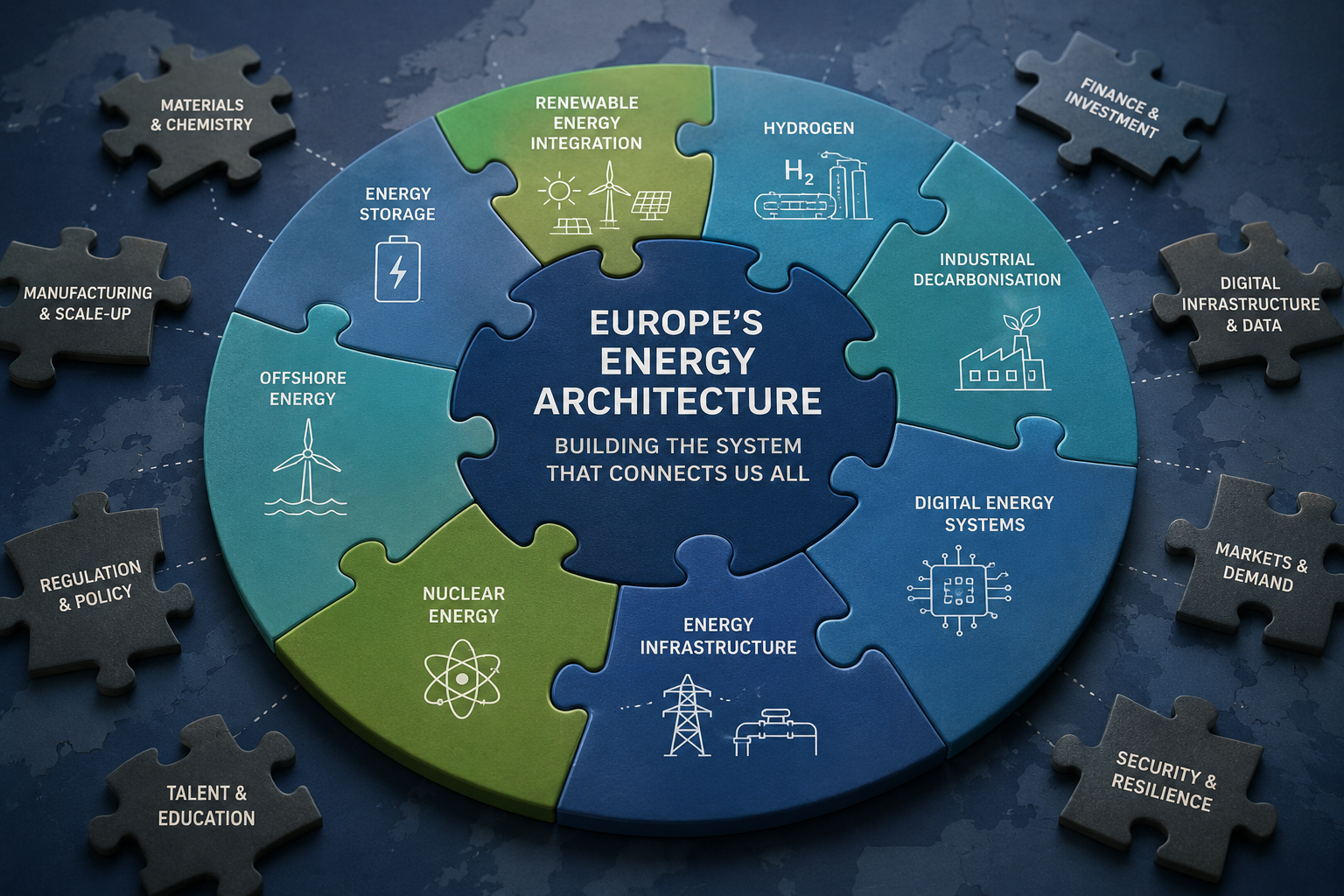
Why the European Innovation Council’s energy portfolio is about far more than individual technologies
The transition towards a sustainable energy system is often presented as a collection of separate innovations. Better batteries. More efficient solar panels. New hydrogen technologies. Smarter electricity grids. Each breakthrough appears to solve an individual problem. The European Innovation Council’s portfolio tells a different story.
Taken individually, the one hundred companies represent promising technological innovations. Viewed together, however, they reveal something much larger. They are not simply developing new products. They are gradually constructing the foundations of a new European energy architecture.
The question is no longer which technology will succeed. The question is how different technologies begin to reinforce one another.
The energy transition is therefore becoming less about isolated inventions and increasingly about coordination.
Innovation Does Not Exist in Isolation
Few energy companies innovate independently of the systems around them. A company developing next-generation batteries depends upon advanced materials, chemistry, manufacturing capacity, electricity networks, software platforms and regulatory frameworks before its technology can be deployed at scale.
The same applies to hydrogen. Companies developing electrolysers require abundant renewable electricity. Hydrogen producers depend upon industrial customers willing to adopt new processes. Pipelines, storage facilities and distribution infrastructure must evolve simultaneously. Innovation therefore rarely replaces an existing system. It grows within one.
This systemic interdependence becomes increasingly visible throughout the European Innovation Council portfolio. Consider what happens when Europe attempts to integrate ever larger volumes of renewable electricity.
The first challenge is not generating more power, but understanding how much capacity existing infrastructure can actually accommodate. Companies such as Heimdall Power develop sensor technologies that allow transmission networks to operate closer to their physical limits.
Yet increasing grid capacity immediately exposes another challenge. Renewable electricity is inherently variable. Managing those fluctuations requires new forms of energy storage. Skeleton Technologies develops ultracapacitors capable of responding almost instantaneously to changing demand, while LeydenJar Technologies is rethinking battery chemistry through silicon-anode technology designed to increase energy density.
As electricity becomes more reliable and flexible, entirely new industrial opportunities emerge. Companies such as Sunfire use renewable electricity to produce green hydrogen for industries where direct electrification remains difficult.
Each innovation addresses a different constraint. Together, they reveal something far larger than the technologies themselves.
Innovation becomes strategically valuable when individual technologies begin functioning as parts of a larger system.
Europe is not simply developing better energy technologies. It is gradually assembling the interconnected capabilities required for an entirely new energy architecture.
Innovation Changes the Architecture
The significance of these innovations extends well beyond the technologies themselves. A faster battery is no longer simply a better battery. It changes electric vehicle charging behaviour. It influences electricity demand throughout the day. It reduces pressure on charging infrastructure. It creates new opportunities for grid balancing, distributed storage and energy trading. One innovation begins reshaping multiple parts of the wider system.
The same dynamic appears throughout the EIC portfolio. Improved grid technologies enable greater integration of renewable energy. Better storage creates more flexible electricity markets. Advances in hydrogen support the decarbonisation of heavy industry. Digital energy platforms increasingly connect producers, consumers and infrastructure in real time.
Europe’s future energy system will not emerge from one breakthrough. It will emerge from the interaction between hundreds of specialised innovations.
Rather than evolving independently, these technologies strengthen one another. The architecture gradually becomes more capable than the sum of its individual innovations.
From Companies to Capability
This perspective fundamentally changes how the EIC Top 100 should be interpreted. Rather than asking which companies may become future market leaders, a more strategic question emerges.
Which capabilities is Europe actually building?
The portfolio reveals investments across energy storage, hydrogen, smart grids, renewable integration, industrial electrification, digital energy management and enabling infrastructure. These are not isolated sectors. They represent complementary capabilities that together strengthen Europe’s resilience, industrial competitiveness and strategic autonomy.
Capability is no longer created by individual technologies alone. It increasingly emerges from the architecture that connects them.
The real strategic asset may therefore not be any individual company. It may be the architecture that connects them.
Understanding the Emerging Architecture
This series explores the European Innovation Council’s energy portfolio through eight strategic themes rather than one hundred individual company profiles. Each article examines how a particular group of technologies contributes to Europe’s emerging energy architecture, the challenges it addresses and the relationships it creates with the wider energy transition.
The European Innovation Council demonstrates that Europe does not suffer from a shortage of innovation. The more important question is whether Europe can coordinate these innovations into an energy architecture capable of supporting the continent’s long-term prosperity, energy security and technological sovereignty.
Ultimately, Europe’s competitive advantage may not depend upon producing the world’s most successful energy companies. It may depend upon coordinating them into the world’s most capable energy system.
Europe’s energy transition is no longer defined by individual technologies. It is increasingly defined by the architecture that connects them. The challenge facing Europe is therefore becoming less technological and increasingly organisational.
Building Europe’s Energy Architecture is an ongoing series within the Innovation & Technology Lab, exploring how Europe’s emerging energy technologies are evolving into an interconnected system of strategic capabilities.
From energy storage and hydrogen to smart grids, digital energy and industrial decarbonisation, each article examines one essential building block of Europe’s future energy architecture.
Building Europe's Energy Architecture

A continuing series within the Innovation & Technology Lab

✓ Part I — What Is Europe's Energy Architecture Becoming?

✓ Part II — Why Energy Storage Is Becoming Europe's Temporal Infrastructure

✓ Part III — Grid Technologies — Coordinating Space

✓ Part IV — Hydrogen Technologies — Coordinating Matter

✓ Part V — Renewable Energy Integration — Coordinating Complexity

✓ Part VI — Digital Energy Systems — Coordinating Decisions

✓ Part VII — Industrial Transformation — Coordinating Production

✓ Part VIII — Europe's Emerging Energy Architecture
Credit
Concept & Editorial Illustration: Altair Media (AI-generated)
Caption
Europe’s future energy system will not be built by a single breakthrough, but by the architecture that connects hundreds of specialised innovations into one coordinated energy ecosystem.
