Renewable Energy Integration — Coordinating Complexity
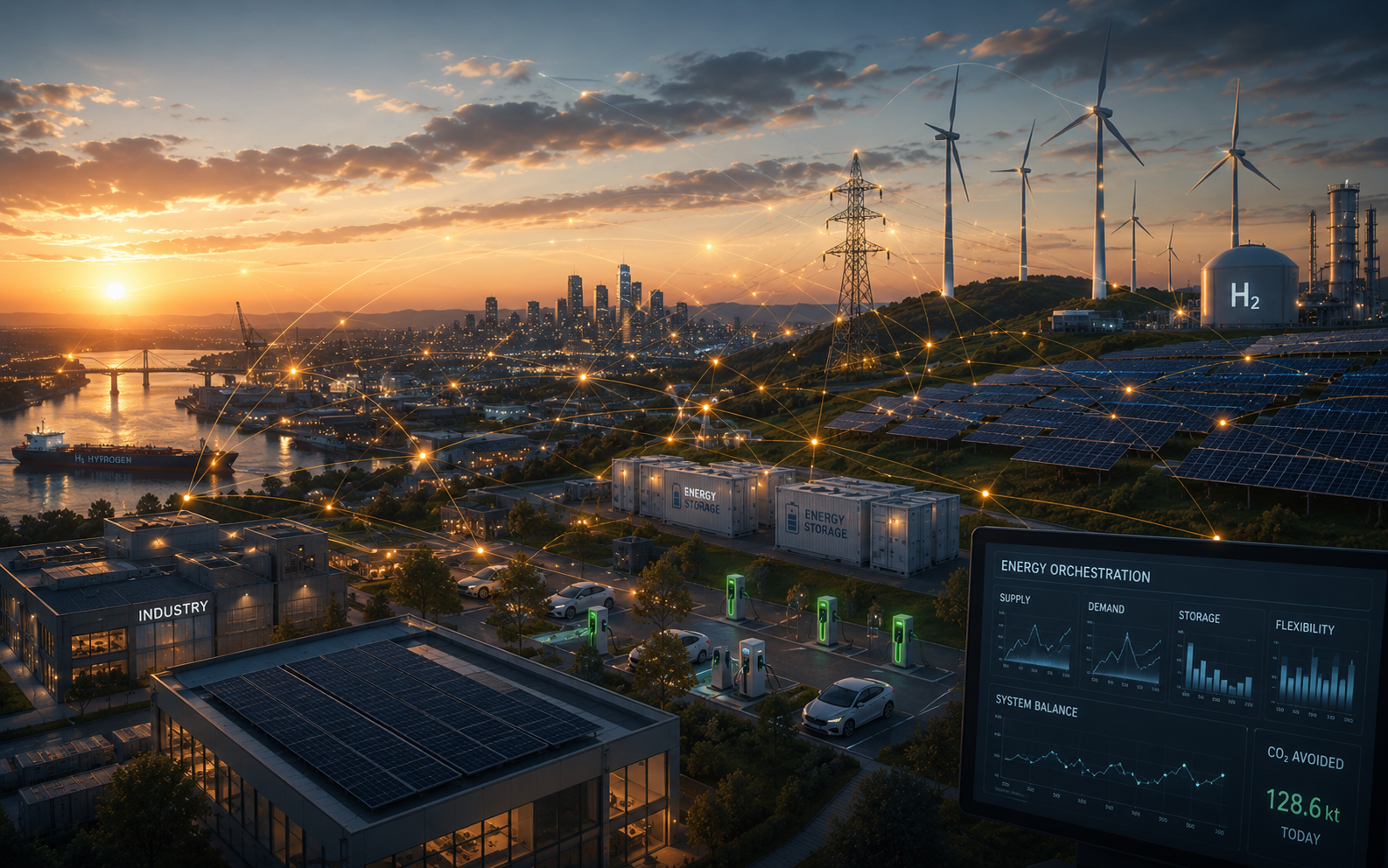
Why the energy transition is becoming a problem of orchestration
Europe no longer lacks renewable technologies. Wind turbines exist, solar panels line rooftops, batteries are scaling by the gigawatt and hydrogen infrastructure is beginning to emerge as an industrial reality. The defining challenge of this decade has therefore shifted.
The question is no longer how societies deploy individual innovations, but how they integrate millions of variable and fragmented assets into a coherent architecture. Renewable integration is no longer a deployment challenge. It is becoming an orchestration challenge.
■ FROM GENERATION TO SYSTEMS
For decades, energy policy was largely measured through the lens of capacity. Success meant more megawatts, more gigawatts and more renewable installations. Yet renewable energy introduces a challenge that volume alone cannot solve.
Renewable energy is not difficult because it is renewable. It is difficult because it is variable.
Wind does not follow industrial schedules and solar energy does not respect demand curves. Electric vehicles charge at irregular moments, while AI data centres increasingly consume power continuously. The question therefore changes. The benchmark of a modern energy system is no longer how much renewable energy Europe can build, but how much variability it can absorb.
Europe is gradually moving beyond an energy transition. It is entering a systems transition.
■ WHEN SCALE CREATES FRICTION
The success of renewable deployment creates its own bottlenecks. At low penetration levels, intermittency remains manageable. At high penetration levels, variability begins to shape market behaviour itself.
Electricity prices become increasingly volatile. Negative pricing periods become structural rather than exceptional. Curtailment rises, congestion intensifies and seasonal mismatches become more visible.
Paradoxically, abundance creates scarcity. Not scarcity of energy. Scarcity of coordination. This is where the previous essays converge. Storage technologies coordinate time. Grid technologies coordinate space. Hydrogen technologies coordinate matter. Renewable integration must coordinate them all simultaneously.
■ THE ORCHESTRATION LAYER
Perhaps the most important infrastructure of the twenty-first century will not be composed of steel, copper or concrete. It will be cognitive.
Managing millions of distributed assets requires millions of automated decisions. Batteries respond to prices, industrial users shift demand, electric vehicles charge dynamically and local energy systems increasingly optimise themselves.
Europe’s next energy challenge is not generating abundance, but learning how to orchestrate it.
The future energy system can no longer operate as a static utility. It is evolving into an informational ecosystem. An architecture of continuous optimisation. A distributed operating system.
■ WINDOWS INTO ORCHESTRATION
This challenge is no longer theoretical. It is already visible through a growing ecosystem of European companies working on the software layer of the transition.
At the local level, Tibo Energy demonstrates how factories and industrial sites can optimise their own energy behaviour in real time, transforming consumers into active coordinators of flexibility.
Yet local optimisation only matters if it can contribute to wider system stability. Sympower illustrates this next layer by aggregating industrial flexibility into virtual power plants, enabling demand itself to become an infrastructure asset.
The renewable economy is not only built from turbines and panels. It is built from algorithms.
The orchestration challenge also extends beyond electricity. Gradyent offers a window into the integration of thermal networks, showing how district heating systems, waste heat and electricity markets increasingly interact as one interconnected architecture.
At larger scales, Bamboo Energy demonstrates that industrial scale in the renewable era may emerge less from centralisation and more from aggregation. Thousands of distributed assets become manageable because they are coordinated collectively.
Finally, coordination requires trust. Flexidao illustrates the institutional layer of integration through software capable of tracking and certifying renewable electricity and hydrogen flows in near real time.
Together, these companies reveal that renewable integration is becoming a software problem as much as an engineering problem.
■ WHEN ENERGY BECOMES SOFTWARE
The energy transition increasingly resembles the logic of digital systems. Prediction. Automation. Feedback loops. Adaptation. Continuous optimisation. Electricity no longer simply flows. It communicates. Responds. Balances. Learns.
The twentieth-century energy model was mechanical. The emerging energy model is computational.
■ CONCLUSION — COORDINATING COMPLEXITY
The twentieth century organised production. The twenty-first century must organise variability.
By now, the architecture underlying Europe’s energy transition becomes increasingly visible. Storage technologies coordinate time. Grid technologies coordinate space. Hydrogen technologies coordinate matter. Renewable integration coordinates complexity. Together they suggest that the energy transition is no longer fundamentally constrained by technology.
The hardware increasingly exists. The challenge lies in orchestration.
Perhaps Europe’s future competitiveness will ultimately depend less on inventing additional technologies and more on learning how to make existing technologies behave as one coherent system.
Because the future may belong not to the societies that deploy the most assets. But to those capable of coordinating abundance.
Building Europe’s Energy Architecture is an ongoing series within the Innovation & Technology Lab, exploring how Europe’s emerging energy technologies are evolving into an interconnected system of strategic capabilities.
From energy storage and hydrogen to smart grids, digital energy and industrial decarbonisation, each article examines one essential building block of Europe’s future energy architecture.
Building Europe's Energy Architecture

A continuing series within the Innovation & Technology Lab

✓ Part I — What Is Europe's Energy Architecture Becoming?

✓ Part II — Why Energy Storage Is Becoming Europe's Temporal Infrastructure

✓ Part III — Grid Technologies — Coordinating Space

✓ Part IV — Hydrogen Technologies — Coordinating Matter

✓ Part V — Renewable Energy Integration — Coordinating Complexity

✓ Part VI — Digital Energy Systems — Coordinating Decisions

✓ Part VII — Industrial Transformation — Coordinating Production

✓ Part VIII — Europe's Emerging Energy Architecture
Credit
Altair Media / OpenAI Image Generation
Caption
Renewable energy integration is transforming electricity systems into intelligent networks where storage, hydrogen, flexibility, digital platforms and distributed assets increasingly operate as a single coordinated architecture.
