Grid Technologies — Coordinating Space
Why Grid Technologies Are Becoming Europe’s Spatial Infrastructure
The End of One-Way Infrastructure
For decades, electricity networks were designed around predictability. Large power stations generated electricity, consumers used it and power flowed in one direction. Today, millions of solar panels, batteries, electric vehicles and data centres are transforming the grid into something fundamentally different: a system designed to coordinate space itself.
Europe does not primarily face a generation problem. Europe faces a synchronisation problem. For years, energy debates revolved around production. More solar capacity. More offshore wind. More gigawatts. Yet electricity does not exist in abstract form.
Electricity only exists when production, transport and consumption occur at precisely the same moment. The grid is therefore more than a collection of cables. It is a spatial architecture in which geography and time must continuously align.
This was relatively straightforward when a limited number of large power stations supplied millions of consumers. But as millions of households become producers themselves, the network changes fundamentally.
Electricity is no longer simply generated. It is increasingly orchestrated.
The energy transition is therefore not merely a climate challenge. It is a coordination challenge.
Maximising Existing Space
Building new transmission infrastructure can take more than a decade. Permitting procedures take time. Planning takes time. Public acceptance takes time. This raises a different question. What if Europe does not primarily lack cables? What if Europe simply lacks visibility into the capacity it already possesses?
Here, Heimdall Power offers an important window into the future. Its sensors are mounted directly on transmission lines, continuously measuring environmental conditions to determine how much electricity existing infrastructure can safely carry.
Wind conditions. Temperature. Current load.Physical constraints. Infrastructure increasingly becomes less static infrastructure and more adaptive infrastructure.
The future grid may depend less on building more infrastructure and more on understanding the infrastructure already in place.
The question therefore shifts. Not how much copper Europe can deploy. But how much information Europe can utilise.
Routing Electrons
Electricity does not behave like road traffic. Electrons do not follow preferred routes. They follow the path of least resistance. This creates an important paradox. Some transmission corridors become congested. Others remain significantly underutilised. A new systemic question therefore emerges. Can electricity networks evolve into something resembling digital networks?
Smart Wires provides a compelling perspective. Its technologies actively redirect electricity away from congested lines without fundamentally changing the geography of the network itself.
The ambition is notable. Not merely to build. But to orchestrate. Not only to expand. But to optimise. Perhaps electricity networks are slowly evolving from infrastructure into platforms.
The Invisible Physics of Stability
Yet another layer exists beneath capacity. Electricity systems depend not only on transmission capability. They depend upon stability.
For decades, large thermal power stations provided natural inertia. Massive rotating turbines acted as shock absorbers, dampening disturbances in real time. They stabilised frequency fluctuations. They absorbed sudden imbalances.
Solar panels do not rotate..Batteries do not provide mechanical inertia. Wind turbines interact differently with the grid. As a result, the network gradually loses part of its physical cushion. New forms of vulnerability emerge.
Here, Reactive Technologies offers a window into one of the least visible dimensions of the energy transition. Its technologies measure grid stability and system inertia in real time.
Not every bottleneck is political. Not every friction is administrative. Some constraints remain deeply embedded in the physics of electricity itself.
The transition towards renewable energy is therefore not solely about generating clean electrons. It is equally about preserving the architecture that keeps those electrons balanced and secure.
When Administration Becomes Infrastructure
Perhaps the greatest bottleneck lies elsewhere. Not in engineering. But in organisation. Europe possesses technology. Europe possesses capital. Europe possesses innovation. Yet renewable projects often wait years for grid connections. Not because solutions do not exist. But because coordination remains difficult.
Grid studies take months. Permitting procedures accumulate. Data systems remain fragmented. Network operators still rely on labour-intensive assessments. Administrative capacity has itself become a component of infrastructure.
In the twenty-first century, institutions coordinate electrons as much as engineers do.
Here, Envelio provides an important perspective. Its software automates planning processes, evaluates network constraints and enables operators to manage increasingly complex systems. Digitalisation is therefore not merely a technical process. It is an institutional process.
Perhaps Europe’s energy transition will ultimately be constrained less by the speed at which engineers can build. And more by the speed at which institutions can learn to coordinate.
Conclusion — Coordinating Space
The twentieth century built infrastructure. The twenty-first century must learn how to coordinate infrastructure. Electricity networks were designed for predictability. They must now accommodate variability.
Millions of producers. Millions of batteries. Electric vehicles. Data centres. Flexible demand. Distributed generation. Perhaps this is the most important lesson emerging from Grid Technologies.
Europe is not merely constructing a larger energy system. Europe is attempting to create a network capable of reconciling space, time and stability in real time. And in doing so, the energy transition increasingly appears to be less about energy itself. And more about coordination.
Building Europe’s Energy Architecture is an ongoing series within the Innovation & Technology Lab, exploring how Europe’s emerging energy technologies are evolving into an interconnected system of strategic capabilities.
From energy storage and hydrogen to smart grids, digital energy and industrial decarbonisation, each article examines one essential building block of Europe’s future energy architecture.
Building Europe's Energy Architecture

A continuing series within the Innovation & Technology Lab

✓ Part I — What Is Europe's Energy Architecture Becoming?

✓ Part II — Why Energy Storage Is Becoming Europe's Temporal Infrastructure

✓ Part III — Grid Technologies — Coordinating Space

✓ Part IV — Hydrogen Technologies — Coordinating Matter

✓ Part V — Renewable Energy Integration — Coordinating Complexity

✓ Part VI — Digital Energy Systems — Coordinating Decisions

✓ Part VII — Industrial Transformation — Coordinating Production

✓ Part VIII — Europe's Emerging Energy Architecture
Credit
Altair Media / OpenAI Image Generation
Caption
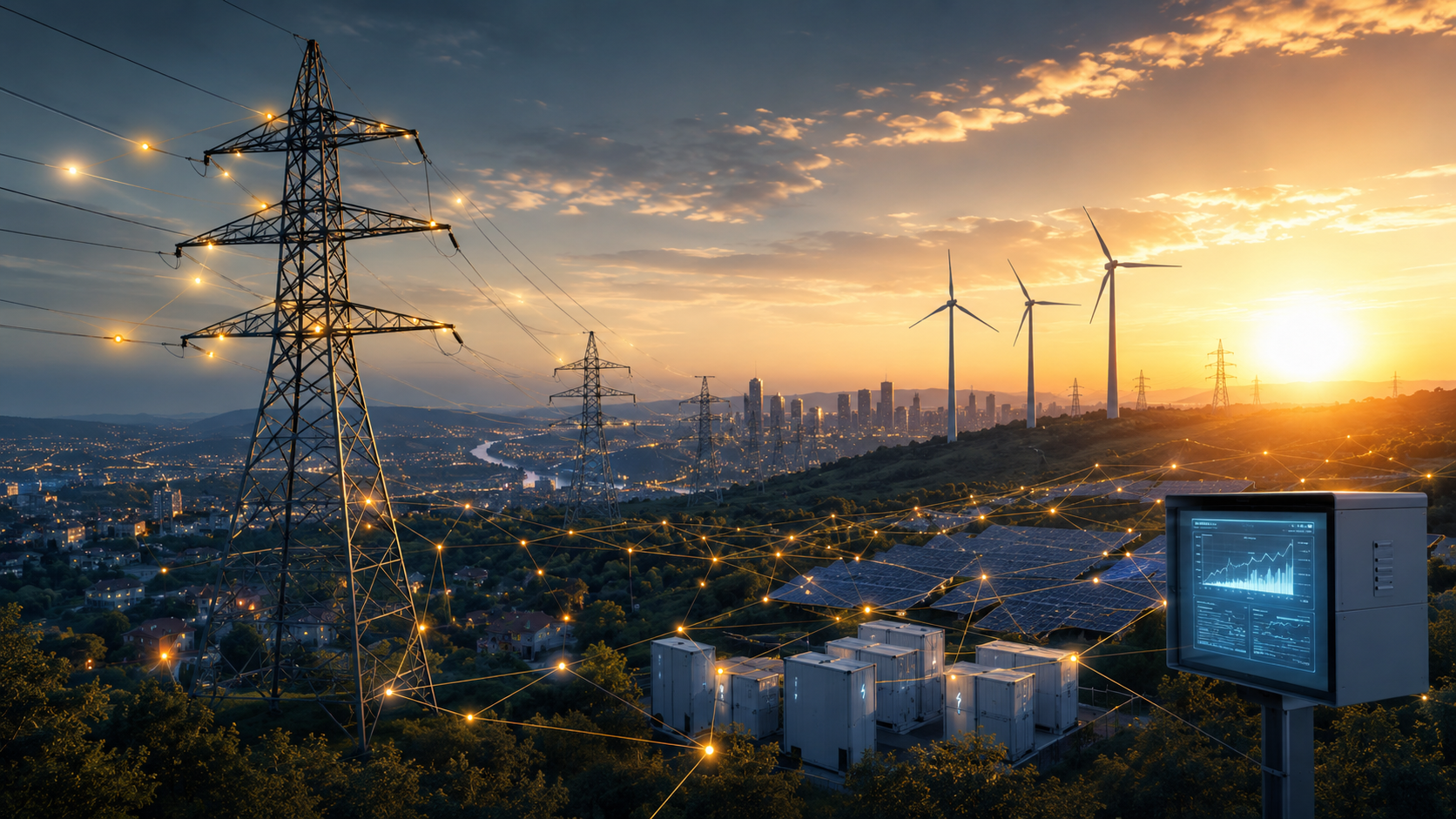
Electricity networks are evolving from passive infrastructure into adaptive systems capable of coordinating energy flows, balancing stability and managing complexity across increasingly distributed energy landscapes.
