Europe’s Emerging Energy Architecture
Why the future of energy is no longer about technologies, but about systems
What Is Europe’s Energy Architecture Becoming? — Part VIII
For decades, Europe’s energy debate has largely revolved around individual technologies. Wind turbines promised cleaner electricity, batteries promised flexibility, hydrogen promised a pathway for difficult industrial sectors and digital systems promised greater intelligence.
Each technology addressed a genuine constraint. Yet none of them, considered in isolation, explains what Europe’s energy system is ultimately becoming. The deeper transformation is no longer merely technological. It is architectural.
Europe is gradually assembling an interconnected system in which different technologies, infrastructures and institutions perform distinct functions within a larger whole.
■ FROM TECHNOLOGIES TO ARCHITECTURE
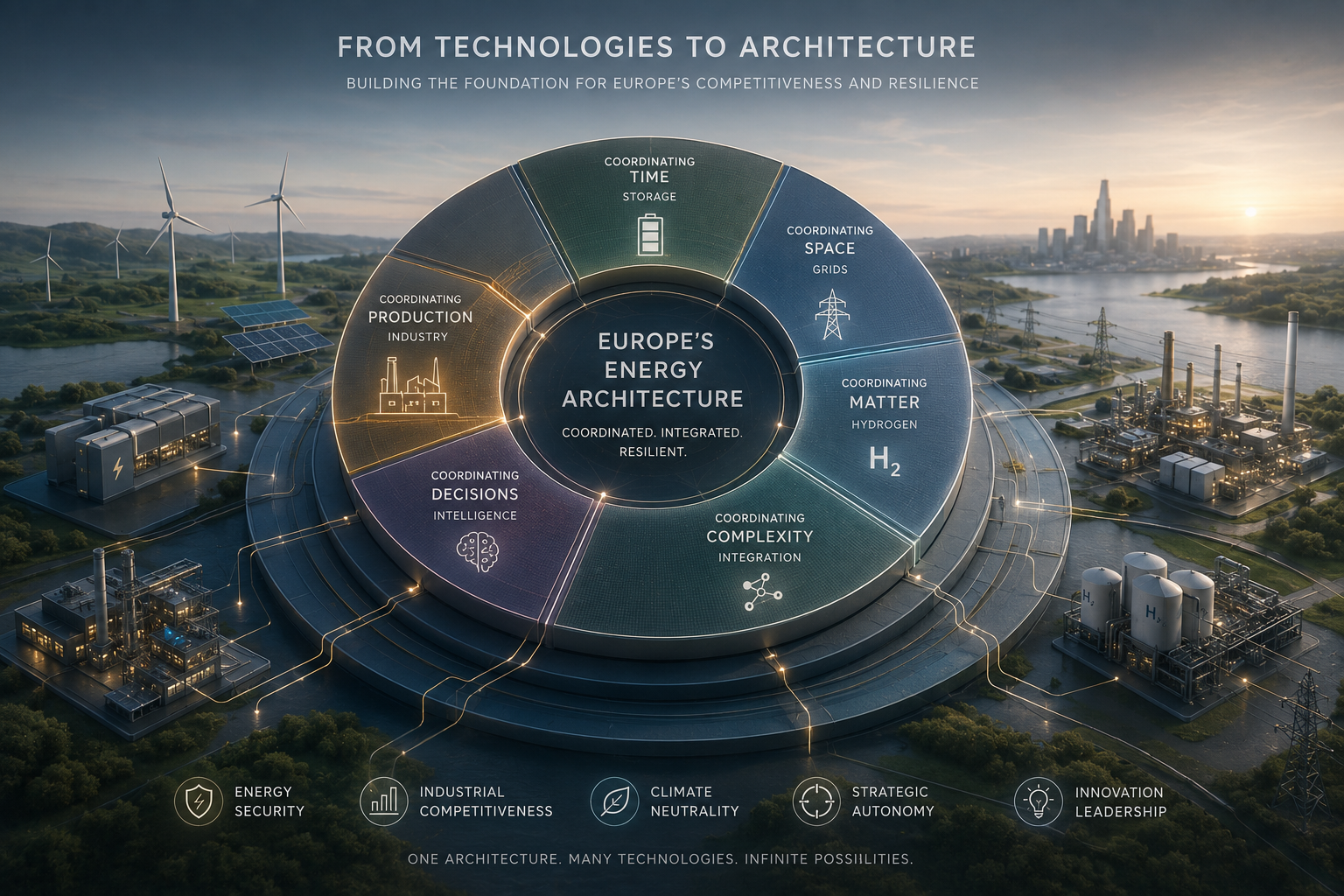
Throughout this series, a broader pattern has gradually emerged. Storage technologies coordinate time by preserving energy beyond the moment in which it is generated. Grid technologies coordinate space by moving electricity between regions, producers and consumers. Hydrogen coordinates matter by transforming electricity into molecules that can be stored, transported and used in industrial production.
Renewable integration coordinates complexity, bringing variable generation, flexible demand and distributed assets into one operational system. Digital energy systems coordinate decisions, while industrial transformation coordinates production by connecting energy, heat, materials and manufacturing.
Infrastructure is never defined by its individual components. It is defined by the relationships between them.
Each layer addresses a different constraint. Together, they reveal something larger. Europe is not building six separate technological industries. It is constructing one interconnected energy architecture.
■ THE NEW SYSTEM
The architecture emerging from Europe’s energy transition behaves differently from the system it replaces.
Electricity no longer moves exclusively from large power stations towards passive consumers. Households, factories, batteries and vehicles increasingly produce, store or redirect energy themselves. Energy no longer exists only as electricity, but also as heat, molecules, flexibility and data.
Factories are gradually becoming active components of the wider energy system. Consumers become producers. Materials re-enter production chains. Algorithms influence physical infrastructure, while decision-making increasingly takes place continuously and automatically.
None of these developments can be understood in isolation. A battery changes the behaviour of the grid. A digital platform changes the value of flexibility. Hydrogen production affects electricity demand. Industrial heat storage changes how factories interact with renewable generation.
The energy transition therefore resembles less a collection of technologies than an evolving ecosystem of interdependent capabilities.
■ THE ARCHITECT
Every architecture requires coordination, but coordination should not be confused with centralised control.
Europe does not need a single institution to direct every battery, factory, grid connection or hydrogen project. What it needs are coherent frameworks within which different actors can operate together: common standards, interoperable systems, predictable regulation, shared infrastructure and clear market signals.
The architect is therefore not necessarily one organisation. It is the collective capacity to design relationships between technologies, institutions and markets.
Innovation creates possibilities. Architecture creates civilisation.
This shifts the central question. The challenge is no longer only who builds batteries, manufactures electrolysers or develops artificial intelligence. It is whether Europe can create the interfaces, rules and institutions that allow these capabilities to strengthen one another.
Perhaps Europe’s greatest weakness is no longer innovation itself. Perhaps it is architectural capability.
■ WINDOWS INTO THE SYSTEM
Throughout this series, companies within Europe’s innovation ecosystem have served as windows into individual layers of this emerging architecture.
Skeleton and LeydenJar illustrated how storage technologies move energy through time. Heimdall Power and Smart Wires revealed how intelligence and active routing can expand the usable capacity of electricity networks. Sunfire, Hydrogenious and Elcogen showed how energy can move through matter, while Tibo Energy, Sympower and Gradyent demonstrated how distributed assets can be coordinated across increasingly complex systems.
Dexter Energy, Cybernetica, Kaluza, Metron and LiveEO exposed the decision layer behind modern energy infrastructure. EnergyNest, Carbios, Bcomp and Energy Dome showed how industrial capability itself must be redesigned.
Seen individually, these companies appear to represent separate technologies and markets. Seen together, they reveal the outlines of an emerging industrial ecosystem. Their significance lies not only in what each company builds, but in the structural capability each one represents.
■ THE EUROPEAN OPPORTUNITY
Europe is often described as too slow. Permitting procedures remain lengthy. Markets are fragmented. Capital does not always move towards industrial scale, while infrastructure planning frequently lags behind technological development.
These weaknesses are real. Yet architecture has never depended upon speed alone. It depends upon coherence.
Europe already possesses many of the scientific, technological and industrial capabilities required for the transition. The deeper question is whether these capabilities can be integrated into a coordinated system before others finance, scale and commercialise them more effectively.
That challenge reaches far beyond energy policy. It affects competitiveness, resilience, strategic autonomy and Europe’s ability to preserve advanced industrial production.
The decisive question is therefore not whether Europe can invent the necessary technologies. It is whether Europe can organise them.
■ FROM INFRASTRUCTURE TO CAPABILITY
The distinction between infrastructure and architecture is important. Infrastructure consists of assets: power lines, storage facilities, ports, electrolysers, factories and data centres. Architecture describes how those assets relate to one another, how information circulates between them and how institutions make coordination possible.
A continent may possess substantial infrastructure without possessing a coherent architecture. It may have batteries without flexible markets, hydrogen projects without corridors, renewable generation without grid capacity or industrial innovation without the capital required to scale it.
Europe’s future energy system will therefore depend not only on how much infrastructure it builds, but on whether that infrastructure becomes an integrated capability. This is where energy policy becomes industrial strategy. And where industrial strategy becomes institutional design.
■ CONCLUSION — BUILDING THE ARCHITECTURE
The twentieth century built energy infrastructure. The twenty-first century must learn to build energy architecture.
Across this series, the contours of that architecture have gradually become visible. Storage coordinates time. Grids coordinate space. Hydrogen coordinates matter. Renewable integration coordinates complexity. Digital systems coordinate decisions, while industrial transformation coordinates production.
Together, these layers reveal that Europe’s energy transition is no longer fundamentally about replacing one energy source with another. It is about redesigning the relationships between energy, information, materials, industry and institutions.
The future will therefore not belong automatically to the societies that possess the greatest number of technologies. It will belong to those capable of turning those technologies into a coherent system.
Europe increasingly possesses the building blocks. The remaining question is whether it can become their architect.
Building Europe’s Energy Architecture is an ongoing series within the Innovation & Technology Lab, exploring how Europe’s emerging energy technologies are evolving into an interconnected system of strategic capabilities.
From energy storage and hydrogen to smart grids, digital energy and industrial decarbonisation, each article examines one essential building block of Europe’s future energy architecture.
Building Europe's Energy Architecture

A continuing series within the Innovation & Technology Lab

✓ Part I — What Is Europe's Energy Architecture Becoming?

✓ Part II — Why Energy Storage Is Becoming Europe's Temporal Infrastructure

✓ Part III — Grid Technologies — Coordinating Space

✓ Part IV — Hydrogen Technologies — Coordinating Matter

✓ Part V — Renewable Energy Integration — Coordinating Complexity

✓ Part VI — Digital Energy Systems — Coordinating Decisions

✓ Part VII — Industrial Transformation — Coordinating Production

✓ Part VIII — Europe's Emerging Energy Architecture
Credit
Altair Media / OpenAI Image Generation
Caption
Europe’s emerging energy architecture is taking shape as interconnected layers of storage, grids, hydrogen, digital intelligence and industrial transformation converge into a single coordinated system. The future of European competitiveness will depend not simply on building these capabilities, but on integrating them into one coherent architecture.
