What Is Education Actually For?
Education, Talent and the Future Capacity of Society
Every summer, thousands of Dutch students receive their diplomas. Flags are raised outside homes, families celebrate achievements and a new generation prepares to enter vocational colleges, universities of applied sciences and research universities.
For many people, education is primarily understood as an individual journey. It opens doors, creates opportunities and provides access to professions, careers and social mobility. Diplomas are often seen as personal milestones that reflect talent, perseverance and ambition.
Yet education also serves another purpose. It determines what kinds of knowledge societies preserve, what capabilities they cultivate and how prepared they are for the challenges of the future. Education is not only about individual success. It is one of the mechanisms through which societies reproduce themselves across generations.
Beyond Individual Opportunity
Education is often framed as a question of personal advancement. Students pursue their interests, families encourage ambition and policymakers emphasise opportunity, accessibility and participation. These goals remain important. But they do not tell the whole story.
Education also concerns collective capacity. Who educates future teachers? Who trains engineers capable of designing semiconductor fabrication facilities, electricity networks or quantum technologies? Who develops the scientists, technicians, healthcare professionals and entrepreneurs required to sustain modern economies?
Education is not only a pathway to opportunity. It is a mechanism through which societies reproduce capability across generations.
Advanced societies increasingly depend upon highly specialised knowledge. Yet expertise does not emerge spontaneously. It is cultivated over decades through institutions designed to transfer knowledge, professional cultures and practical capabilities from one generation to the next.
Education therefore becomes more than a pathway towards employment. It becomes a long-term investment in societal capacity.
The Dutch Paradox
High-Tech Ambitions and Social Preferences
The Netherlands is among Europe’s most knowledge-intensive economies. It hosts globally competitive industries in semiconductors, agriculture, photonics, logistics, energy systems and advanced manufacturing.
Its economic ambitions continue to expand. Digitalisation requires software engineers. The energy transition requires technicians. Healthcare systems require additional professionals. Defence industries increasingly demand specialised expertise.
Societies do not simply decide what they want to become. They educate for it.
At the same time, shortages continue to grow. Schools struggle to recruit teachers. Technical industries face persistent labour constraints. Healthcare organisations compete for scarce personnel. And universities increasingly depend upon international talent to sustain educational quality and research capacity. This creates a structural paradox.
The Netherlands seeks to position itself at the technological frontier, yet the educational choices of young people do not always align with the capabilities such ambitions require.
Fields such as psychology, business studies and social sciences continue to absorb a large share of human capital, while engineering and the foundational sciences struggle to recruit—creating shortages precisely where future economic capacity is expected to emerge.
The challenge is therefore not whether students make rational choices. Most do. The challenge is whether the aggregate outcome of millions of individual decisions can continue to support the collective ambitions society has set for itself.
Education as Capacity Building
Education is often discussed as preparation for today’s labour market. In reality, education prepares societies for a future that does not yet exist. A child entering primary school today will likely remain economically active well into the 2080s.
Students beginning university this year may graduate into professions that have not yet fully emerged. This creates an inherent tension. Educational systems evolve slowly. Curricula change gradually. Institutional reform takes years. Technological change increasingly unfolds in months rather than decades.
Artificial intelligence, automation and digital platforms are transforming industries faster than educational institutions have historically needed to adapt. The capabilities societies cultivate today are therefore intended for the world of tomorrow, but are often shaped by assumptions inherited from yesterday.
Education is consequently not simply about transmitting knowledge. It is about maintaining the capacity to adapt. A country seeking technological sovereignty requires engineers. A country seeking social cohesion requires teachers, social workers and healthcare professionals. A country seeking economic resilience requires researchers, innovators and entrepreneurs.
The capabilities societies cultivate today are intended for the world of tomorrow, but are often shaped by the assumptions of yesterday.
Education ultimately determines whether societies possess the capabilities necessary to navigate uncertainty.
The Strategic Questions for Dutch Capacity
The Dutch education system will increasingly face questions that extend far beyond schools and universities. Can the Netherlands produce sufficient technical talent to sustain its high-tech ambitions? How should universities adapt when the half-life of knowledge continues to shrink under the influence of artificial intelligence?
Can educational institutions maintain international competitiveness while reducing their dependence on international students? Do examinations still measure the capabilities societies require in the twenty-first century? And can education continue to function as a mechanism for social mobility in an era of demographic change, technological disruption and growing inequality?
These are not merely educational questions. They are questions about the future capacity of society itself. Because education ultimately determines not only who we become as individuals, but also what kinds of institutions, industries and communities we remain capable of building together.
This article is part of The Dutch Education System, a Perspective series exploring education, talent and the future capacity of society.
Credit
Altair Media / AI-generated visualisation
Caption
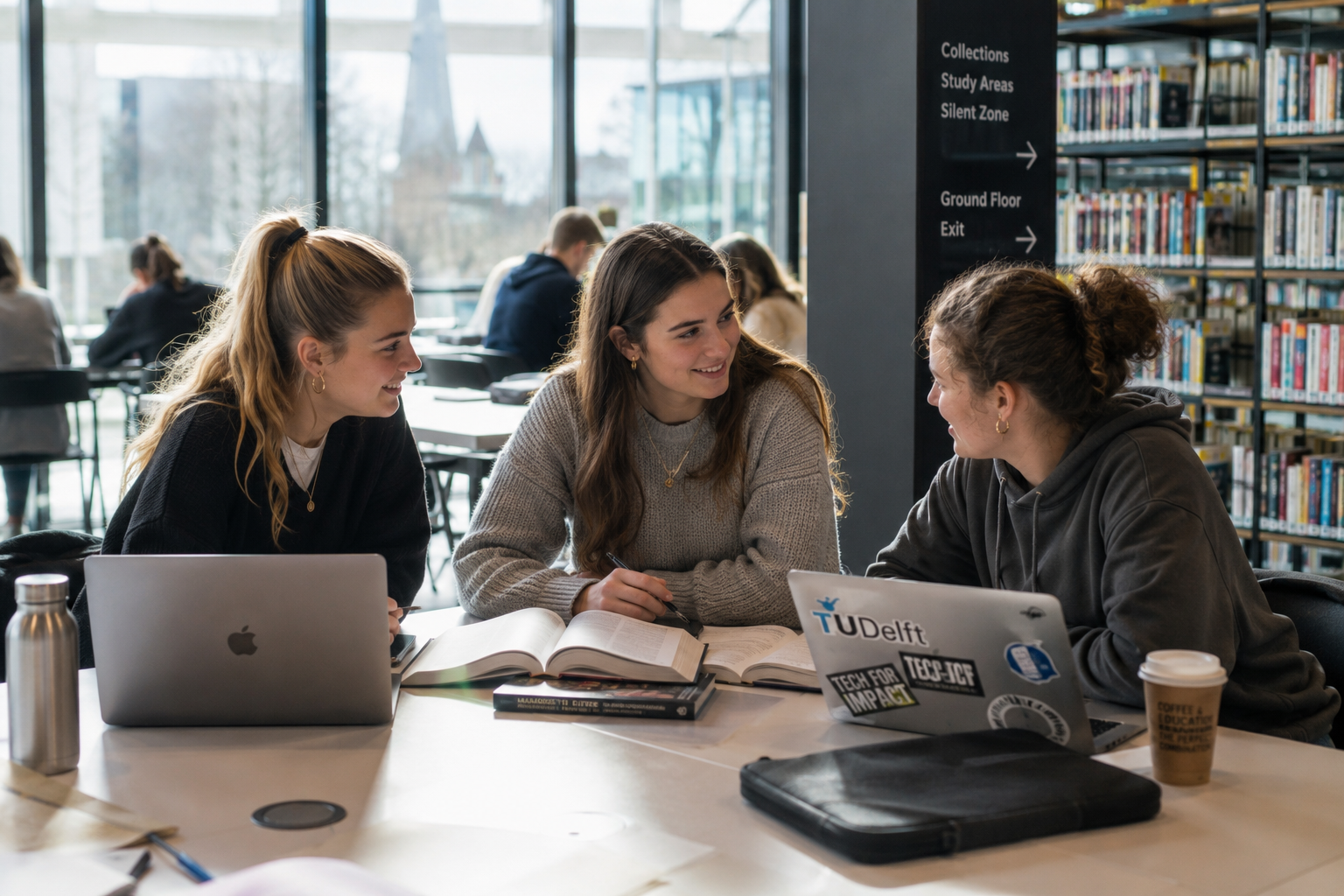
Three students collaborate in a contemporary academic environment, illustrating education not only as a personal journey, but as a long-term investment in the knowledge, talent and societal capacity of future generations.
