Turkey — Building Outside the European Model
The Autarkic Network at the Crossroads of Europe and Asia
Turkey occupies a unique position in Europe’s digital geography. Part European, part Middle Eastern and deeply connected to Asia, the country increasingly operates as both a bridge and a buffer between multiple infrastructure worlds. Yet unlike most European states, Turkey approaches digital infrastructure through a fundamentally different political philosophy.
Where much of Europe built digital systems around openness, regulation and market integration, Turkey increasingly approaches infrastructure through sovereignty, strategic coordination and national technological capacity.
That distinction shapes nearly every layer of the country’s infrastructure strategy.
Infrastructure as sovereign state capacity
Turkey’s infrastructure model is deeply tied to the state.
Over the past decade, Ankara increasingly treated telecommunications, cloud systems, defence technologies and AI infrastructure not simply as economic sectors, but as instruments of geopolitical resilience and sovereign power.
Unlike much of the European Union, Turkey does not primarily frame digital infrastructure through:
- liberal market integration;
- supranational coordination;
- regulatory harmonisation;
- open digital ecosystems.
Instead, Ankara increasingly prioritises:
- strategic autonomy;
- domestic industrial capability;
- sovereign communications systems;
- cybersecurity control;
- vertically integrated infrastructure.
This philosophy increasingly shapes Turkey’s ambitions across telecom, cloud infrastructure, AI systems, defence technologies and digital state platforms.
“Technological independence is becoming as important as military independence.”
Recep Tayyip Erdoğan, President of Turkey
One of the clearest examples is the rise of Turkcell as part of a broader sovereign infrastructure ecosystem increasingly linked to:
- national cloud services;
- cybersecurity;
- datacenters;
- digital identity systems;
- secure communications;
- state infrastructure coordination.
The appointment of Ali Taha Koç — formerly one of the Turkish government’s central digital transformation architects — as CEO of Turkcell symbolised this convergence between state infrastructure strategy and telecom governance itself.
Telecom increasingly functions not merely as a commercial sector, but as an extension of sovereign state capacity.
The integrated infrastructure stack
Turkey’s infrastructure ambitions extend far beyond telecom alone.
Over the past decade, Ankara aggressively expanded domestic technological capabilities through companies such as Baykar and a wider ecosystem of defence-industrial actors increasingly linked to AI systems, autonomous technologies and secure communications infrastructure.
This matters because Turkey increasingly treats infrastructure as a vertically integrated strategic stack.
Telecom networks, drones, satellite systems, cloud environments, AI-enabled defence platforms and cybersecurity architectures are not viewed as separate industries, but as interconnected components of national sovereignty itself.
The emergence of platforms such as Baykar’s Kızılelma unmanned combat aircraft increasingly reflects this broader philosophy: AI-enabled systems are becoming part of an integrated sovereign infrastructure architecture linking compute, autonomy, communications and defence.
In many ways, Turkey increasingly approaches strategic technology as a coordinated state ecosystem rather than a fragmented market environment.
That creates a sharp contrast with Europe’s often decentralised infrastructure landscape.
While many European countries remain heavily dependent on American hyperscalers, external AI ecosystems and fragmented telecom governance, Turkey increasingly attempts to build a more sovereign technological stack — even if doing so sometimes sacrifices openness or interoperability.
“Countries that cannot produce their own critical technologies risk losing strategic autonomy.”
Selçuk Bayraktar, Chairman and CTO of Baykar
This philosophy also shapes Turkey’s approach toward next-generation telecom infrastructure.
Unlike the European Union’s slower consensus-driven telecom environment, Turkey increasingly treats 5G deployment as part of a national sovereignty project closely linked to industrial coordination, infrastructure security and domestic technological capacity.
Between Europe and sovereign autonomy
Turkey’s geographic position gives this strategy additional significance.
The country sits at the intersection of:
- European fibre corridors;
- Middle Eastern connectivity routes;
- Black Sea infrastructure systems;
- Mediterranean subsea networks;
- Asian logistics corridors.
This increasingly positions Turkey as a strategic infrastructure bridge between regions whose geopolitical interests are often diverging.
At the same time, Ankara pursues a far more independent geopolitical course than most European states.
Turkey simultaneously cooperates with:
- NATO structures;
- Gulf investment systems;
- Asian infrastructure networks;
- European markets;
- regional defence ecosystems.
This multi-vector strategy also shapes its digital infrastructure philosophy.
Unlike the European Union — where digital governance often emerges through institutional negotiation and regulatory coordination — Turkey increasingly centralises strategic technological decisions within the state itself.
That creates both strengths and risks.
Turkey can move rapidly in areas such as:
- defence-industrial coordination;
- sovereign telecom systems;
- AI-enabled infrastructure;
- cybersecurity integration;
- strategic infrastructure investment.
But this model also raises concerns surrounding:
- democratic oversight;
- political centralisation;
- digital freedoms;
- state influence over communications infrastructure.
Outside the European model
Turkey ultimately represents more than a neighbouring infrastructure power. It represents an alternative model for how states may organise digital sovereignty in an era increasingly shaped by geopolitical fragmentation and technological competition.
Where much of Europe still struggles to balance openness with strategic autonomy, Turkey increasingly prioritises sovereign coordination first — even at the cost of deeper integration with Western digital ecosystems.
That does not make Turkey technologically independent.
The country still depends on global semiconductor supply chains, external technologies and international capital flows in critical areas.
Yet Turkey increasingly seeks leverage through state coordination, infrastructural integration and sovereign technological capacity rather than through European-style market integration alone.
And in Europe’s next network era, that may make Turkey one of the continent’s most important external mirrors.
Because Turkey forces Europe to confront a difficult strategic question about its own future:
Can open societies maintain technological sovereignty in a world increasingly organised around integrated infrastructure power?
This article is part of FASE III — NATIONAL ARCHITECTURES, a series exploring how European countries approach infrastructure, sovereignty and digital power in the next network era.
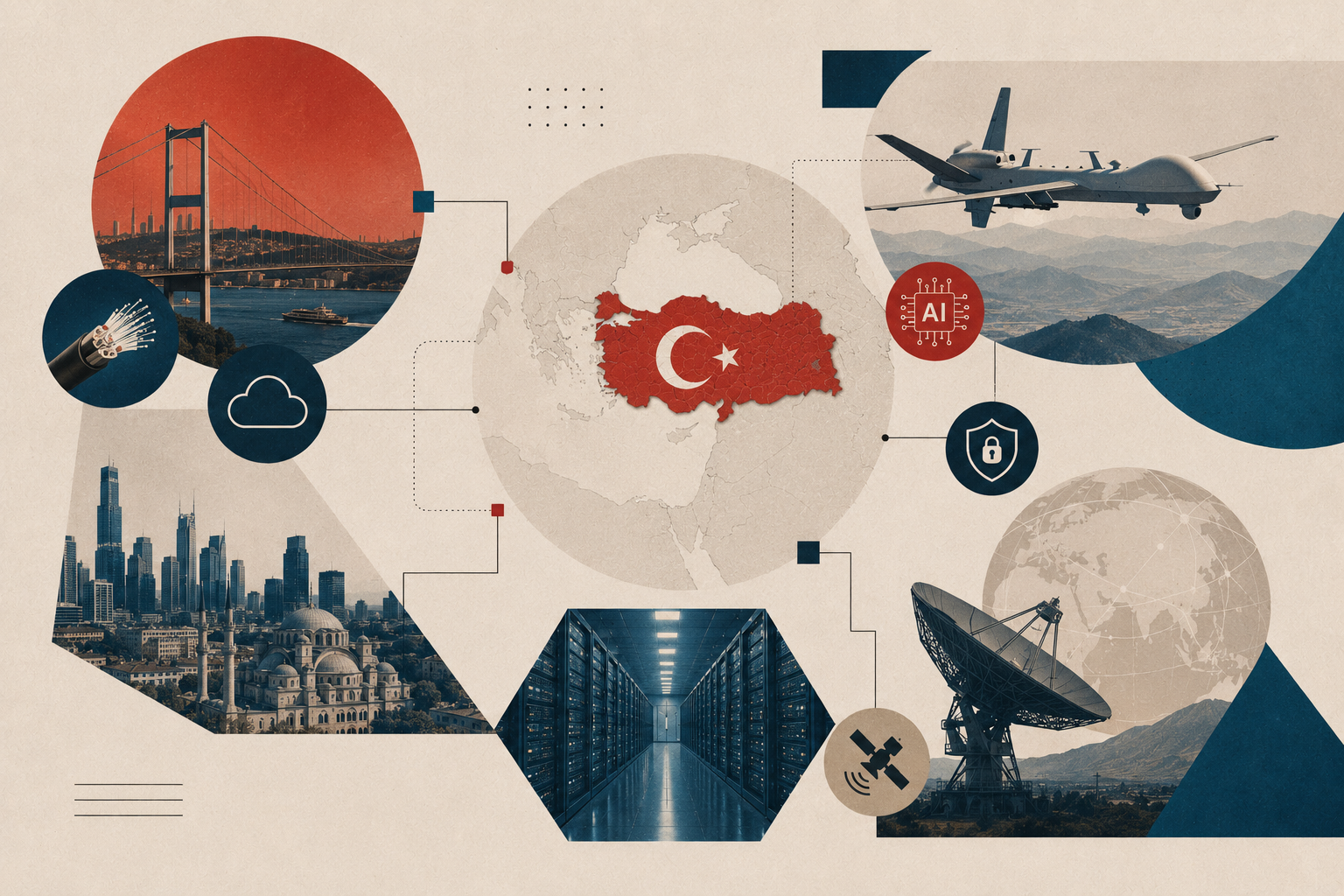
Illustration: Minimalist editorial illustration of Turkey’s sovereign infrastructure strategy, combining telecom systems, AI, defence technology, cloud infrastructure and transcontinental connectivity through geometric forms and interconnected visual architecture.
Caption: Turkey increasingly approaches digital infrastructure as an integrated system of sovereign state power — linking telecom, AI, cybersecurity and defence technologies across the crossroads of Europe and Asia.
