The Technical Talent Paradox
Why the Netherlands Needs More Engineers Than It Produces
The Netherlands is expanding its ambitions in semiconductors, integrated photonics, artificial intelligence, energy infrastructure, defence and advanced manufacturing. Yet almost every one of these ambitions depends upon the same scarce foundation: people with the technical knowledge required to design, build, operate and maintain increasingly complex systems.
That foundation is not expanding quickly enough.
The Netherlands does not lack technological ambition, innovative companies or promising research. It faces a growing mismatch between the economic future it wants to build and the number of engineers, technicians and scientific specialists its education system produces.
🟦 Why Has Technical Talent Become Strategic?
The Netherlands has long been shaped by engineering. Water management, land reclamation, infrastructure and industrial development required generations of people capable of turning complex physical problems into functioning systems. Companies such as Philips, ASML, NXP and ASM emerged from this wider technical culture, supported by universities, vocational institutions, research laboratories and specialised suppliers.
Today, technical expertise has become even more important. Engineers are needed not only in traditional industry, but across nearly every strategic transition facing the country. Electricity grids must be expanded, semiconductor capacity strengthened, defence systems modernised and energy-intensive industries redesigned. Digital systems, telecommunications networks and artificial intelligence also depend upon physical infrastructure that must be engineered, manufactured and maintained.
Technical talent is therefore no longer merely a labour-market category. It has become part of the Netherlands’ economic resilience and strategic capacity.
Yet the incentives surrounding technical education do not always reflect this importance. Engineering programmes are demanding, mathematics can become an early barrier and many technical professions remain less visible to young people than careers in law, business, healthcare or the social sciences. In some parts of the economy, highly capable students may also see clearer routes to status, income or influence through consultancy, finance and management than through research or engineering.
The country celebrates technology, but the social and educational signals surrounding technical careers remain far less consistent.
🟦 Why Does Demand Grow Faster Than Supply?
The demand for technical talent is being driven by several transformations at once. The energy transition requires electrical engineers, installers and grid specialists. The semiconductor sector needs physicists, software developers, process engineers and specialised technicians. Construction, mobility, water management and defence all compete for overlapping groups of technically skilled people.
The education pipeline, however, cannot adjust at the same speed.
Studying engineering requires earlier choices in mathematics and science. These choices may already narrow during secondary education, long before students fully understand the industries or professions they are choosing for or against. By the time shortages become visible in the labour market, changing enrolment patterns can take years.
This creates a structural delay. Economic demand can rise rapidly because of a new technology, industrial investment or political priority, while the supply of qualified people remains shaped by decisions made much earlier in schools, families and educational institutions.
The paradox is therefore not simply that too few students choose engineering. It is that a fast-changing economy depends upon a slow-moving talent pipeline.
🟦 Can Industrial Capacity Grow Faster Than Human Capacity?
Governments can announce new funds. Companies can expand factories and laboratories. Regions can invest in campuses, housing and infrastructure. Physical capacity can sometimes be increased within a few years.
Human capacity takes longer.
Training an experienced engineer in semiconductors, photonics or energy systems may require a decade of secondary education, university study and professional development. Even technical occupations requiring shorter formal pathways depend upon qualified teachers, suitable facilities, apprenticeships and employers willing to invest in practical training.
This difference in time scales is becoming one of the most important constraints on Dutch industrial policy. A semiconductor facility can be planned before the people required to operate it have been educated. An electricity grid can receive additional investment while the technicians needed to complete the work remain scarce. New strategic priorities can be declared far more quickly than expertise can be created.
Talent cannot be produced on demand. That makes education part of the physical reality of industrial transformation. The limits of future growth may be determined not only by capital, technology or regulation, but by choices made years earlier in classrooms and lecture halls.
🟦 Can the Netherlands Close the Gap Without International Talent?
When domestic education does not produce enough specialists, international recruitment becomes an essential part of the talent system. Dutch universities, research institutes and high-tech companies already depend upon students, researchers and professionals from outside the Netherlands. This creates a politically sensitive dilemma.
The Netherlands wants greater control over migration, more Dutch-language education and less pressure on housing and public services. At the same time, sectors central to the country’s economic future rely heavily on international knowledge and expertise. Universities need international researchers to maintain specialised fields, while companies need access to labour markets extending far beyond national borders.
Both concerns are legitimate. Internationalisation creates real pressures, but restricting international talent without substantially increasing domestic technical education would deepen the existing shortage.
The issue is therefore not whether the Netherlands should educate its own talent or attract people from abroad. A high-tech economy will need to do both. The strategic question is whether education, migration, housing and industrial policy are being treated as parts of the same capacity problem.
At present, they are still too often discussed separately.
🟦 What Does the Netherlands Actually Want Its Talent System to Produce?
Students should not be treated as inputs to an industrial plan. They make choices based on interests, abilities, identity and the futures they imagine for themselves. A free society cannot simply allocate young people to the professions with the largest shortages.
Yet millions of reasonable individual choices can still produce a collective outcome that does not match society’s long-term needs.
That is the deeper technical talent paradox. The Netherlands needs more engineers and technicians, but technical education competes with other attractive pathways for a limited pool of students. Employers ask for scarce specialists, while schools struggle to recruit the teachers needed to inspire the next generation. Political leaders call for technological sovereignty, while educational and migration policies can make the required talent harder to find.
Solving this mismatch will require more than promotional campaigns encouraging young people to choose technology. It requires stronger technical education from an early age, greater visibility for technical professions, better movement between vocational and academic pathways, sustained investment in teachers and laboratories, and a more coherent approach to international talent.
Most importantly, it requires recognising that education policy is also industrial policy.
🟦 Signify
The Netherlands does not face a shortage of technological ambition. It faces a widening gap between the systems it wants to build and the technical capacity available to build them.
Capital can be allocated, laboratories can be financed and industrial strategies can be announced. But engineers, technicians and scientific specialists require years to educate and develop.
The technical talent paradox is therefore not simply a labour shortage. It is a structural mismatch between national ambition and the way talent is cultivated, valued and distributed.
A country cannot secure a high-tech future unless its education system, migration policy and industrial strategy begin preparing for that future together.
Series Reference
Part of The Dutch Education System, a series exploring education, talent and the future capacity of society.
Credit
Altair Media / AI-generated visualisation
Caption
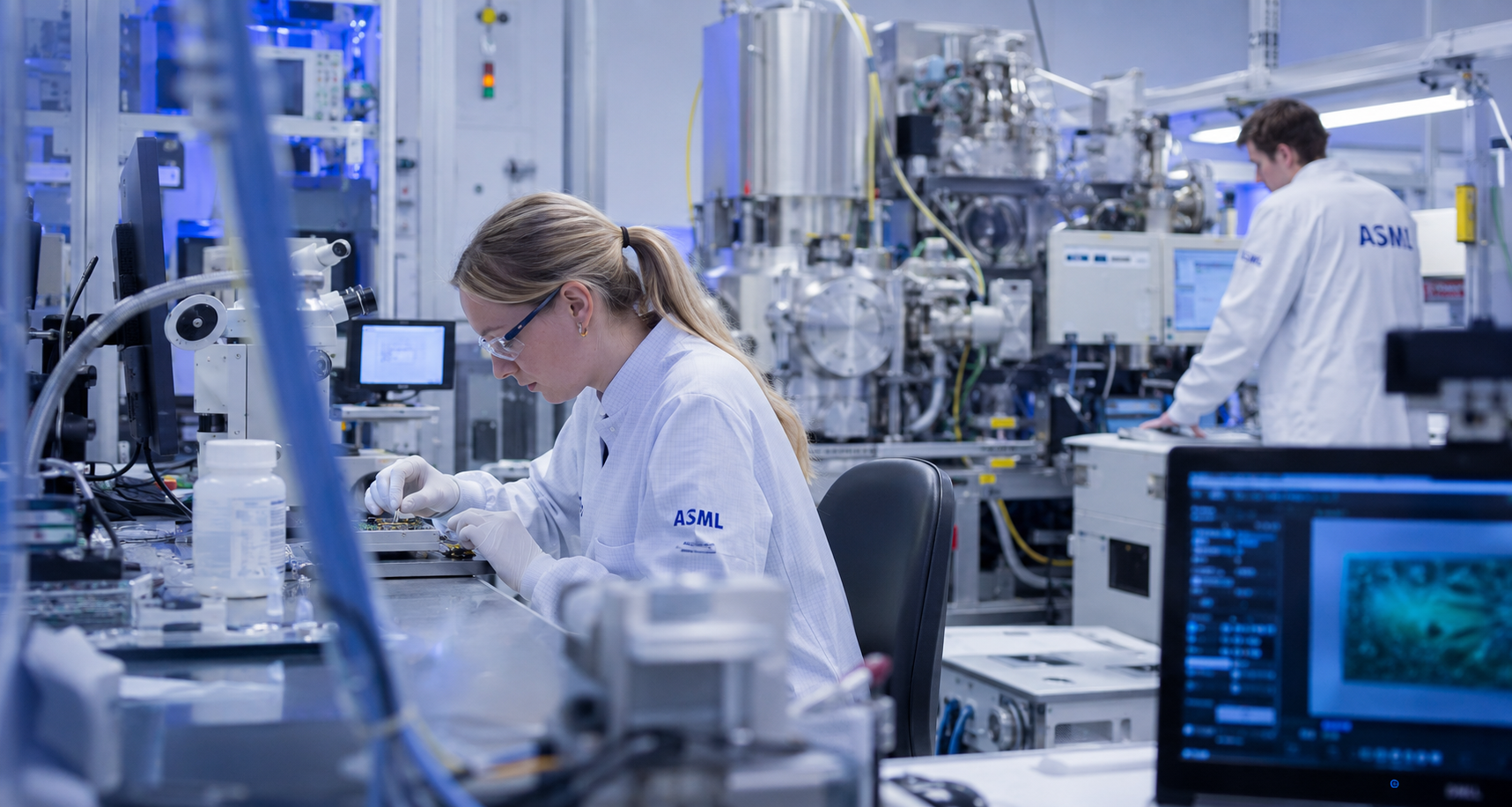
Behind every semiconductor, electricity grid, photonic chip and AI system stands a generation of engineers. The Netherlands’ technological ambitions will ultimately depend not only on innovation, but on its ability to educate the people who build it.
