Denmark and the Power of Adaptability
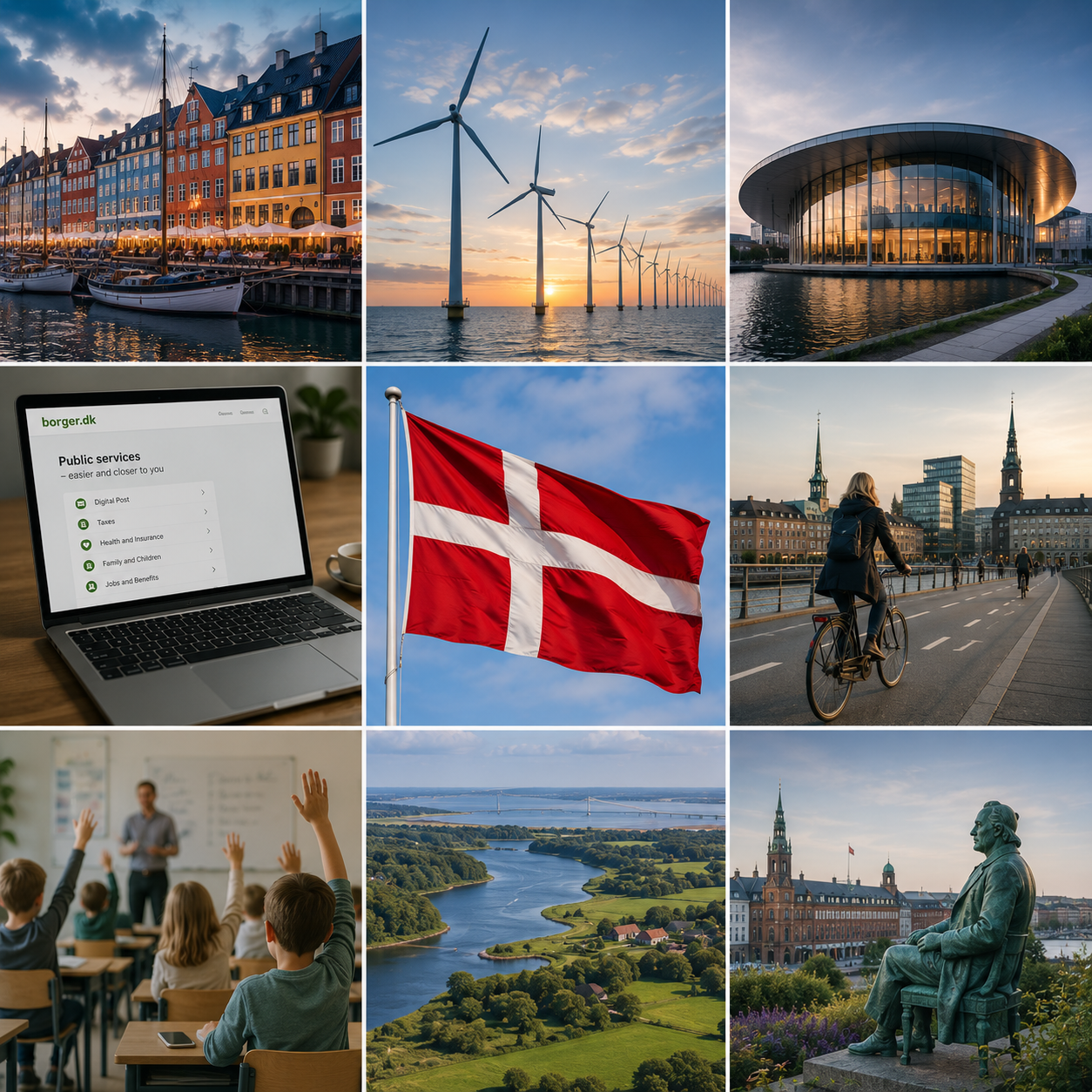
Can Flexibility Create Resilience in an Age of Uncertainty?
Denmark is not a large country. Nor does it seek influence through military power or vast domestic markets. Its strength lies elsewhere.
For decades, Denmark has built a reputation as one of the world’s most adaptable societies. From labour markets and digital government to renewable energy and public administration, the country has repeatedly demonstrated an ability to adjust to changing circumstances without abandoning social cohesion.
In an age defined by technological disruption, geopolitical uncertainty and demographic change, this capacity for adaptation may be one of Denmark’s most important strategic assets.
The Danish story is therefore not primarily about size. It is about flexibility.
Flexicurity and the Danish Labour Market
At the centre of Denmark’s economic model lies a concept that has attracted international attention for decades: flexicurity. The idea is relatively simple.
Employers can hire and dismiss workers more easily than in many European countries. At the same time, workers benefit from strong social protections, unemployment support and extensive opportunities for retraining and lifelong learning.
The result is a labour market designed not to prevent change, but to help people navigate it.
Denmark’s model is not about protecting people from change. It is about equipping people to thrive in it.
This approach has helped Denmark maintain high employment rates, strong labour participation and relatively low levels of long-term unemployment. Rather than viewing flexibility and security as opposites, Denmark attempts to combine both.
The Danish approach reflects a broader philosophy. Rather than treating social protection and economic competitiveness as competing objectives, Denmark has often sought to combine them.
Education, retraining, childcare, healthcare and active labour market policies are not viewed solely as social expenditures. They are also investments in a society’s ability to adapt.
In this sense, the welfare state functions not only as a safety net, but also as an infrastructure for resilience.
Leading the Green Transition
Denmark’s adaptability is also visible in energy policy. Long before renewable energy became a global priority, Denmark began investing heavily in wind power and energy innovation. What started as a response to energy vulnerabilities evolved into one of the country’s most important strategic industries.
Today, Danish companies such as Ørsted and Vestas are recognised internationally for their role in offshore wind energy and renewable infrastructure. The green transition is not simply an environmental ambition. It is also an industrial strategy.
Denmark recognised early that future competitiveness would increasingly depend upon sustainable technologies and energy systems.
Digital by Design
Denmark is consistently ranked among the world’s most digitally advanced societies. Citizens interact with public services through integrated digital platforms. Businesses benefit from efficient administration and digital infrastructure. Government agencies increasingly use technology to improve service delivery and reduce bureaucracy.
What distinguishes the Danish approach is not technology alone. It is trust. Digital governance functions effectively because citizens generally trust institutions to manage data responsibly and transparently.
Technology can improve efficiency. Trust determines whether societies are willing to embrace it.
In many respects, Denmark demonstrates how digital transformation depends as much upon social capital as technological capability.
Pragmatic Governance
Another defining characteristic of Denmark is its pragmatic political culture. Political disagreements certainly exist. Yet Danish policymaking often places a strong emphasis on consensus-building, evidence and long-term problem solving.
Major reforms frequently emerge through cooperation between government, employers, trade unions and civil society organisations. This does not eliminate conflict. It does, however, create institutions capable of adapting over time. This emphasis on adaptation extends beyond economic policy.
Early intervention, lifelong learning and preventive social programmes reflect a broader belief that societies function best when challenges are addressed before they become crises.
The objective is not simply to respond to disruption, but to increase society’s capacity to absorb and adapt to change over time. In a rapidly changing world, the ability to adjust policies may become just as important as the policies themselves.
Prosperity and Pressure
Denmark’s model is not without challenges. Like many advanced societies, the country faces demographic pressures associated with ageing populations. Labour shortages are emerging in several sectors. Global competition continues to intensify, while geopolitical tensions create new uncertainties.
At the same time, maintaining a high-trust society requires constant renewal. Economic change, technological disruption and demographic shifts place new demands on institutions that have historically underpinned social cohesion.
The challenge is therefore not whether Denmark can adapt. The challenge is whether it can continue adapting while preserving the trust upon which its model depends. Maintaining flexibility without increasing insecurity will remain a delicate balancing act.
Denmark’s resilience may ultimately depend less on any individual policy than on the capacity of its institutions to learn, adapt and reform.
Looking Ahead
Denmark’s greatest strength may not be any individual policy. It may be the existence of institutions capable of learning, adjusting and evolving. As technological change accelerates and economic conditions become less predictable, adaptability itself may become a strategic resource.
The Danish experience suggests that resilience is not necessarily achieved by resisting change. It may instead emerge from developing the capacity to respond to it.
“Denmark’s future will not be defined by its size, but by its ability to adapt—and to help others adapt with it.”
The central question facing Denmark therefore remains:
Can flexibility create resilience in an age of uncertainty?
For much of the past half-century, Denmark’s answer has been yes.
Series — Economic Europe: Northern Europe
This article is part of Economic Europe, a United Europe series exploring the economic architectures that shape modern Europe. The Northern Europe chapter examines how Denmark, Sweden, Norway, Finland and Iceland have built distinctive models of resilience through trust, innovation, institutional capacity and long-term adaptation.
Credit
Illustration generated by OpenAI’s DALL·E for Altair Media Europe
Caption
Denmark’s strength lies not in its size, but in its ability to adapt. Combining labour market flexibility, social trust, digital governance and renewable energy leadership, the country has built institutions designed to navigate change while preserving social cohesion.
