Who Is Actually Investing?
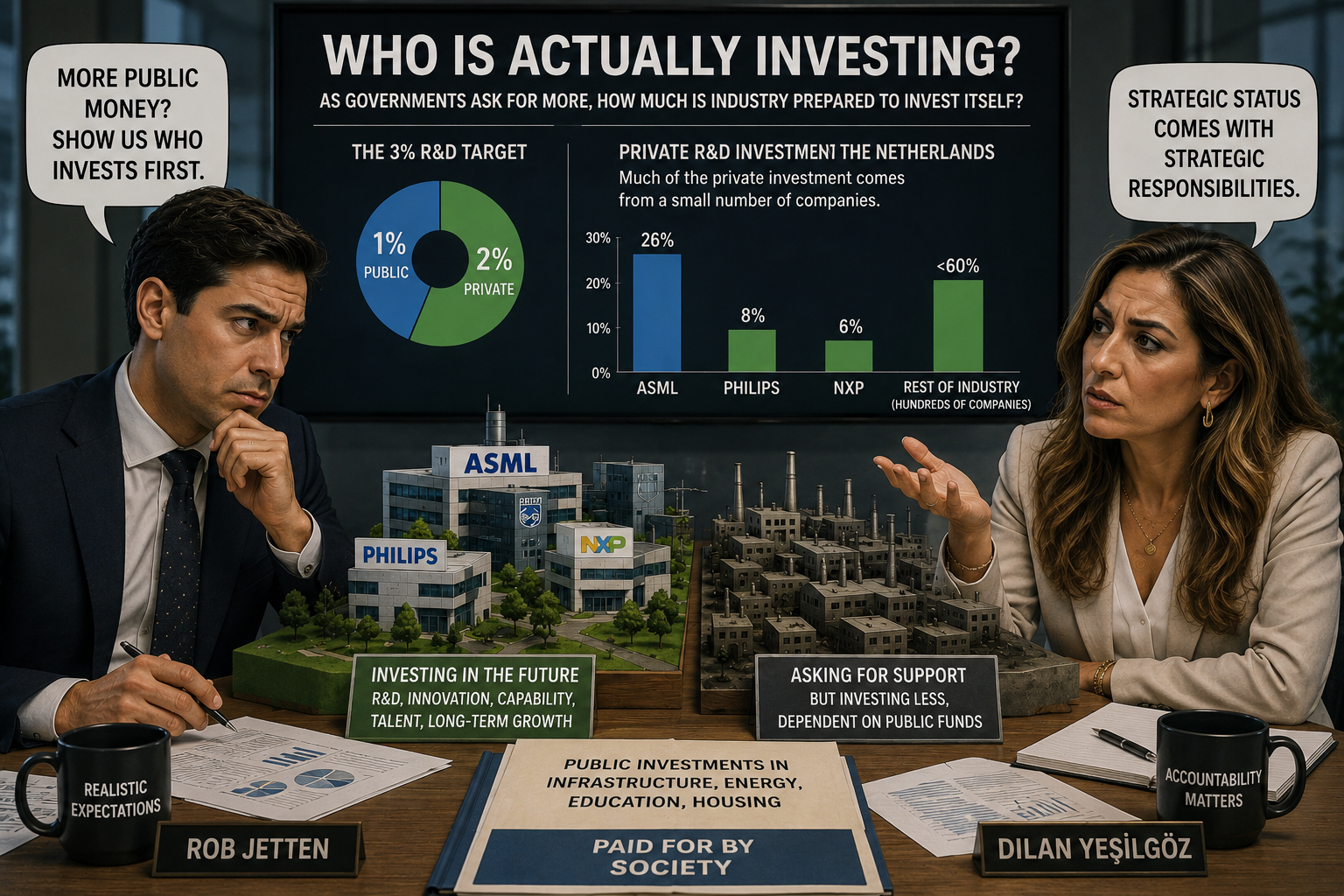
As governments are increasingly asked to fund competitiveness, a simple question remains. How much is industry prepared to invest itself?
Dutch industry leaders have argued that an additional €500 million in public investment is insufficient to safeguard the country’s future prosperity. Their concerns are understandable.
The United States is investing heavily in semiconductors, artificial intelligence and advanced manufacturing. China continues to direct enormous resources toward strategic industries. Across Europe, governments are searching for ways to strengthen technological sovereignty, industrial resilience and economic security.
There is little disagreement that innovation, industrial capability and competitiveness require substantial investment. The more interesting question is something else.
Who is actually expected to make those investments?
Listening to contemporary policy debates, one could easily conclude that competitiveness is primarily a government responsibility. The original logic of industrial policy suggests otherwise.
The Forgotten Half of the 3 Percent Debate
For decades, European policymakers have promoted a simple target. Three percent of GDP should be invested in research and development. The figure is frequently cited in discussions about competitiveness, innovation and economic growth.
What is mentioned less often is how the target was originally structured. The assumption was never that governments would provide all the funding. Quite the opposite. Roughly one-third was expected to come from public sources. The remaining two-thirds would come from private industry.
The logic was straightforward. Governments create the conditions. Industry provides most of the investment. Yet contemporary debates increasingly create a different impression.
• Funding gaps become government problems.
• Infrastructure becomes a government problem.
• Housing becomes a government problem.
• Education becomes a government problem.
• Energy networks become a government problem.
• Industrial competitiveness increasingly becomes a government problem.
At some point a reasonable question emerges. How much investment is industry itself prepared to provide? The original promise of industrial policy was partnership, not substitution.
ASML Is Not the Problem
Any serious discussion must begin with an important distinction. ASML is not a company that avoids investment. The opposite is true. The company invests billions of euros annually in research and development and remains one of Europe’s most important technology investors.
Nor is ASML alone. Companies such as Philips and NXP have invested heavily in research, development and technological capability for decades. Together, these firms demonstrate that long-term innovation requires sustained private commitment as well as public support. This matters because ASML is frequently used as a symbol for the broader industrial sector. Yet the broader industrial sector is not ASML.
The question is therefore not whether ASML invests. The question is whether industry as a whole invests with the same long-term commitment and ambition.
If some of the country’s most successful companies are already investing heavily in future capability, why should lower levels of investment elsewhere automatically become a public responsibility?
The Anonymous Industry
One of the most striking features of contemporary economic debates is the frequent use of a single phrase.
“The industry”
The term appears constantly in policy discussions. Industry demands. Industry warns. Industry requests. Industry advises. Yet industry is not a single actor. Under this label sit technology companies, manufacturers, logistics firms, suppliers, energy-intensive industries and countless other organisations with very different business models and investment patterns.
One of the paradoxes of the Dutch innovation debate is that a relatively small number of companies account for a disproportionate share of private research and development spending.
ASML alone represents a significant share of all private R&D investment in the Netherlands. Together with companies such as Philips, NXP and the broader Brainport ecosystem, they contribute substantially to the country’s innovation performance. This raises an uncomfortable possibility.
When policymakers speak about “industry”, are they describing a broad culture of private investment? Or are they describing a small number of exceptional companies whose investment efforts mask a much wider pattern of underinvestment elsewhere?
Some companies invest heavily in future capabilities. Others invest far less. Some create new technologies. Others primarily operate within existing markets. Some take significant technological risks. Others seek protection from competitive pressures.
When policymakers speak about industry, who is actually investing?
Treating all of them as a single strategic constituency risks obscuring important differences. Not every company asking for strategic support is making strategic investments.
Public Money and Private Capital
Project Beethoven illustrates the complexity of the discussion. Billions of euros in public resources have been committed to housing, infrastructure, education and regional development. The rationale is clear. A strong technology ecosystem benefits the wider economy.
Yet these investments also raise important questions. What level of private commitment should accompany public support? What obligations should exist when companies benefit from publicly funded ecosystems? Should firms that request additional public investment demonstrate specific levels of private investment? Should public support be linked to long-term commitments regarding research, education or domestic capability?
These are not anti-business questions. They are questions about alignment. If governments and industry are genuinely partners, both sides should be expected to contribute.
The Dividend Question
The debate becomes even more complicated when considering the allocation of corporate capital. Successful companies have choices. They can invest in research. They can invest in production capacity. They can invest in talent development. They can return capital to shareholders through dividends and share buybacks. None of these choices are inherently wrong. But they do reveal priorities.
When governments are asked to invest billions in competitiveness, questions about corporate capital allocation become unavoidable. How much capital is being committed to future capability? How much is being distributed? How much risk is being carried privately? How much is being transferred to society? These questions deserve the same attention as discussions about public spending.
What Does Commitment Look Like?
The word commitment appears frequently in discussions about strategic industry. Companies are committed to innovation. Committed to the Netherlands. Committed to competitiveness. Committed to growth. But commitment is ultimately measured through actions.
Research investment. Long-term planning. Capability development. Workforce training. Infrastructure investment. Knowledge creation. These are measurable forms of commitment. They demonstrate whether strategic ambition is matched by strategic investment.
Who Is Actually Investing?
The debate about competitiveness often begins with demands for more public investment. Perhaps that investment is necessary. Perhaps much of it is. But before discussing how much more governments should spend, another question deserves attention.
How much is industry prepared to invest itself?
The original logic of industrial policy was never that governments would replace private capital. It was that public and private actors would invest together. That principle remains as important today as ever. Because competitiveness is not created by governments alone. And it is not created by industry alone.
It emerges when both are willing to share the costs, the risks and the responsibilities of building the future.
If public investment is expected to grow, private commitment should grow with it.
Credit
Illustration: OpenAI / Altair Media
Caption
ASML, Philips and NXP have built their positions through decades of sustained investment in research, engineering and innovation. Yet calls for additional public funding are increasingly made in the name of “industry” as a whole. The illustration highlights a growing policy dilemma: if a relatively small number of companies account for a disproportionate share of private innovation investment, should governments continue to assume that competitiveness is primarily a public responsibility? Or is it time to ask who is actually investing?
