Friday, September 11, 2026

Europe’s deep-tech challenge is no longer only about creating start-ups. It is increasingly about building a financial flywheel in which public capital de-risks early growth, private investors follow, and successful scale-ups generate the returns needed to finance the next generation.
Read More
Thursday, June 25, 2026
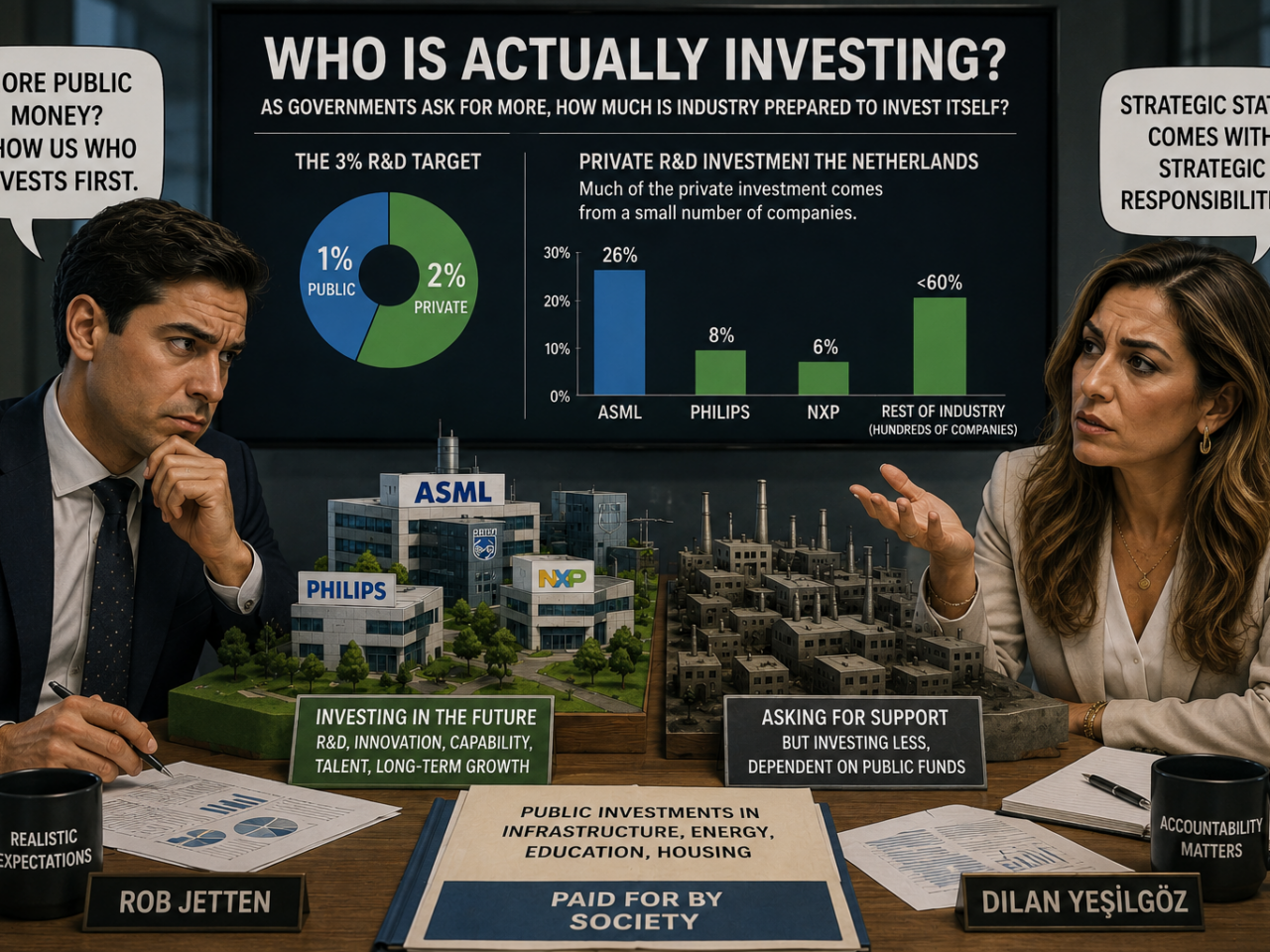
As governments are increasingly asked to fund competitiveness, a simple question remains. How much is industry prepared to invest itself? While companies such as ASML, Philips and NXP invest heavily in research and development, the broader picture may be more complicated than political debates often suggest.
Read More
Tuesday, June 23, 2026

As Dutch industry argues that another €500 million in public investment is not enough, a broader question emerges. When governments invest billions to support strategic industries, what should society expect in return?
Read More
Tuesday, April 7, 2026

Europe is building a new generation of deep tech — but risks losing control at the moment of scale. As global capital steps in, the question shifts from innovation to ownership: who will finance, and ultimately shape, Europe’s technological future?
Read More
Wednesday, February 11, 2026

In the corridors of power, venture capital has become a shorthand for “the future”. VC data is clean, quantitative and internationally comparable. It arrives in dashboards and league tables, translating uncertainty into upward curves. When the charts point up and to the right, a collective sigh of relief follows: innovation is happening.
Read More
Saturday, January 3, 2026

Europe stands at a crossroads. AI, digital infrastructure, chip sovereignty and the shifting alliances of geopolitics are no longer distant considerations—they shape economies, influence global power and redefine opportunity. Yet political discourse often struggles to match the pace of change. Headlines react, rhetoric reassures, but strategic clarity is elusive.
Read More
Saturday, November 29, 2025

Quantum computing is not just the next step in computing: it is a fundamentally different paradigm. Unlike traditional computers, which use bits that are either 0 or 1, a quantum computer uses quantum bits — qubits. These qubits can exist in superposition (both 0 and 1 simultaneously) and can become entangled with one another, meaning their states become deeply linked even when separated.
Read More

 Available here: