From Paideia to Prompt — What Education Is Still For

In the shadow of the marble columns of Plato’s Academy, an ideal was born: paideia. Education was not a credential but the shaping of a human being capable of participating in the polis — intellectually, morally and politically. Its purpose was not merely knowledge, but judgment.
Twenty-four centuries later, that same formation unfolds behind glowing screens. An algorithm can explain calculus, structure an essay and construct a legal argument in seconds. Yet while our tools have adopted the speed of light, the foundations of the institution housing them are beginning to crack. We possess the technology of the future, the pedagogy of the twentieth century and a public trust still rooted in the certainties of the industrial age.
We therefore inhabit a peculiar historical vacuum: education still functions, but its legitimacy has become increasingly unclear. Diplomas persist, yet what they actually signify is harder than ever to define.
“The purpose of education is not to validate what we already know, but to challenge the very foundations of our certainty. In an age of algorithmic answers, the human contribution is the quality of the question.”
— Minouche Shafik, former President of Columbia University & former Deputy Governor, Bank of England
When algorithms supply answers, the value shifts from possessing knowledge to exercising judgment. Yet judgment — weighing evidence, interpreting context, correcting errors — is precisely what cannot easily be standardized, tested or certified. It is therefore no coincidence that modern education is least equipped to cultivate it.
Read MoreFrom Masts to Orbits: The New Architecture of Presence
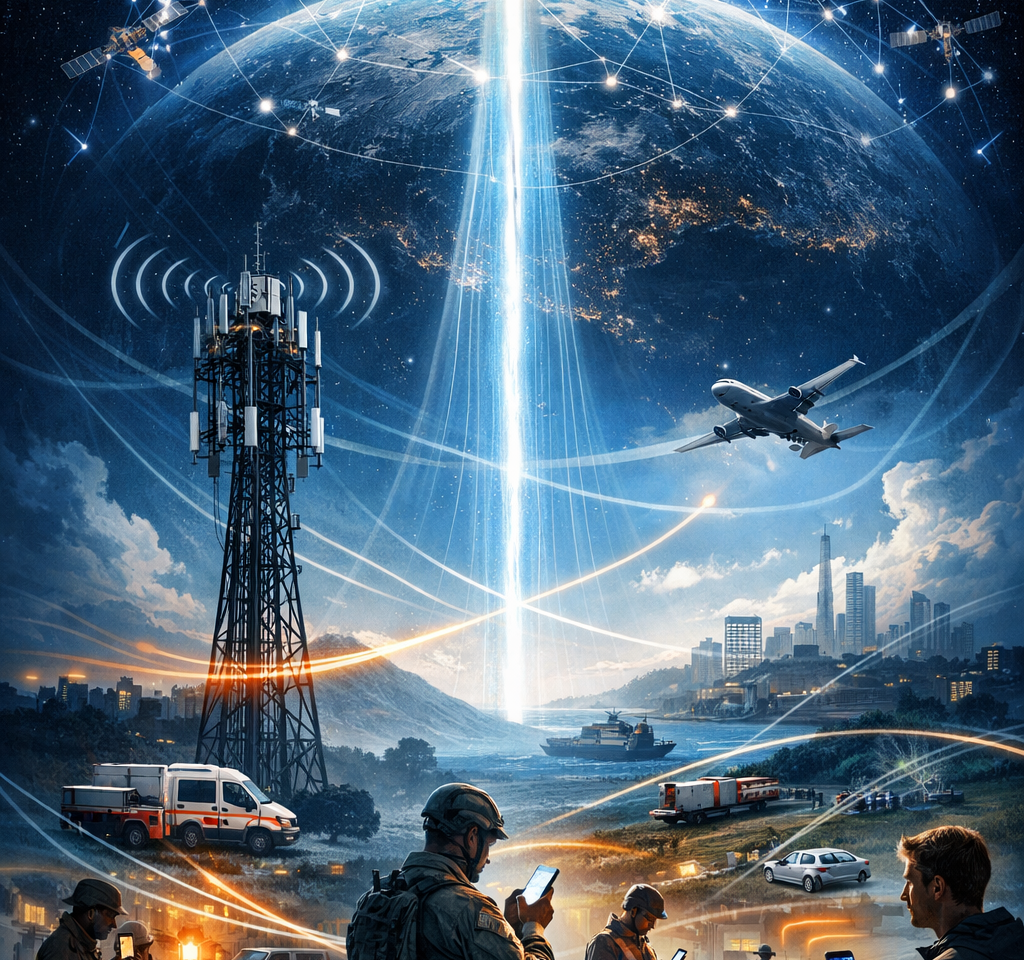
How satellite-to-smartphone connectivity is transforming telecom into a layer of national resilience
For more than a century, communication networks have been shaped by geography. Copper followed roads, fibre followed railways and mobile signals radiated outward from towers anchored to the ground. Connectivity meant coverage — a footprint on a map defined by infrastructure density and terrain. If you left the footprint, you left the network.
That logic is now dissolving. With regulators approving direct satellite-to-smartphone services, connectivity is no longer tied exclusively to terrestrial assets. A device in a remote valley, at sea or high in the mountains can remain connected without a single nearby base station. The network, in effect, no longer ends at the horizon.
“With satellite technology, people will in future be able to send selfies from Scafell Pike, livestream from Lake Windermere or hunt for bargains from Ben Nevis. This will connect remote and rural areas better than ever before, unlocking opportunities for communities, businesses and economic growth.”
David Willis, Group Director for Spectrum, Ofcom
At first glance, such statements frame the development as a quality-of-life improvement — better coverage for rural communities. Yet the deeper shift lies elsewhere. The transition is not from poor coverage to good coverage, but from coverage to continuity. Connectivity becomes an ambient condition rather than a service you actively seek.
Read MoreWho Decides What the World Is Worth?

Why the Next Financial War Is Not About Capital — But About the Code That Defines It
If the first question was whether markets still create meaning, the deeper question now becomes: who designs the systems that assign meaning in the first place? They reflected industrial output, productivity gains, demographic shifts and technological innovation. Prices moved, bubbles formed, crashes corrected excess — but the underlying belief remained stable: markets discovered value.
That belief now looks increasingly outdated.
Today, valuation is no longer merely the outcome of aggregated human judgment. It is the product of layered infrastructures: data pipelines, AI-driven model architectures and standard-setting regimes that pre-structure what can be seen as risk, growth or sustainability. What appears on the exchange is the surface expression of a deeper computational order.
“Power is no longer about occupying territory, but about occupying the logic by which people understand their reality.”
— Henry Kissinger, former U.S. Secretary of State
Though articulated in a geopolitical context, the observation captures the structural shift underway. Yet his observation captures the structural shift underway. If power increasingly resides in shaping the logic through which reality is interpreted, then modern financial systems are no longer neutral arenas. They are epistemic infrastructures. They do not just price the world; they define it.
In the 21st century, the market is no longer a mirror of the economy. It has become a lens — bending capital flows according to the architecture of its underlying models.
Read More