Nordic Axis — Where Europe Designs the Future of Connectivity
Why Europe’s telecommunications leadership is built across borders
For decades, Europe has remained one of the few regions capable of developing its own telecommunications infrastructure. Much of that capability has been associated with two globally recognised companies: Nokia and Ericsson.
Yet behind these familiar names lies a far broader innovation ecosystem stretching from northern Finland to Sweden—one that has quietly shaped successive generations of mobile communications and is now helping define the future of 6G.
Unlike many of the world’s leading technology regions, the Nordic telecommunications ecosystem does not revolve around a single city. Instead, it operates as an interconnected network of universities, research institutes, technology companies and public institutions whose combined capabilities extend far beyond national borders.
The Nordic Axis is not a single technology cluster. It is a distributed innovation system.
The Nordic Axis is not a single technology cluster. It is a distributed innovation system where scientific discovery, industrial engineering and global deployment reinforce one another. As telecommunications evolve from physical infrastructure into intelligent, software-defined systems, this collaborative model may represent one of Europe’s greatest strategic advantages.
A Different Innovation Model
Innovation ecosystems rarely perform identical functions. Some specialise in scientific discovery. Others excel at industrial production, while still others transform technological capabilities into globally scalable platforms. The Nordic ecosystem combines all three.
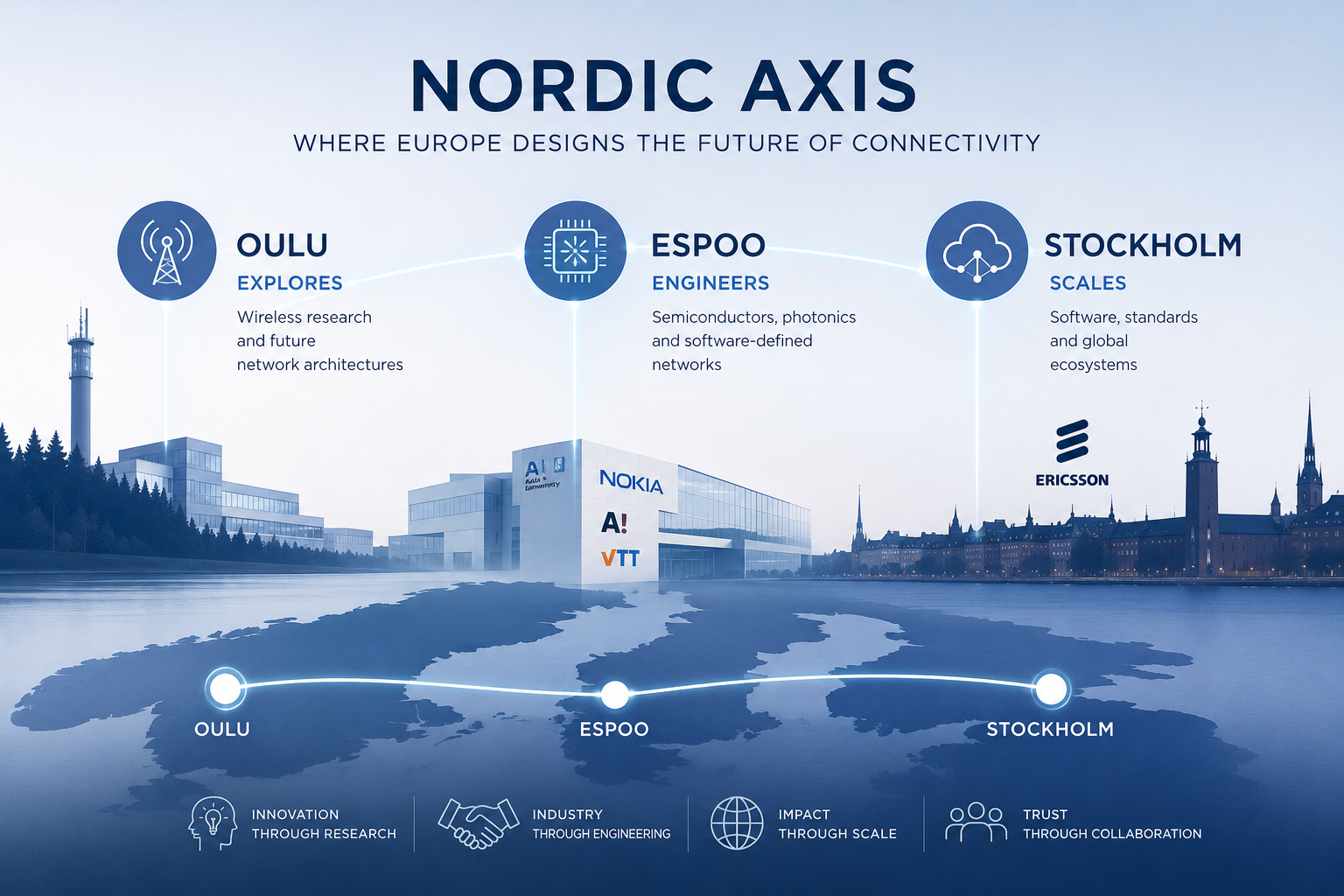
Oulu develops the scientific foundations of future wireless communications. Espoo translates those discoveries into industrial capability. Stockholm connects engineering excellence with software, standards and global markets.
Rather than competing for leadership, these regions perform complementary roles within a shared innovation architecture. Their strength lies not in concentration, but in connection.
Oulu — Where Wireless Futures Begin
If any European city deserves to be recognised as one of the birthplaces of modern mobile communications, it is Oulu.
For decades, northern Finland has cultivated internationally recognised expertise in wireless engineering, radio systems and future network architectures. The University of Oulu has become a leading centre for next-generation communications research, attracting global collaborations around artificial intelligence, resilient wireless systems and emerging 6G technologies.
Increasingly, future telecommunications begin not with network equipment, but with mathematical models, radio physics and computational research.
Yet future connectivity will depend upon far more than radio technologies alone. Intelligent networks increasingly require advances in semiconductor design, integrated photonics, edge computing and energy-efficient architectures capable of processing unprecedented volumes of data.
The foundations of tomorrow’s networks are therefore being laid long before the first antenna is deployed.
Espoo — From Scientific Discovery to Industrial Capability
Further south, Espoo demonstrates how scientific knowledge becomes industrial infrastructure.
Nokia, Aalto University and VTT together form one of Europe’s most important telecommunications ecosystems, connecting academic research with engineering excellence and commercial deployment.
Semiconductors, integrated photonics, software-defined networking, cybersecurity and artificial intelligence increasingly converge within this single innovation corridor. Rather than treating these as separate disciplines, the ecosystem integrates them into deployable communications systems capable of supporting Europe’s future digital infrastructure.
Espoo illustrates an increasingly important reality. Technological sovereignty begins long before products leave the factory. It begins where advances in physics, chip design, photonics and software engineering are translated into industrial capability.
Technological sovereignty begins where scientific discovery becomes industrial capability.
Institutions capable of bridging that gap may prove just as strategically important as manufacturing facilities themselves.
Stockholm — Connecting Technology to Global Scale
Stockholm contributes a different, yet equally essential, capability. While Finland has long excelled in wireless engineering, Stockholm increasingly complements this strength through software-defined networking, cloud-native architectures, digital platforms and internationally recognised expertise in telecommunications standards.
Ericsson continues to shape the evolution of mobile communications across the world, while the region’s dynamic software ecosystem and one of Europe’s strongest venture capital environments help transform technological capability into globally deployable platforms.
Future telecommunications will increasingly depend upon the integration of hardware, software and cloud infrastructure rather than any single technological layer. Stockholm illustrates how engineering capability becomes scalable digital infrastructure.
One Ecosystem, Three Functions
The strength of the Nordic Axis lies not in duplication, but in complementarity.
Oulu explores.
Espoo engineers.
Stockholm scales.
Together they demonstrate that Europe’s competitive advantage may not depend upon creating a single dominant technology hub. Instead, it may depend upon connecting specialised regional ecosystems capable of contributing different forms of expertise throughout the innovation cycle.
Scientific discovery, industrial capability and commercial deployment increasingly operate as parts of the same system.
Beyond National Innovation
Perhaps the most remarkable characteristic of the Nordic telecommunications ecosystem is institutional rather than technological. Its success depends upon long-term cooperation.
Universities collaborate closely with industry. Companies participate in pre-competitive research while simultaneously competing in global markets. Governments invest patiently in scientific capability, and research organisations contribute to international standards that benefit the wider telecommunications ecosystem.
Innovation is supported not only by capital or engineering talent, but by institutions that have learned to cooperate across organisational and national boundaries. The Baltic Sea does not divide this ecosystem. It connects it.
The Nordic Axis therefore functions less as a collection of national innovation systems than as a shared European capability built upon trust, collaboration and long-term investment.
A Blueprint for Europe
The Nordic experience offers an important lesson for Europe’s broader innovation strategy. Rather than attempting to replicate Silicon Valley by concentrating every capability within a single location, Europe may achieve greater resilience by connecting specialised ecosystems across the continent.
Innovation is no longer a place. It is becoming an architecture.
Different regions contribute different strengths. Some generate scientific breakthroughs. Others develop enabling technologies. Others transform innovation into globally competitive industries. Europe’s advantage may ultimately lie in the ability to connect these complementary capabilities into coherent strategic networks.
Connectivity, in this sense, becomes more than a technological product. It becomes an organisational capability.
Conclusion
Regional leadership is no longer defined solely by manufacturing capacity, research excellence or financial scale. Increasingly, it depends upon the ability to integrate these capabilities across institutions, disciplines and national borders.
If Brainport Eindhoven demonstrates how Europe engineers technological capability, and Paris-Saclay reveals where Europe develops the intellectual foundations of future networks, the Nordic Axis shows how these capabilities become an integrated innovation system.
Oulu imagines future wireless technologies.
Espoo transforms scientific discovery into industrial capability.
Stockholm connects engineering excellence with software, standards and global markets.
Together they demonstrate that Europe’s future will not be built by a single Silicon Valley. It will emerge through a continent of specialised ecosystems, each contributing a different layer of capability—from scientific discovery and industrial engineering to software, manufacturing and institutional cooperation.
The Nordic Axis reminds us that Europe’s greatest strength may not lie in concentrating innovation in one place, but in connecting many places into a single strategic architecture.
That may ultimately become Europe’s defining advantage in the age of intelligent infrastructure.
Regional Rising explores the European ecosystems where future industries are imagined, engineered and brought to scale.
Credit
Illustration: Altair Media (AI-assisted visualisation)
Caption
The Nordic Axis demonstrates how Europe’s future telecommunications ecosystem extends beyond individual cities. Oulu advances wireless research, Espoo transforms scientific discovery into industrial capability, and Stockholm connects engineering excellence with software, standards and global markets—together forming one of Europe’s most integrated innovation corridors.
