LAG Spiel und Theater Niedersachsen and Building Society Through Culture
How creative participation helps strengthen communities
Modern societies invest heavily in education. Schools teach knowledge. Universities develop expertise. Training programmes prepare people for work. Yet some of the capabilities that societies value most are often learned elsewhere. Listening. Working together. Expressing ideas. Resolving differences. Imagining another person’s perspective. These are qualities that develop through participation as much as through instruction.
Across Europe, cultural organisations quietly create the environments where these experiences become possible.
In Germany, LAG Spiel und Theater Niedersachsen offers an illuminating example of how theatre education can contribute not only to artistic development, but also to the social fabric of society itself.
Beyond the Performance
Theatre is often associated with performance. Audiences gather. Lights dim. Actors step onto a stage. Yet the performance is only the visible outcome of something much larger.
Culture does not only reflect society. It helps societies learn how to live together.
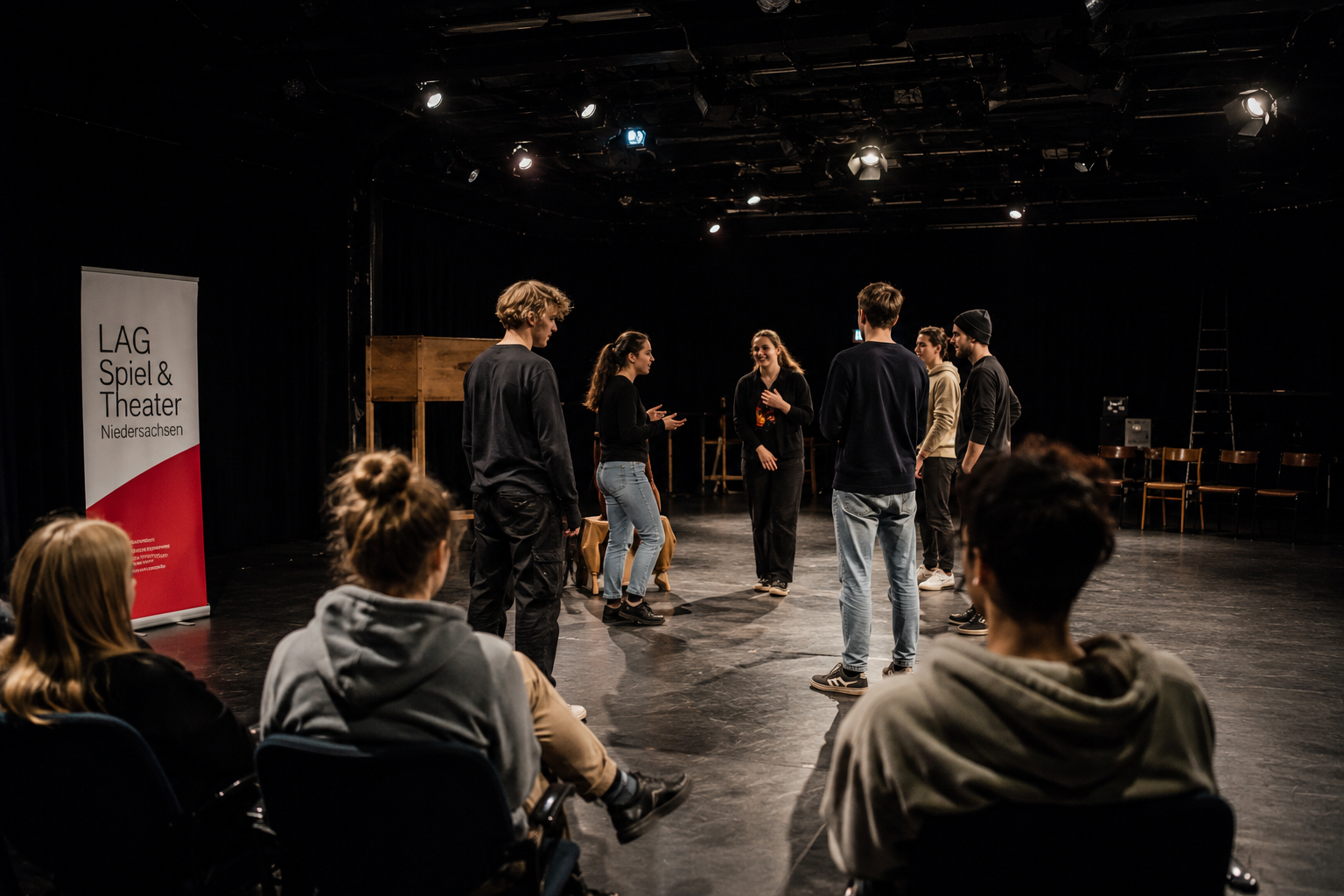
Behind every production lies a process of collaboration. Young people learn to trust one another. They discover how to communicate, negotiate ideas and solve problems collectively. Individual expression gradually becomes shared creation.
The value of theatre therefore extends far beyond the final applause. It lies within the process itself.
The Power of Connection
Unlike many cultural organisations, LAG Spiel und Theater Niedersachsen does not focus primarily on producing performances.
Instead, it connects theatres, schools, educators, artists and community organisations throughout Lower Saxony. Through professional development, partnerships and educational initiatives, it strengthens the conditions that allow creative participation to flourish across an entire region. Its work demonstrates an important principle.
A classroom can explain cooperation. A rehearsal requires it.
Culture grows through relationships. The stronger the connections between people and organisations, the greater the opportunities for creativity to become part of everyday community life.
What Do We Expect Culture to Do?
This leads to a more fundamental question.
What do we actually expect culture to do?
Public debate often measures culture through visitor numbers, ticket sales or economic value. These indicators matter, but they rarely capture its deeper significance.
Culture also creates places where people encounter perspectives different from their own. Where cooperation becomes necessary. Where confidence develops through experience rather than competition. Where young people discover that their voice can contribute to something larger than themselves.
Theatre is not simply a place where stories are performed. It is a place where citizenship is quietly rehearsed.
In that sense, culture is not simply entertainment. It is preparation for participation.
Learning Through Experience
This becomes particularly important during adolescence. Young people are not only acquiring knowledge. They are gradually discovering who they are, how they relate to others and where they belong within society.
Creative environments offer something increasingly valuable. Permission to experiment. A rehearsal does not demand perfection. An improvisation has no single correct answer. Different ideas become opportunities rather than mistakes.
Within these spaces, identity is not examined from a distance. It is experienced.
Human Capabilities in an AI Society
As Europe navigates technological transformation, demographic change and growing social complexity, conversations about education increasingly focus on digital skills, artificial intelligence and future employment.
These debates are essential. Yet they also reveal a second question. Who helps young people develop the capabilities that technology cannot provide on its own? Empathy. Curiosity. Collaboration. Imagination. The confidence to participate in public life. These qualities are rarely acquired through information alone. They emerge through experience.
A classroom can explain cooperation. A rehearsal requires it. Knowledge can describe resilience. Creative practice allows it to be lived.
Organisations such as LAG Spiel und Theater Niedersachsen remind us that some of the most important human capabilities are not simply taught. They are practised.
Building Society Through Culture
This is what makes organisations such as LAG Spiel und Theater Niedersachsen particularly relevant today. Its contribution cannot be measured only by the number of workshops organised or performances supported.
Some of society’s most important lessons are not taught through instruction. They are learned through participation.
Its broader impact lies in strengthening the networks through which creativity reaches schools, communities and young people across an entire region. Rather than seeing culture as something separate from society, the organisation demonstrates that culture is one of the ways society continuously renews itself.
Shared experiences
Perhaps this is the deeper lesson offered by organisations such as LAG Spiel und Theater Niedersachsen. Communities are not held together by institutions alone. They are held together by shared experiences. By places where people create something together. By environments where participation becomes natural.
Culture is often described as an expression of society. It may be something even more fundamental. It is one of the places where society learns how to become society.
About This Article
This article is part of Europe’s Creative Spaces, an ongoing Altair Media series exploring how cultural institutions across Europe contribute to identity, participation, confidence and human development.
Rather than examining culture solely through the lens of artistic production, the series investigates how creative environments help shape the social foundations of contemporary European societies.
The article is based on publicly available information and is intended as an independent analysis of broader developments and trends.
Image Credit
Altair Media (AI-generated)
Caption
LAG Spiel und Theater Niedersachsen demonstrates how theatre education can strengthen communities by connecting creativity, participation and human development across an entire region.
