How Much of Europe Is Still Agricultural?
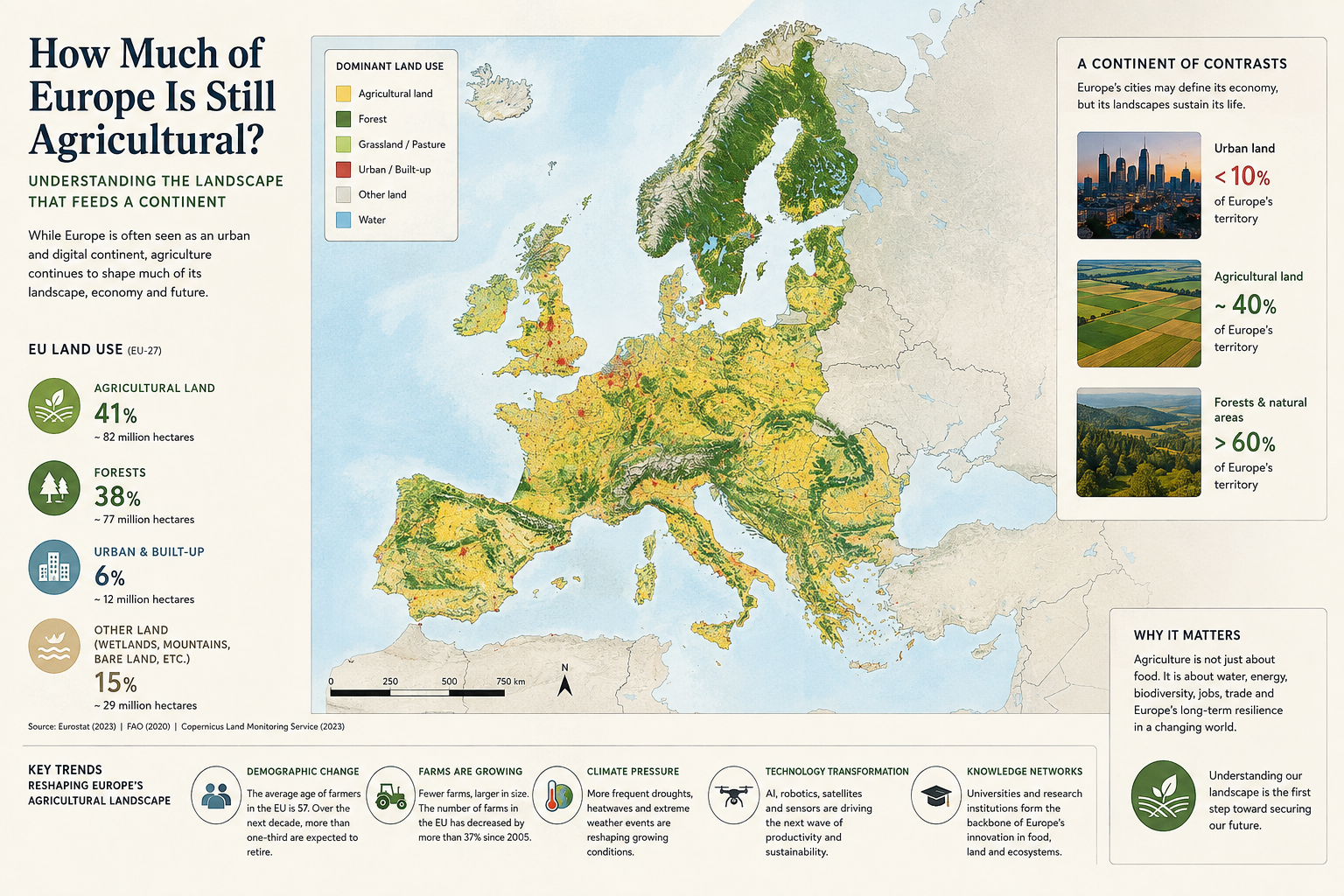
Understanding the landscape that feeds a continent
Europe’s Food System
Most people think of Europe as an urban continent. Cities dominate our imagination. Amsterdam, Paris, Berlin, Milan and Madrid have become symbols of European innovation, culture and economic development. They are home to governments, universities, financial institutions and technology companies that increasingly shape the global economy. Yet beyond Europe’s cities lies another Europe.
A Europe of fields, forests, rivers, orchards, vineyards and rural communities that continues to shape the continent’s economy, environment and food security. These landscapes are not simply empty spaces between cities. They are productive landscapes that generate food, store water, support biodiversity and sustain regional economies.
While Europe’s cities dominate political, economic and cultural life, they occupy only a relatively small share of the continent’s surface. Agricultural land, by contrast, still covers roughly two-fifths of the European Union, making it one of Europe’s largest physical systems.
Europe’s future will not be shaped by its cities alone, but also by the landscapes that continue to sustain them.
The question is therefore not simply how much food Europe produces. A more interesting question is this: How much of Europe is still agricultural—and what does that tell us about Europe’s future?
A Continent Shaped by Agriculture
For centuries, agriculture shaped Europe long before it became an industrial or technological power.
Villages emerged around fertile soils. Rivers evolved into trade routes. Ports expanded through the export of grain, wine and livestock. Entire regions developed distinctive identities through the landscapes they cultivated.
Although Europe has become increasingly urbanised, agriculture continues to define much of the continent’s geography. Alongside extensive forests, wetlands and protected natural areas, agricultural land remains one of Europe’s dominant land uses and one of the foundations upon which its prosperity has long been built.
This perspective changes how we think about Europe. Rather than viewing Europe primarily as a network of cities, we begin to recognise a continent whose long-term resilience still depends upon the careful management of land, water and biological resources.
Agriculture is therefore far more than an economic sector. It remains one of the physical foundations of European society.
A Landscape in Transition
Yet this landscape is changing. Climate change is altering growing conditions across the continent. Southern Europe increasingly faces drought and water scarcity, while northern regions experience longer growing seasons alongside new environmental challenges.
At the same time, Europe’s farming population is ageing. Fewer young people choose careers in agriculture, while farms continue to consolidate into larger and increasingly specialised businesses.
Agriculture is no longer simply about producing food. It has become a meeting point of biology, technology and society.
Demographic change, environmental pressures and economic realities are gradually reshaping the European countryside. These developments are often discussed as agricultural challenges. In reality, they extend far beyond farming itself.
Food production influences biodiversity, water management, public health, energy consumption, regional development and international trade. Understanding agriculture therefore requires understanding the wider system in which it operates.
Agriculture Becomes High Technology
Perhaps the greatest transformation is taking place quietly. Agriculture is becoming one of Europe’s most technology-intensive sectors.
Satellite observations monitor crop development across entire regions. Artificial intelligence analyses weather patterns and predicts yields. Robotic systems increasingly support harvesting, weeding and precision farming, while sensors continuously measure soil moisture, nutrient levels and plant health. Advances in genetics accelerate the development of crops capable of adapting to changing climates.
The image of agriculture as a traditional industry no longer reflects reality.
Increasingly, Europe’s farms operate at the intersection of biology, engineering, artificial intelligence and data science. Food production has become a knowledge-intensive activity in which scientific research and digital technologies are as important as tractors and harvesters.
Europe’s Knowledge Landscape
This transformation did not emerge by chance. Behind Europe’s agricultural sector stands an extensive network of universities, research institutes, companies and public organisations that continuously develop new knowledge.
Institutions such as Wageningen University & Research, the University of Hohenheim, Ghent University, the Swedish University of Agricultural Sciences and many others contribute expertise in plant science, robotics, ecology, genetics, economics and food systems.
Europe’s food system begins long before the harvest—with knowledge, research and the landscapes that make production possible.
Their work increasingly extends far beyond agriculture itself. Today it encompasses climate resilience, regional water management, healthy diets, sustainable production, artificial intelligence and circular economies. Together, these disciplines contribute not only to Europe’s food security, but also to the long-term resilience of European society.
Europe’s food system is therefore not simply sustained by farmland. It is sustained by knowledge.
Looking Beyond Agriculture
Perhaps the most surprising conclusion is that agriculture itself is no longer the central story. The real story is how multiple systems increasingly converge.
Food production depends upon fertile soils, but equally upon energy infrastructure, digital technologies, logistics, finance, education, scientific research and international trade. Understanding these interdependencies will become increasingly important as Europe navigates a more uncertain geopolitical environment.
Understanding Europe’s agricultural landscape is the first step towards understanding one of the continent’s most essential systems.
The traditional boundaries between agriculture, technology and society are gradually disappearing. Understanding Europe’s agricultural landscape is therefore no longer simply about farming. It is about understanding how modern societies organise one of their most fundamental systems.
Final Reflection
Europe remains one of the world’s great agricultural regions. But its future will not be determined by hectares alone. It will depend upon how successfully Europe combines biological knowledge, technological innovation, environmental stewardship and long-term strategic thinking.
Europe’s future will not be shaped by its cities alone. It will also be shaped by the landscapes beyond them.
Understanding those landscapes is the first step towards understanding Europe’s Food System.
Europe’s Food System
Understanding the systems that feed a continent.
- Perspective I — How Much of Europe Is Still Agricultural?
- Perspective II — Can Europe Feed Itself?
- Perspective III — Europe’s Food Systems University
- Perspective IV — Seeds of Europe
In the next Perspective, we explore a deceptively simple question:
Can Europe Feed Itself?
Credit
Illustration by Altair Media. Created for the Europe’s Food System series, visualising the changing geography, land use and technological transformation of Europe’s agricultural landscape.
Caption
How Much of Europe Is Still Agricultural? explores the landscapes that continue to feed Europe and examines how agriculture, technology, science and demographic change are reshaping one of the continent’s most important systems.
