France — State, Strategy and Sovereignty
The Dirigiste Cloud and Europe’s Search for Digital Power
France has long approached infrastructure differently from much of Europe. Where some countries largely treat networks and technology as market systems, France traditionally views strategic infrastructure as part of state power itself.
That instinct increasingly shapes the country’s position in Europe’s digital future.
As debates around AI, cloud systems, telecom sovereignty and strategic autonomy intensify across Europe, France has emerged as one of the continent’s strongest advocates for greater control over critical digital infrastructure. Not simply as economic policy, but as geopolitical necessity.
The French logic of strategic infrastructure
France’s infrastructure philosophy is deeply tied to the role of the state.
From railways and nuclear energy to aerospace and telecommunications, the French political tradition has long accepted a stronger role for national coordination, industrial policy and strategic planning than many liberal market economies.
That logic never fully disappeared during the platform era.
While parts of Europe embraced global digital integration relatively pragmatically, France remained more cautious about losing control over critical technological layers. This partly explains why French policymakers consistently push debates around:
- digital sovereignty;
- European cloud infrastructure;
- AI regulation;
- industrial resilience;
- cybersecurity;
- strategic technology investment.
France’s position is not purely defensive. Paris increasingly sees digital infrastructure as an opportunity to strengthen European strategic capacity and geopolitical leverage.
That ambition is visible across AI, telecom, cloud infrastructure and defence technologies.
But the French model also reveals a growing contradiction between sovereignty ambitions and technological reality.
“Europe cannot simply become a digital colony of either the United States or China.”
Bruno Le Maire, French Minister of Defence and former Minister of the Economy and Finance
France strongly supported the rise of Mistral AI as a European AI champion capable of competing with American firms. French policymakers also lobbied intensely during negotiations around the EU AI Act to prevent regulation from limiting European AI development too early.
Yet Mistral AI quickly entered major partnerships involving Microsoft infrastructure and distribution agreements — reflecting how difficult it has become for European technology companies to scale independently from American cloud ecosystems.
That paradox increasingly defines Europe’s digital position itself.
Orange, Gaia-X and the limits of sovereignty
France’s telecom ecosystem reflects this broader strategic culture.
Orange remains more than a commercial telecom operator. Historically rooted in the former France Télécom structure, the company still carries part of the institutional logic of the French state itself.
This partly explains why France often treats telecom infrastructure differently from more market-oriented systems elsewhere in Europe.
Like Deutsche Telekom and other major European operators, Orange increasingly positions itself around:
- cloud services;
- edge computing;
- cybersecurity;
- enterprise AI infrastructure;
- sovereign digital environments.
But France’s wider sovereignty ambitions have also exposed Europe’s structural limitations.
Together with Germany, France helped launch Gaia-X as a European initiative for more sovereign and federated cloud infrastructure. The project symbolised Europe’s growing recognition that cloud systems had become strategic infrastructure.
Yet Gaia-X gradually revealed how difficult genuine autonomy would be to achieve.
Despite ambitions for European independence, the project became increasingly intertwined with the same American hyperscalers Europe originally hoped to balance. Sovereignty did not emerge as separation, but as negotiation within interconnected systems.
“Digital sovereignty does not mean isolation. It means the ability to make independent choices.”
Thierry Breton, former European Commissioner and prominent advocate of European technological sovereignty
Breton himself has increasingly become a symbol of the growing tensions between European regulation and American platform power — particularly as Europe pushes harder on digital competition, platform accountability and infrastructure control.
The result is a hybrid model in which sovereignty and dependency increasingly coexist at the same time.
Between autonomy and interdependence
France’s infrastructure strategy increasingly influences the broader European debate.
Paris consistently pushes for stronger industrial coordination, strategic investment and greater European technological resilience. Critics sometimes view this approach as overly state-driven or difficult to implement across Europe’s fragmented political landscape.
Yet geopolitical developments increasingly reinforce parts of the French argument.
Cloud systems, AI infrastructure, semiconductors and telecom networks are no longer viewed purely as economic assets. They increasingly function as instruments of geopolitical leverage and strategic influence.
This places France in a distinctive position inside Europe.
Not because it fully controls its own digital future, but because it recognised relatively early that infrastructure, sovereignty and power were beginning to merge again in the digital age.
And in Europe’s next network era, that recognition may prove more important than many European governments once assumed.
This article is part of FASE III — NATIONAL ARCHITECTURES, a series exploring how European countries approach infrastructure, sovereignty and digital power in the next network era.
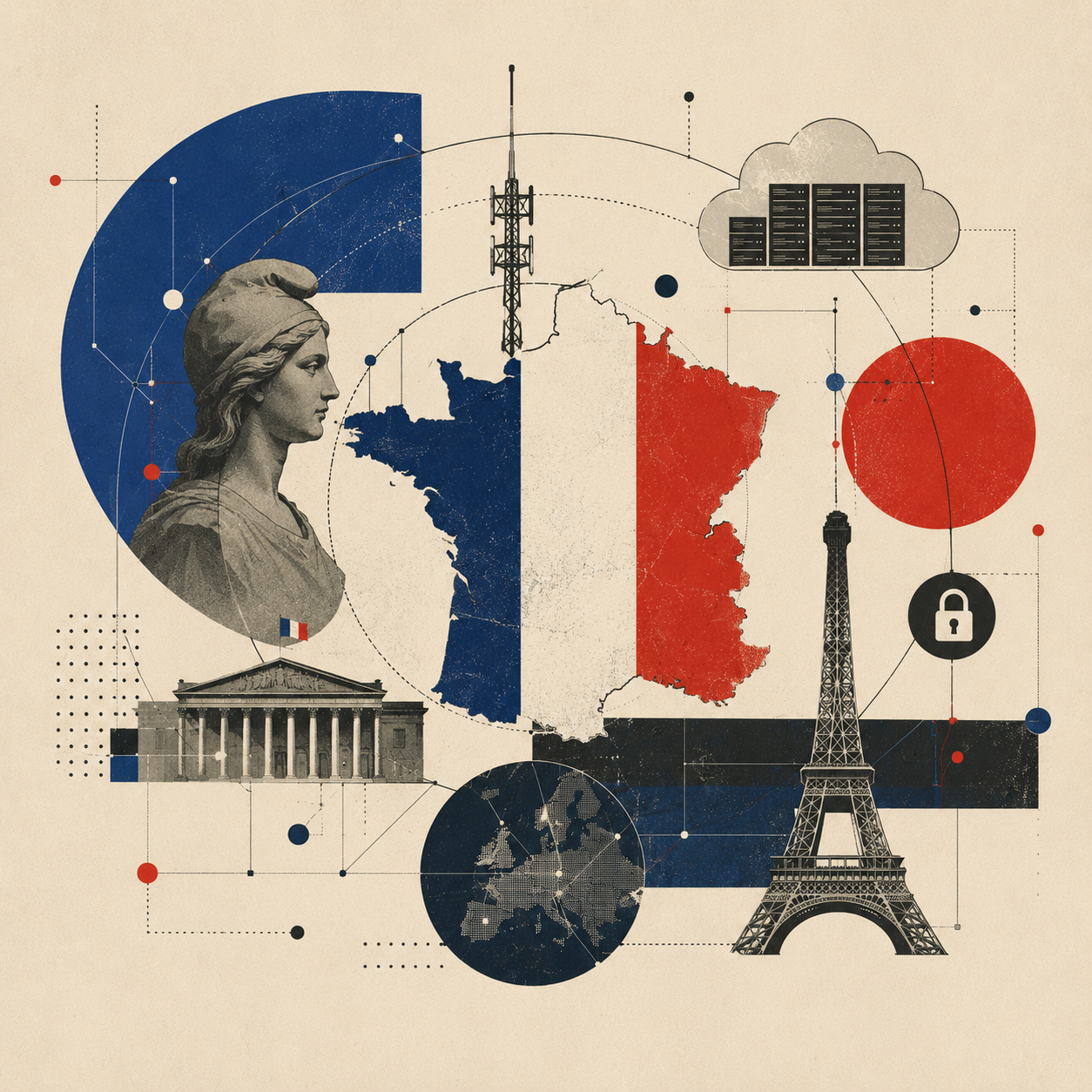
Illustration: Artistic interpretation of France’s digital sovereignty strategy, combining state infrastructure, cloud systems, telecom networks and European strategic autonomy in a geometric Altair Media visual style.
Caption: France increasingly treats digital infrastructure not simply as an economic sector, but as strategic territory where sovereignty, cloud power and geopolitical influence increasingly converge.
