Europe’s Orbital Cloud: Who Will Build the Business?
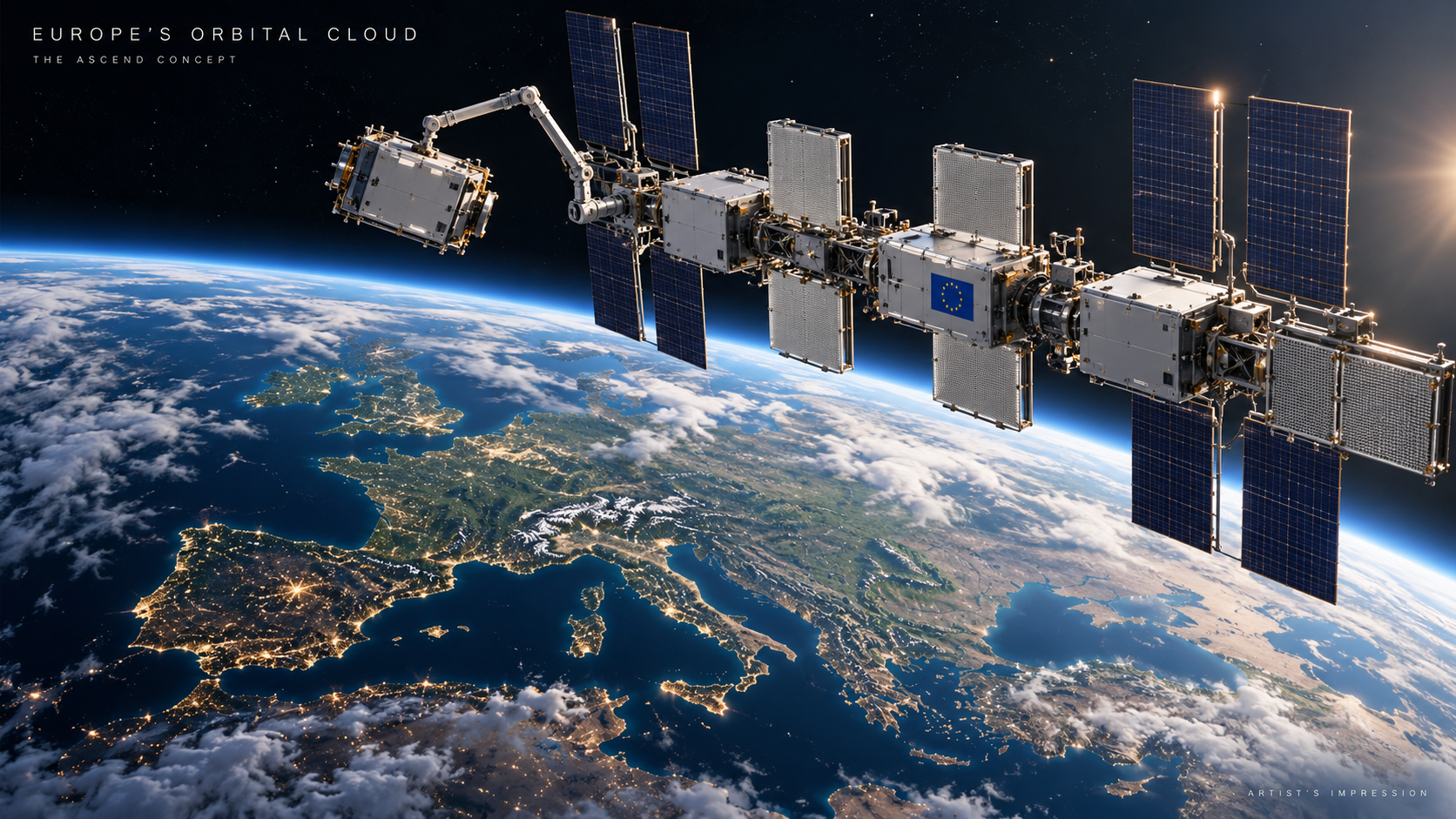
Airbus, Thales Alenia Space and their partners have studied data centres in orbit. Turning that architecture into a service requires customers, capital and an accountable operator.
Airbus, Thales Alenia Space and their partners have studied how Europe could build data centres in orbit. Google’s latest AI demonstration in space gives that work renewed relevance. The European challenge is turning an engineering concept into infrastructure with committed customers, credible financing and an operator responsible for delivering a dependable service.
The Horizon Europe-funded ASCEND study brought spacecraft engineering, computing, cloud services and environmental analysis into one consortium. Six questions determine how that research could support an investable European infrastructure project.
🟦 What has Europe actually established?
ASCEND examined the technical, environmental and economic feasibility of space-based data centres. The approximately €2 million project ran from January 2023 to April 2024. Its official reporting describes an initial 10-megawatt system concept and an ambition to deploy one gigawatt by 2050. These figures describe proposed power capacity, rather than demonstrated computing output.
Reaching that scale would require an industrial expansion in spacecraft production, orbital assembly and infrastructure operations. A gigawatt objective provides a direction; the productive computing capacity and cost would depend on the system eventually built.
ASCEND’s reporting explicitly calls for further technical work and consolidation of the business and development plan. A funded demonstration would need to identify which assumptions it tests and what results would justify proceeding beyond it.
🟦 Who takes responsibility for the complete service?
Airbus contributed more than satellite-manufacturing expertise. Its French and German teams worked on communications architecture, in-orbit assembly concepts and overall system design and evaluation. Thales Alenia Space coordinated the study. Other partners included HPE for computing hardware, CloudFerro for software and Orange Business for cloud services and integration.
A commercial operator would have to connect those capabilities to a service-level agreement covering availability, performance and recovery from interruptions.
A spacecraft supply contract and a cloud service guarantee address different responsibilities. A processor can remain operational while communications delays or reduced capacity prevent the operator from delivering the service a customer purchased. Who absorbs the resulting cost?
The commercial structure also determines who controls the customer relationship. European manufacturers could secure valuable construction contracts while another company receives the recurring cloud revenue. Allocating operational risk and retaining commercial value belong in the same negotiation.
🟦 Who commits before the economics are proven?
Research funding can support experiments with uncertain outcomes. Infrastructure investors need a credible path to revenue, while customers need confidence that a service will perform. An orbital cloud must resolve that tension before its operating record exists.
Earth observation, scientific processing and public-sector applications offer possible starting points. Each would require a specific case showing why processing in orbit creates enough value to cover its additional complexity.
A useful comparison comes from a separate programme. On September 10, 2026, Airbus announced an initial contract for an IRIS² satellite layer on behalf of Eutelsat, with platforms and integration supplied by Airbus and payloads from Thales Alenia Space. IRIS² provides communications infrastructure; the agreement illustrates how a European industrial partnership becomes concrete through an identified customer and defined responsibilities.
For orbital computing, an equivalent commitment would need to specify the capacity being purchased, the acceptable price and who bears development delays. Strategic interest becomes useful to investors when it produces credible purchasing commitments.
🟦 Can Europe launch and assemble it at the required scale?
ASCEND’s proposed architecture depends on developments across the space industry. Its reporting describes a new European super-heavy launch vehicle, robotic assembly and substantial increases in manufacturing and launch capacity.
ArianeGroup contributed to the launcher assessment, including work drawing on ESA’s PROTEIN feasibility study. The published findings envisage a high-capacity, reusable launcher with a much lower environmental footprint. These are development requirements underlying the larger concept.
This creates a sequencing problem. Launch providers need sufficient demand to justify investment. Data-centre developers need credible launch prices and schedules before committing to deployment.
Using an external launch provider could change the cost and timetable, but would also change the dependency structure. A smaller demonstrator could reduce uncertainty if it tests the assumptions that matter at commercial scale.
🟦 What would make an orbital cloud sovereign?
ASCEND explicitly included European digital sovereignty among its objectives. Translating that ambition into a service requires decisions about control throughout the system.
European ownership of a spacecraft does not, by itself, settle dependencies on accelerators, proprietary software or ground infrastructure. Moving computing into orbit preserves any unresolved reliance on suppliers that control essential components or access.
Customers would need to know who can access their data, interrupt their service or change its operating terms. The ability to maintain software, replace suppliers and recover from disruptions would help determine effective control.
International technology can remain part of a European-controlled service. The investment case must identify which dependencies are acceptable, which require alternatives and how much customers or public authorities are prepared to pay for that resilience.
🟦 Does the environmental case survive the complete lifecycle?
Solar power in orbit offers an attractive proposition. ASCEND’s published findings nevertheless attach a substantial condition to the emissions argument: achieving significant reductions would require a launcher with approximately ten times lower emissions over its lifecycle. The environmental case therefore depends partly on technology beyond the computing installation itself.
The comparison must account for spacecraft production, launches, operating life and replacement. It must also consider the terrestrial infrastructure available when an orbital facility actually enters service.
A future space-based system would compete with future terrestrial data centres, whose energy supply and efficiency may also improve. Environmental credibility depends on comparing equivalent computing services over realistic lifetimes.
That assessment could influence financing, procurement and public support. It needs to remain testable as the engineering assumptions change.
Signal
ASCEND has given Europe an architectural starting point. The next step requires an organisation that can secure customers, allocate risk and finance a dependable service. Airbus and its partners provide relevant industrial capabilities; the commercial structure will determine who turns those capabilities into a lasting orbital cloud business.
Credit
AI-generated illustration: OpenAI for Altair Media.
Caption
Artist’s impression of modular computing infrastructure being assembled above Europe, inspired by the ASCEND feasibility study. The image illustrates the concept rather than an operational facility or an exact engineering design.
