Europe’s Nervous System
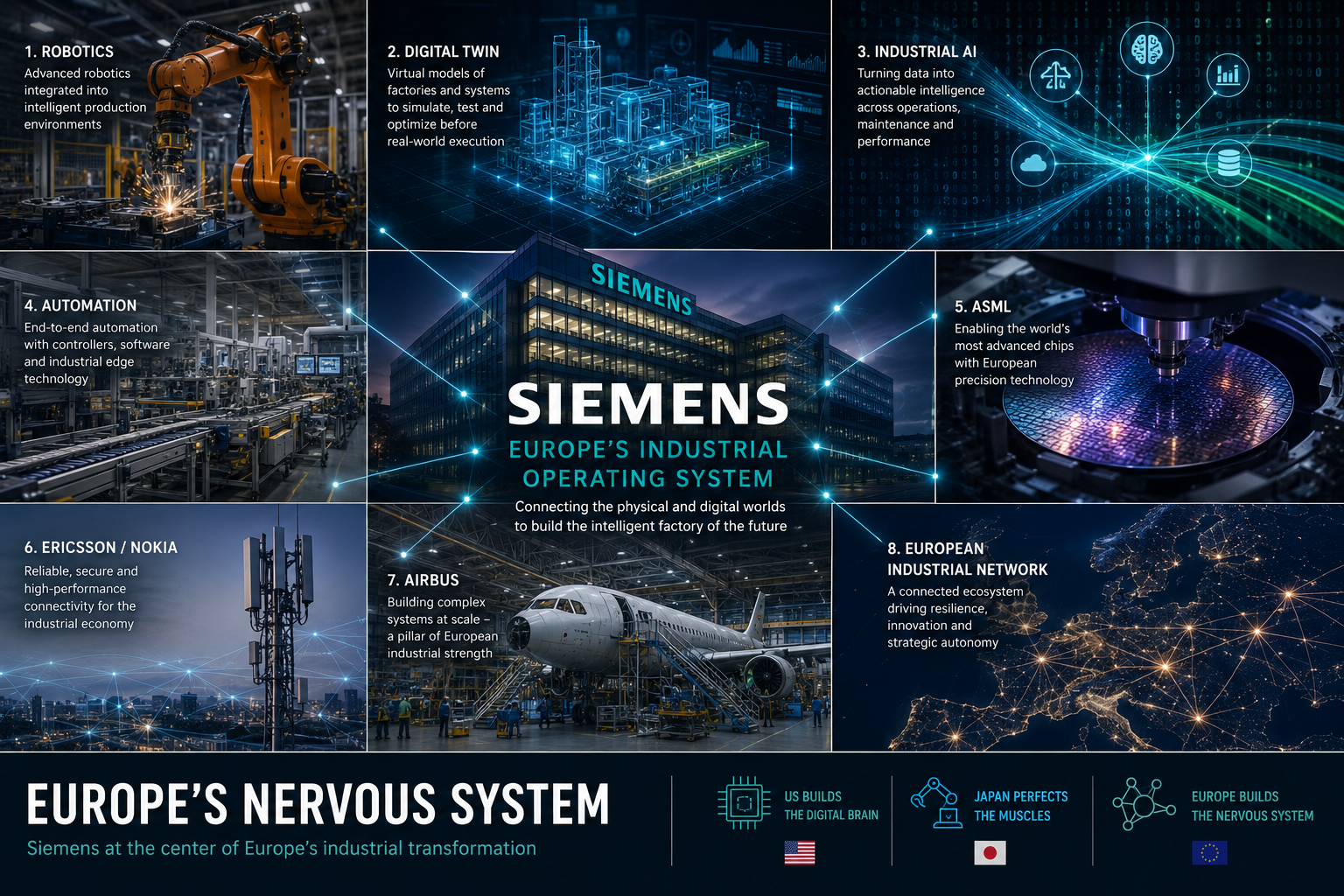
Why Siemens may be building the architecture behind the age of automation
When people think about robotics, they often imagine humanoid machines walking through warehouses, autonomous robots replacing workers or futuristic demonstrations from Silicon Valley. The global robotics conversation is increasingly dominated by companies such as Tesla, NVIDIA, Figure AI, Boston Dynamics and a growing ecosystem of AI-driven robotics startups.
Yet beneath the headlines, a different transformation is quietly taking place. And Europe may be pursuing a fundamentally different path. At the center of that transformation stands Siemens.
Not as a robotics company in the traditional sense. But increasingly as one of the companies building the digital infrastructure that allows automated factories, industrial AI systems and future robotic environments to function at scale.
While the United States focuses heavily on artificial intelligence and Japan remains a global leader in industrial robotics hardware, Siemens appears to be positioning itself around a different question: How do entire industrial systems become intelligent?
Beyond the Robot
For decades, industrial automation largely focused on individual machines. Robots performed repetitive tasks. Sensors monitored production lines. Software controlled specific processes. Today that model is changing.
Modern factories increasingly operate as connected ecosystems where machines, software, sensors, simulation environments and artificial intelligence continuously exchange information.
In this environment, the robot itself becomes only one component of a much larger system. This is where Siemens has been steadily expanding its position.
Through platforms such as Siemens Xcelerator, Industrial Operations X, Digital Twin technologies and Industrial AI, the company is building an architecture that connects the physical factory with its digital counterpart.
Rather than focusing solely on automation hardware, Siemens is creating systems that allow entire production environments to be simulated, monitored, optimized and eventually operated with increasing autonomy.
The strategic objective appears clear. Not simply smarter robots. Smarter industrial ecosystems.
The Industrial Operating System
Most discussions about technological power focus on products. Who builds the best robot Who develops the most advanced AI model Who manufactures the fastest chips?
Yet history suggests that the most durable power often belongs to those who control the underlying platforms.
Microsoft did not dominate because it built every application. It dominated because it controlled Windows. Google’s influence extends far beyond search because Android became one of the operating systems of the digital world. A similar shift may now be emerging within industrial technology.
Rather than building robots themselves, Siemens increasingly appears to be constructing something broader: a common operating layer that connects machines, software, simulation environments and artificial intelligence across entire industrial systems.
In that sense, Siemens may be attempting to build what could eventually become the industrial operating system of the physical economy.
The Digital Twin Economy
One of the most important concepts behind Siemens’ vision is the digital twin. A digital twin is a virtual replica of a physical object, production line or entire factory. Engineers can test changes, simulate disruptions and optimize workflows before implementing them in the real world.
But the technology may become even more important as artificial intelligence moves into manufacturing. An AI system cannot safely learn through trial and error inside a billion-euro semiconductor facility, chemical plant or automotive factory. The risks are simply too high.
Instead, AI increasingly requires virtual environments where millions of scenarios can be tested safely before deployment. The digital twin provides exactly that environment. It becomes a training ground where AI can learn the behaviour of complex physical systems before interacting with reality itself.
In this sense, Siemens is not only helping companies simulate factories. It is helping create the environments in which industrial AI can learn.
Three Regions, Three Visions
The emerging automation landscape increasingly reflects three distinct regional strategies.
Japan continues to excel in robotics hardware. Faced with demographic decline and labour shortages, Japanese companies have spent decades perfecting industrial robots, precision manufacturing systems and factory automation technologies.
The United States increasingly dominates the intelligence layer. From large language models and advanced computing infrastructure to autonomous systems and humanoid robotics, much of today’s AI revolution remains concentrated around American technology firms.
Europe appears to be pursuing a different role. Rather than focusing primarily on consumer-facing AI or standalone robotic systems, Europe increasingly specializes in industrial integration.
The United States builds the digital brain.
Japan perfects the mechanical muscles.
Europe is quietly building the nervous system.
This is the regional specialization embodied by Siemens. The company focuses on connecting machines, factories, software platforms, digital twins and artificial intelligence into coherent industrial environments.
In advanced manufacturing, a robot is only as intelligent as the system surrounding it. Europe’s competitive advantage may therefore lie less in visibility and more in indispensability.
The European Pattern
Seen in isolation, Siemens appears to be an industrial software and automation company. Viewed in a broader geopolitical context, however, it becomes part of a much larger European pattern.
ASML provides the machines that make advanced semiconductor production possible.
Ericsson and Nokia supply critical communications infrastructure connecting industrial systems.
Airbus represents strategic manufacturing at continental scale.
Siemens increasingly connects these layers through automation, simulation and industrial intelligence.
Together they illustrate a distinctly European approach to technological competition. Rather than dominating consumer platforms, Europe often occupies the critical infrastructure layers upon which modern economies depend.
These companies may not always generate the same headlines as Silicon Valley startups. Yet they increasingly shape the foundations of the global economy.
The Invisible Layer
The irony is that much of Siemens’ influence remains largely invisible to the public. Consumers can easily recognize a humanoid robot. They rarely notice the industrial software, simulation environments, control systems, digital twins and factory operating platforms working behind the scenes.
Yet these invisible layers increasingly determine how manufacturing systems function. Who controls those layers may ultimately prove just as important as who builds the robots themselves.
As artificial intelligence moves from software into the physical economy, the strategic competition may gradually shift away from individual machines and toward the industrial architectures connecting them.
That is where Siemens has been positioning itself. Quietly. And perhaps more successfully than many observers realize.
Europe may not be leading the race to build the most famous robots. But through companies such as Siemens, it is becoming increasingly influential in building the systems that make future automation possible.
Caption
Siemens increasingly operates at the intersection of industrial automation, digital twins, artificial intelligence and manufacturing systems. Rather than building robots alone, the company is helping create the digital architecture that connects Europe’s industrial economy.
Credit
Image concept and composition: Altair Media (AI-assisted visualisation)
