Europe Can Make Chips. But Can It Build a Market?
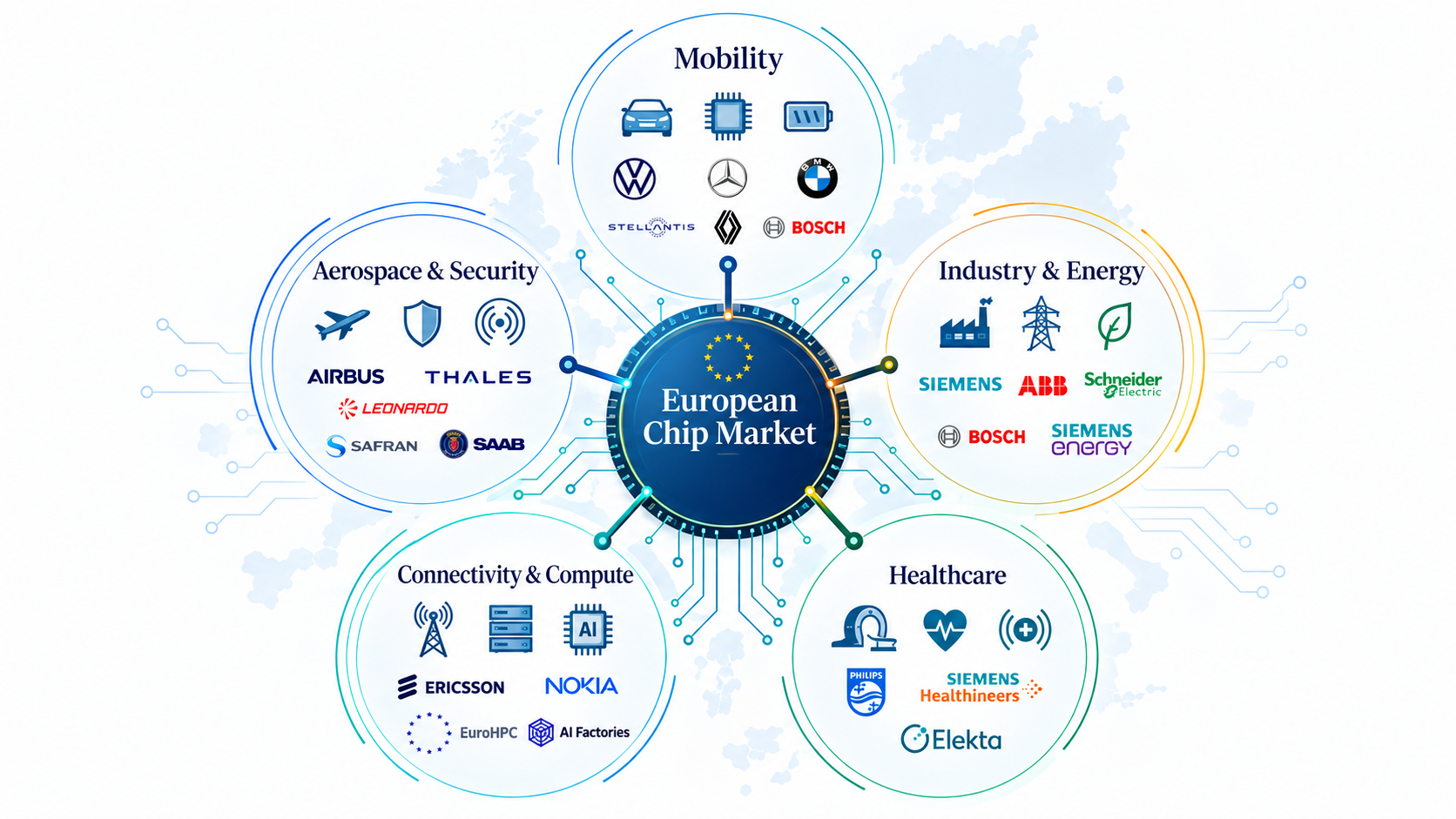
Europe has spent years asking where its next semiconductor fab should be built. Chips Act 2.0 points towards a different question: which European industries will create the demand that makes those fabs worth building?
SIGNAL | ASML may be Europe’s most indispensable technology company. Its machines sit at the centre of advanced semiconductor manufacturing, supported by one of the most sophisticated industrial ecosystems the continent has ever built. Yet almost none of that demand is European.
In 2025, ASML generated €32.7 billion in sales. Around €28 billion came from Asia. EMEA accounted for just €524 million, with another €4.7 million in the Netherlands itself. On ASML’s system-sales measure, only 1% of machines shipped to EMEA.
Europe builds the machines on which much of the global semiconductor industry depends. But the factories using them are overwhelmingly somewhere else. That imbalance is usually described as a production problem. It may be something more fundamental.
Europe has a semiconductor market problem.
🟦 What If Europe’s Chip Problem Is Not Supply?
The first European Chips Act emerged from scarcity. Pandemic-era shortages exposed Europe’s dependence on external semiconductor supply, and the response concentrated heavily on fabrication capacity, research infrastructure, investment incentives and resilience. Chips Act 2.0 changes the emphasis.
The European Commission now explicitly identifies stimulating demand and industrial uptake as one of the central objectives of semiconductor policy. It wants stronger links between chip manufacturers and user industries, new Demand Accelerators, greater use of innovation procurement and connections between European semiconductor production and the rapidly expanding demand from data centres, cloud providers and AI Gigafactories.
Its parallel advanced-chips initiative makes the shift even clearer. Europe, the Commission argues, must create sustained demand for advanced semiconductors while developing fabless chip companies and AI-driven system design. This changes the sequence.
For years, the central question was:
How can Europe persuade someone to build another fab?
The more important question may now be:
What would make someone need to build it?
A fab is not the beginning of a semiconductor economy. It is one of its consequences.
🟦 Where Is Europe’s Missing Chip Market?
Europe cannot reproduce the semiconductor economies of East Asia or the United States. It lacks Asia’s electronics manufacturing scale and America’s concentration of hyperscalers, consumer platforms and advanced chip designers. But Europe possesses something different: a dense industrial economy in which semiconductor intensity is rising almost everywhere.
| Demand System | Potential European Anchors | Strategic Semiconductor Demand |
|---|---|---|
| Mobility | Volkswagen, Mercedes-Benz, BMW, Stellantis, Renault, Bosch | Automotive SoCs, radar, ADAS, MCUs, SiC/GaN power |
| Industry & Energy | Siemens, ABB, Schneider Electric, Bosch, Siemens Energy | Edge AI, sensing, motor control, grid and power electronics |
| Healthcare | Philips, Siemens Healthineers, Elekta | Detector ASICs, imaging processors, sensors, photonics |
| Connectivity & Compute | Ericsson, Nokia, EuroHPC, AI Factories and Gigafactories | RF SoCs, networking silicon, accelerators, optical interconnects |
| Aerospace & Security | Airbus, Thales, Leonardo, Safran, Saab | Secure processors, radar, RF, sensing, space-grade electronics |
These companies are normally discussed as members of completely different industries. That may be precisely the problem.
Automotive procurement is treated separately from semiconductor strategy. Medical technology sits somewhere else again. Energy policy, telecom infrastructure, defence procurement and AI computing each have their own programmes, ministries and industrial structures.
Yet silicon increasingly runs through all of them. Europe already possesses a semiconductor market large enough to matter. It simply does not yet behave like one.
🟦 What Happens When the Customer Designs the Chip?
Healthcare provides an unusually clear glimpse of what a different model could look like.
Philips is no longer a semiconductor manufacturer. But advanced medical imaging increasingly depends on specialised detectors, sophisticated signal processing, AI and high-performance electronics. The strategic semiconductor demand exists inside the medical system even when Philips does not manufacture the chips itself.
Siemens Healthineers has gone further. On 11 September 2026, it opened a dedicated semiconductor facility in Forchheim producing cadmium-telluride sensors for photon-counting CT scanners. The company brought crystal growth, semiconductor manufacturing and the final medical application into one technological system. The sequence is revealing.
A clinical requirement demanded a specialised detector. That detector became strategically important to the diagnostic system. Its technological value became commercial value. And that commercial value justified semiconductor manufacturing in Europe. The application pulled the fab into existence.
The same mechanism is visible elsewhere. Ericsson develops custom silicon for radio-access networks. Nokia has built specialised ReefShark silicon around telecom requirements. European carmakers increasingly specify critical semiconductor architectures and negotiate more directly with chip suppliers. Bosch sits on both sides of the equation: a major industrial and automotive customer that also manufactures semiconductors.
Siemens, ABB and Schneider Electric occupy a similar strategic position further downstream. Their machines, factories, grids, drives and datacentre systems will require growing quantities of sensing, processing and power electronics. These companies do not need to become European versions of Nvidia. Their strategic importance may lie elsewhere. They can become anchor customers for European silicon.
🟦 Can Europe Become the Customer It Does Not Have?
The largest gap remains advanced computing. Europe has no equivalent concentration of Microsoft, Amazon, Google, Meta and Nvidia continuously generating massive commercial demand for advanced processors. The AI Gigafactory programme begins to address that absence from the opposite direction.
The Commission is mobilising €20 billion around large-scale AI computing infrastructure. Individual Gigafactories are designed to bring together more than 100,000 advanced AI processors. More importantly, the Commission explicitly describes that infrastructure as a mechanism for creating predictable, large-scale demand that can stimulate European AI-processor design and, eventually, manufacturing. That is a profound shift.
Historically, a European chip company could receive research funding, develop a processor and then discover that the customers capable of deploying it at scale were located in America. The new model connects both ends.
Research produces technology. European compute infrastructure creates demand. Demand gives chip designers a first reference customer. Volume makes local packaging and manufacturing more viable.
Public investment stops merely subsidising technical innovation. It helps construct the market in which that innovation can survive.
🟦 Can Europe Turn Its Semiconductor Islands Into a Market?
Europe already has much of the physical geography of a semiconductor ecosystem. Eindhoven connects ASML, ASM, NXP, BESI, photonics and an extraordinary supplier base. Leuven adds imec and one of the world’s leading semiconductor research environments. Dresden combines Infineon, Bosch, GlobalFoundries and the emerging capacity of ESMC, while Grenoble and Crolles connect STMicroelectronics with CEA-Leti.
Further south and east, Germany links Infineon with Siemens, Bosch, BMW, Mercedes-Benz and specialised medical semiconductor production in Forchheim. Finland and Sweden bring Nokia and Ericsson into the architecture. France, Germany, Italy and the Nordic countries add aerospace, defence, energy and industrial demand.
The weakness is not the islands. It is the water between them. Brainport needs Brussels, but Brussels cannot be Brainport’s principal customer.
The consequential connections must run horizontally: Eindhoven to Leuven, Dresden and Grenoble; semiconductor clusters to automotive hubs in Stuttgart and Munich; photonics to telecom and AI infrastructure; power electronics to European grids and factories; medical sensors to healthcare systems across the continent.
Europe does not need every region to reproduce the entire semiconductor stack. It needs those regions to become economically dependent on one another. Not self-sufficiency.
Interdependence at European scale.
The Signal
The semiconductor debate has concentrated for too long on where Europe should subsidise factories. Chips Act 2.0 suggests that the Commission has started to recognise the underlying reality: Europe must also build the market.
Volkswagen, BMW, Mercedes-Benz and Stellantis create demand. Siemens, Bosch, ABB and Schneider create demand. Philips and Siemens Healthineers create demand. Ericsson and Nokia create demand. Airbus, Thales and Leonardo create demand.
AI Gigafactories create demand. Yet those demand systems are still rarely treated as parts of the same industrial architecture. That is the opportunity.
Aggregate the demand. Connect it to European designers. Give emerging architectures long-term anchor customers. Link those customers to European research, packaging, manufacturing, photonics, materials and equipment.
Then the semiconductor geography begins to change. Not because another government has offered the largest subsidy. But because the customer has moved closer.
Europe does not need to summon its next semiconductor fab into existence. It needs to create the market that makes that fab unavoidable.
Semiconductor sovereignty does not start with the factory. It starts with the customer.
Credit
Illustration: Altair Media / OpenAI
Caption
Europe’s potential semiconductor market stretches far beyond chipmakers themselves. Mobility, industry, energy, healthcare, connectivity, aerospace and AI infrastructure could together provide the anchor demand needed to turn Europe’s fragmented semiconductor strengths into an integrated market.
