Estonia — Europe’s Digital Pioneer
Why digital government became a national strategy
Estonia has become one of the world’s most advanced digital societies. Yet its transformation was never simply about technology. Following the restoration of independence in 1991, the country chose to rebuild its institutions around digital infrastructure, turning efficiency, resilience and trust into the foundations of a modern European state.
Many countries pursue digital transformation as a programme of government modernisation. Estonia approached the challenge differently. For the country, digitalisation became a nation-building project.
When Estonia regained its independence after the collapse of the Soviet Union, it faced a daunting task. Institutions had to be rebuilt. Public administration had to be reorganised. Economic reforms were necessary, while financial resources remained limited. Rather than replicating large bureaucratic structures, policymakers saw an opportunity to design a state suited to the emerging digital age.
Technology became an instrument for rebuilding governance itself.
Digital transformation begins with institutions, not software.
Over the following decades, Estonia developed what has become one of the most integrated digital public administrations in the world. Citizens routinely access government services online, sign legally binding documents electronically and interact with public institutions through secure digital identities. Administrative processes that once required offices, paperwork and waiting times have largely become digital services operating continuously in the background.
What distinguishes Estonia, however, is not the number of online services. It is the architecture that connects them.
Building a Digital State
Much of Estonia’s international reputation centres on initiatives such as digital identity, online voting and electronic tax administration. These innovations are significant, but they represent components of a broader institutional design rather than isolated technological achievements.
At the heart of this architecture lies the principle that citizens should provide information to government only once. Public institutions exchange authorised information securely through interconnected digital systems, reducing duplication while improving efficiency across government.
The result is not simply faster public administration. It is a different relationship between citizens and the state.
Digital infrastructure has become part of everyday governance, supporting healthcare, education, business registration, taxation and judicial processes through a coherent national framework. The state increasingly operates as an integrated information system rather than a collection of separate administrative organisations.
Trust as Public Infrastructure
Digital government depends upon something far less visible than software. It depends upon trust.
Citizens must believe that their information is secure, that institutions operate transparently and that public authorities remain accountable for how digital systems are used. Estonia therefore invested not only in technological capability but also in legal frameworks, cybersecurity and public confidence. Trust functions as infrastructure in its own right.
Without institutional legitimacy, even sophisticated digital platforms struggle to gain acceptance. Estonia demonstrates that successful digital transformation requires governance and technology to evolve together.
For Europe, this lesson is becoming increasingly relevant as artificial intelligence, digital identities and cross-border public services expand across the continent.
Cybersecurity as National Resilience
The importance of digital resilience became particularly evident in 2007. Large-scale cyberattacks targeting Estonian institutions demonstrated that digital societies also face new forms of vulnerability. Government services, financial institutions and communication networks all became targets of coordinated attacks.
Rather than slowing digitalisation, the experience reinforced its strategic importance.
Cybersecurity became an integral component of national policy. Estonia strengthened its cyber capabilities, invested in resilient digital infrastructure and deepened international cooperation. The country now hosts NATO’s Cooperative Cyber Defence Centre of Excellence, reflecting its growing role in European cybersecurity expertise. Digital government could no longer be separated from national security. The two had become closely interconnected.
Innovation Beyond Government
Estonia’s digital transformation has also shaped its private sector.
The country’s technology ecosystem has produced internationally recognised companies including Skype, Wise, Bolt, Pipedrive, Veriff and Starship Technologies. These firms emerged within an environment where digital identity, efficient administration and a supportive entrepreneurial culture reduced barriers for innovation.
Government alone did not create this ecosystem. Rather, digital public infrastructure lowered transaction costs, simplified regulation and enabled entrepreneurs to focus on developing new products and services.
The relationship between public institutions and private innovation became mutually reinforcing.
As Europe seeks to strengthen its own technology ecosystem, Estonia illustrates that innovation policy extends beyond research funding and venture capital. Institutional design itself can influence entrepreneurial activity.
Geography Still Matters
Despite its reputation as a digital leader, Estonia’s strategic position remains shaped by geography.
Bordering Russia and located on Europe’s eastern frontier, the country has long viewed resilience as a necessity rather than an abstract policy objective. Digital infrastructure, cybersecurity, defence cooperation and energy security increasingly form parts of the same strategic landscape.
Economic competitiveness and national security are becoming progressively interconnected. This broader perspective helps explain why Estonia continues to invest simultaneously in innovation, cybersecurity, education and international partnerships.
The digital state is not merely an economic model. It is part of a wider strategy for national resilience.
A European Laboratory
Estonia’s experience demonstrates that relatively small countries can exercise influence far beyond their size when institutions are designed with long-term objectives in mind.
Its success cannot simply be replicated elsewhere. Estonia’s historical experience, political consensus and scale are unique. Nevertheless, its development offers important lessons for Europe.
Digital transformation is not primarily about introducing new technologies. It is about redesigning institutions.
As Europe debates artificial intelligence, digital sovereignty and public sector modernisation, Estonia illustrates that technological leadership ultimately depends upon governance, trust and resilience working together.
Perhaps Estonia’s greatest contribution to Europe is not that it built one of the world’s most advanced digital societies. It is that it demonstrated how digital infrastructure can become part of the institutional architecture of a modern democratic state.
This article is part of Economic Europe – Phase IV: Baltic Europe, a series examining how Estonia, Latvia and Lithuania are strengthening Europe’s economy through innovation, resilience and strategic adaptation.
Image Credit
AI-generated illustration for Altair Media Europe
Caption
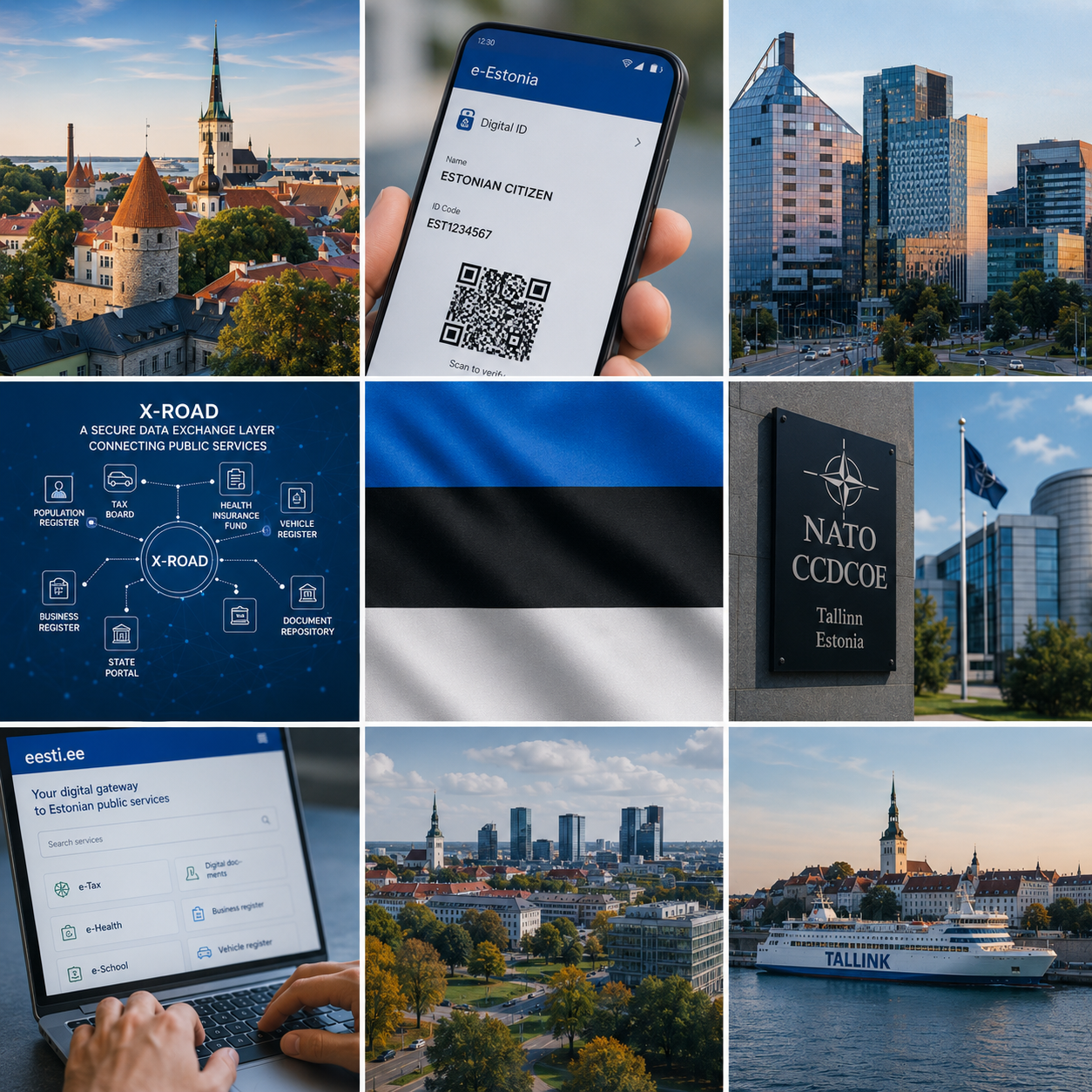
Estonia — Europe’s Digital Pioneer.
From secure digital identities and online public services to cybersecurity and innovation, Estonia has transformed digital infrastructure into a cornerstone of modern governance, economic competitiveness and national resilience, offering valuable lessons for Europe’s digital future.
