ESMC’s Dresden Fab Moves Towards Machine Installation
A project exceeding €10 billion brings TSMC’s manufacturing technology to Silicon Saxony. The next stage will test how equipment, skills and customer demand come together.
ESMC marked the topping-out of its Dresden factory on 14 September 2026 and is preparing for manufacturing equipment to arrive in 2027. The venture between TSMC, Bosch, Infineon and NXP expects total investment to exceed €10 billion. The task ahead is to turn the building into a dependable source of chips for industry.
For an industrial customer, the useful milestone is the delivery of chips it has approved for its products. Between the completed roof and that delivery lie trained teams, reliable production and orders. How much of that industrial system can Dresden put in place together?
🟦 How much remains after the roof is finished?
ESMC’s next steps include fitting out the cleanroom and bringing in the first manufacturing equipment, which the company targets for late 2027. Each machine then has to be connected, tested and brought into a working manufacturing process.
The pace matters because capital is committed before the factory can deliver at scale. ESMC says it will align the build-up of production with customer needs and market conditions. The factory has to be ready when customers need chips, while the company has to manage the cost of capacity that is still coming into use.
🟦 Can manufacturing expertise travel as quickly as machines?
ESMC plans to train technical staff at TSMC in Taiwan before they help establish production in Dresden. Its recruitment material also offers flexible shift arrangements in Germany. The transfer of expertise therefore includes learning how to organise a new team around a demanding manufacturing process.
A trained engineer needs to recognise a developing fault and understand what it could do to the chips being made. The next shift needs to know what happened and which decisions were taken.
Training can pass on experience. Dresden’s daily routines have to make that experience work consistently across people, machines and shifts. That is where imported knowledge becomes a capability the local factory can sustain.
🟦 Will three industrial shareholders fill the factory?
The venture was structured with TSMC holding 70 per cent and Bosch, Infineon and NXP each holding 10 per cent. At the project’s announcement, Infineon said it intended to use the capacity for its customers, particularly in automotive and connected devices.
The partners bring knowledge of the products their customers need and a direct route to potential orders. Their financial commitment gives the project a strong industrial base.
The commercial test will be how many designs move into production, the volumes they require and how long orders continue. Customers must choose the chips, approve them in their equipment and keep buying the finished products that contain them.
🟦 How much will each usable chip cost?
ESMC plans to use 28/22nm and 16/12nm manufacturing technologies for markets including automotive, industry and connected devices. These labels describe the manufacturing generations customers design for. The factory is being designed for annual capacity of 480,000 wafers, the circular discs on which chips are made.
Each wafer can carry many chips. How many work correctly, how reliably the equipment runs and how fully the factory is used all affect the cost of each chip that can be sold.
Customers will weigh that price alongside performance, reliability and delivery. Dresden has to build a competitive offer while its teams are still learning to get the most from the new production line. More working chips from the same resources will help turn manufacturing experience into lower costs.
🟦 Will smaller customers get a place in the production schedule?
The European Commission approved €5 billion in German state aid for ESMC on 20 August 2024. The approval describes an open foundry serving customers beyond the shareholders, with dedicated support for European smaller businesses and start-ups, plus special access for smaller businesses and universities.
Those commitments become especially important when several customers want capacity at once. A small chip designer needs an initial production run and help getting its design ready. An established customer may be seeking a much larger order.
The policy test will be how those needs are accommodated in the production schedule. Access becomes useful when a smaller company can secure the support, timing and commercial terms needed to bring its product to market.
🟦 Can Silicon Saxony supply everything needed to keep it running?
ESMC’s September Supplier Connection Day sought partners for equipment installation, maintenance, logistics, specialist gas and chemical systems, testing and waste services. The company invited local and regional expertise from across Europe.
These services become part of daily manufacturing. A machine needs materials delivered to specification, utilities supplied reliably and maintenance available when faults appear. Each supplier becomes part of the factory’s ability to keep its promises to customers.
For Silicon Saxony, the opportunity extends into the businesses that can meet those requirements repeatedly. Serving a demanding factory can give them work, experience and a basis for winning customers elsewhere.
Signal
Dresden’s factory must turn customer designs into reliable deliveries at a competitive cost. Europe’s wider return depends on smaller companies also being able to book their place in production.
Credit
AI-generated illustration for Altair Media Europe, created with OpenAI.
Caption
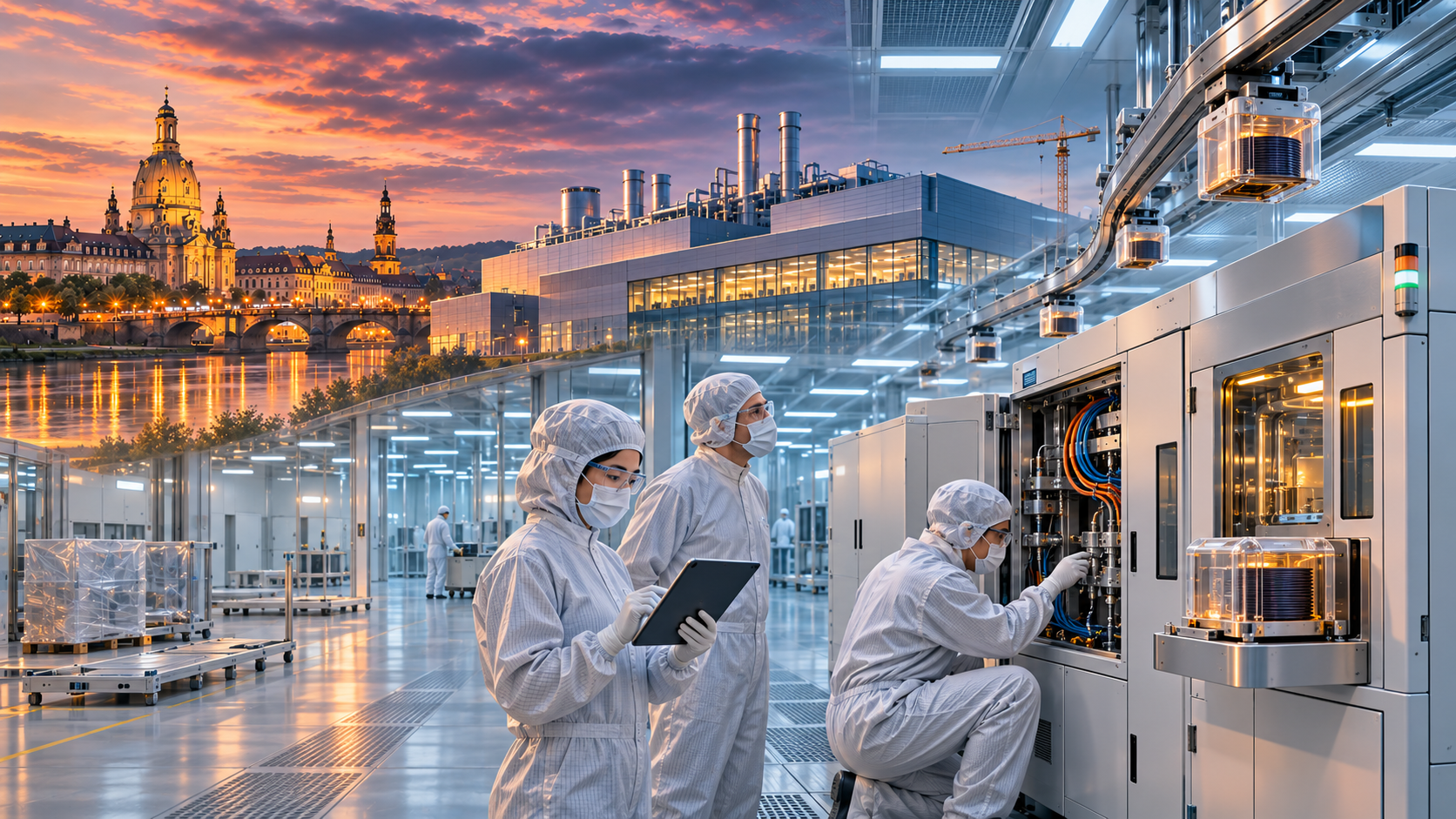
Conceptual illustration connecting Dresden’s skyline with engineers preparing semiconductor equipment for production. ESMC’s next challenge is to bring machines, skills and customer demand together in Silicon Saxony.
