Czech Republic and Europe’s Manufacturing Machine
Can a highly specialized industrial economy adapt to the next technological era?
The Czech Republic rarely dominates discussions about Europe’s economic future. Yet few countries are as deeply embedded within the continent’s industrial architecture.
With one of the strongest manufacturing sectors in Europe, a highly skilled workforce and close integration into German and Central European supply chains, the Czech Republic has become a critical component of Europe’s industrial ecosystem.
For decades, this model delivered remarkable success. Manufacturing, engineering and automotive production transformed the country into one of Central Europe’s most prosperous economies. But as Europe enters a period of technological transition, the foundations of that success are increasingly being tested.
The challenge facing the Czech Republic is not whether it can compete. The challenge is whether a highly specialized industrial economy can successfully adapt when the industries that created its prosperity begin to change.
The Factory Floor of Central Europe
Manufacturing remains the backbone of the Czech economy. Few European countries depend as heavily on industrial production. Engineering, machinery, electronics and automotive manufacturing continue generating a substantial share of economic output and exports.
This industrial strength is not accidental. The Czech Republic combines a long engineering tradition with strong vocational education, technical expertise and geographic proximity to Germany, Austria and Poland. Over time, this combination helped transform the country into one of the most productive manufacturing locations in Europe.
As a result, the Czech Republic has become deeply integrated into one of the world’s most sophisticated industrial regions.
“The Czech economy is not built around scale. It is built around specialization.”
Its success lies in precision, productivity and integration rather than sheer size.
The Automotive Question
No industry illustrates the country’s economic success more clearly than automotive manufacturing.
Companies such as Škoda Auto have become symbols of Czech industrial competitiveness, supported by an extensive network of suppliers, engineering firms and production facilities spread across Central Europe.
The sector provides employment, exports and investment. It also creates vulnerability.
Europe’s transition toward electric mobility is reshaping supply chains, production processes and industrial requirements across the continent. The challenge extends beyond replacing combustion engines with batteries. Entire supplier networks built around mechanical precision, engine components and transmission systems are being forced to adapt to technologies that often require fewer parts, different skills and increasingly software-driven architectures.
New competitors are emerging. Battery technology is becoming strategically important. Software increasingly determines value creation.
For the Czech Republic, this raises a fundamental question: Can a country that mastered the industrial age successfully reposition itself for the electric and digital age?
“Industrial specialization builds prosperity. It also creates exposure when the underlying technology begins to shift.”
The Czech Republic has experienced significant economic growth since joining the European Union.
Wages, Housing and Economic Stability
Living standards have improved, unemployment remains among the lowest in Europe and cities such as Prague and Brno continue attracting investment and talent.
Yet success brings new pressures. Housing affordability has become a growing concern, particularly in Prague. Labour shortages affect multiple sectors and employers increasingly compete for skilled workers. Rising costs are gradually narrowing one of the country’s traditional competitive advantages: relatively affordable labour.
Unlike neighbouring Slovakia, the Czech Republic retained its own currency. While deeply integrated into European supply chains, the country has preserved greater monetary flexibility than many of its regional peers.
This forces the economy to move further toward innovation, productivity and higher-value industrial activities.
Innovation Beyond Manufacturing
Although often associated with factories and industrial production, the Czech economy is becoming increasingly diversified.
Cities such as Brno increasingly illustrate the country’s next economic chapter. Long associated with engineering and manufacturing, Brno is gradually evolving into a centre for software development, cybersecurity, research and advanced technology services.
Universities, research institutes and technology companies are contributing to a growing innovation ecosystem that extends beyond traditional manufacturing.
This transition remains incomplete. Yet the direction of travel is becoming increasingly clear. Future competitiveness will depend not only on what the Czech Republic manufactures, but also on what it designs, develops and innovates.
Demography and Labour
Like many European countries, the Czech Republic faces demographic pressures. An ageing population, labour shortages and growing competition for skilled workers are becoming increasingly important economic concerns.
Migration plays a growing role in supporting workforce capacity, while businesses continue searching for ways to increase productivity through automation and technological modernization.
The challenge is familiar across Central Europe. How can industrial economies continue growing when the workforce itself is shrinking?
The Czech Republic and Europe’s Future
The Czech Republic illustrates both the strengths and vulnerabilities of Europe’s industrial model. It demonstrates how integration, specialization and manufacturing excellence can create prosperity. But it also reveals how dependent that prosperity can become on technological transitions beyond national control.
As Europe moves toward electrification, automation and increasingly software-driven industries, countries such as the Czech Republic will play an important role in determining whether Europe can remain globally competitive.
“Europe’s industrial strength is often measured in factories and exports. Its resilience may ultimately depend on the specialized ecosystems hidden behind them.”
Looking Ahead
The Czech Republic has spent decades building one of Europe’s most successful industrial economies. The next challenge is transformation.
As automotive manufacturing evolves, labour markets tighten and technological competition intensifies, the country’s future will depend on its ability to move beyond production alone and strengthen its position within Europe’s innovation economy.
Because if Germany represents the industrial heart of Europe and Poland its rising frontier, then the Czech Republic represents something equally important: the specialized industrial capability that quietly helps keep the entire European system running.
Series — Economic Europe: Central Europe
This article is part of Economic Europe, a United Europe series exploring the economic foundations beneath European cohesion. The Central Europe chapter examines Germany, Poland, the Czech Republic, Slovakia, Austria, Hungary, Switzerland and Liechtenstein — a region that forms the industrial and manufacturing core of the European economy.
Credit
Illustration generated by OpenAI’s DALL·E for Altair Media Europe
Caption
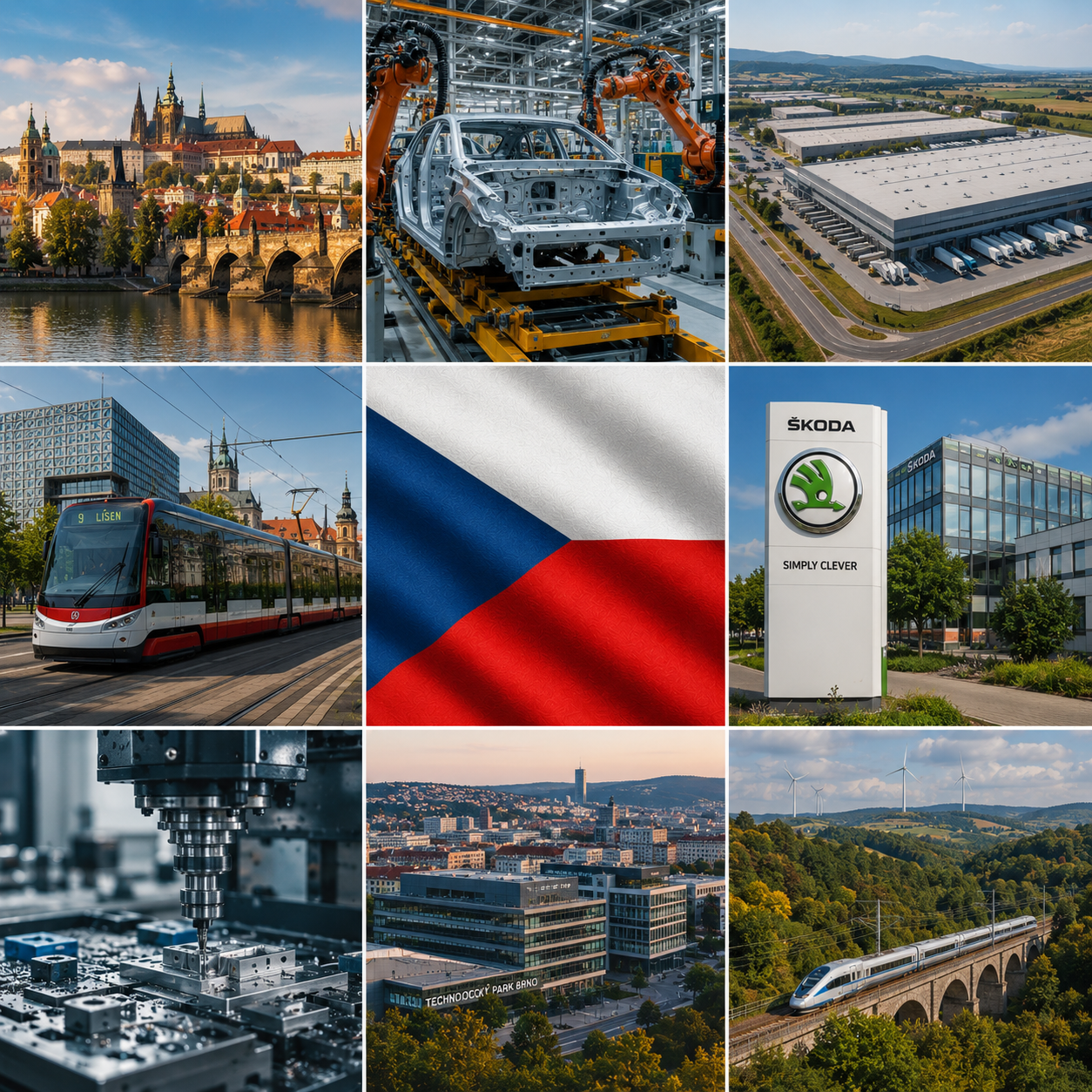
The Czech Republic combines industrial specialization, engineering expertise and technological adaptation. As Europe’s automotive sector enters a period of transformation, the country sits at the intersection of manufacturing excellence and economic reinvention.
