Posted by Altair Media on May 11, 2026 · Leave a Comment
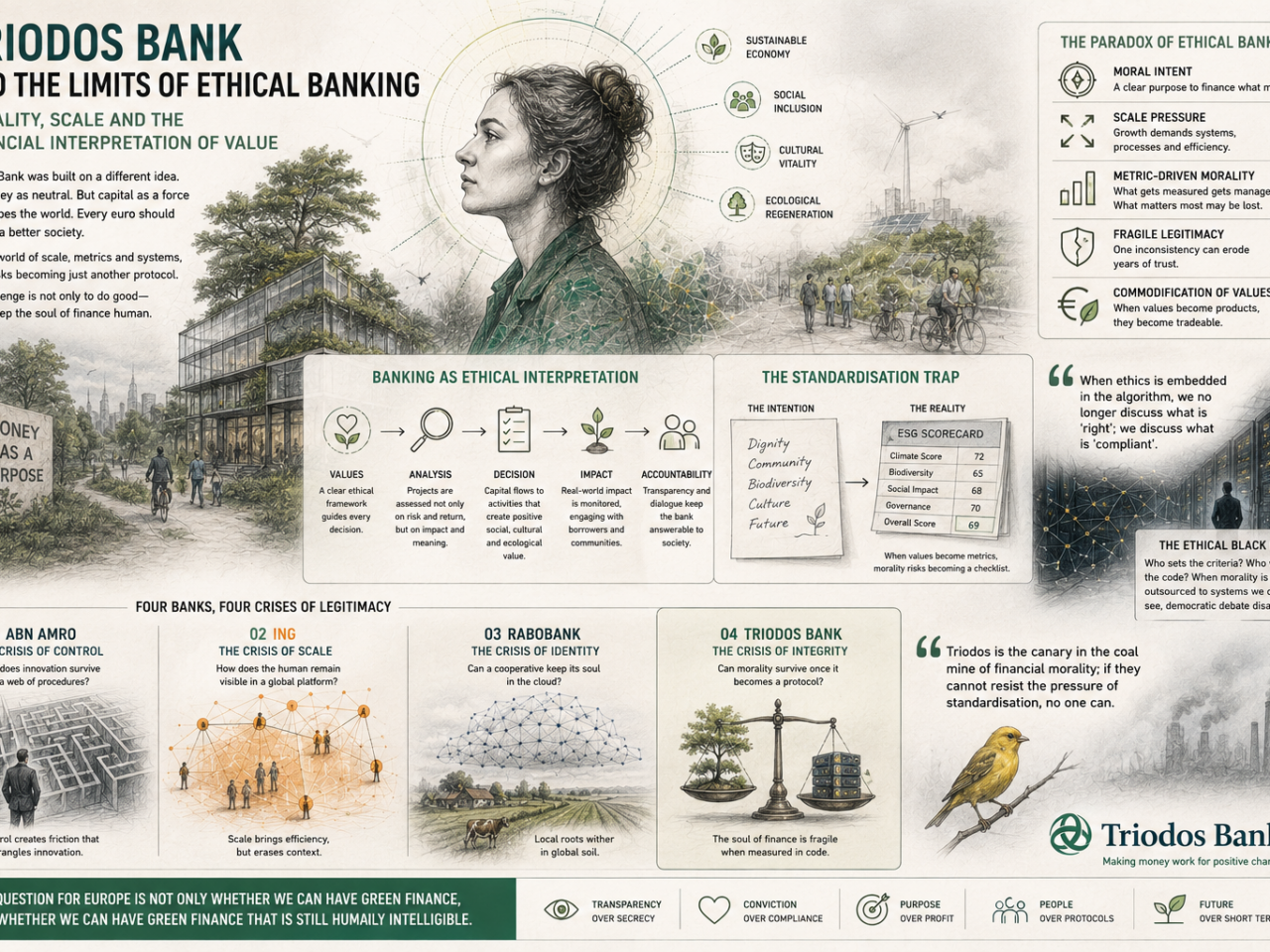
Morality, Scale and the Financial Interpretation of Value
Most banks present themselves as neutral financial intermediaries. Triodos Bank never fully did. From the beginning, the institution explicitly connected capital allocation to moral interpretation — financing projects considered socially, culturally or ecologically valuable while refusing activities regarded as incompatible with its ethical framework.
In many ways, Triodos represents one of the most ambitious experiments in modern European finance: the attempt to organise banking around values rather than scale alone. This makes the institution fundamentally different from traditional commercial banking.
The central question is no longer only whether investments are profitable or operationally efficient. It becomes: What should capital support? Which forms of economic activity deserve legitimacy? And who gets to decide?
Triodos therefore does not merely allocate capital. It interprets moral legitimacy economically.
The Moral Bank
The modern financial system often presents money as neutral. Capital flows toward opportunity, risk and return. Markets decide. Financial institutions facilitate.
Triodos rejects that assumption. The institution operates from the idea that financial systems inevitably shape society itself — and that banking therefore always contains moral consequences whether institutions acknowledge them openly or not.
Every financing decision implicitly expresses a value judgment. Which industries are considered desirable? Which futures are regarded as sustainable? Which forms of cultural or ecological activity deserve economic support?
“When we decide that certain goods may be bought and sold, we decide, at least implicitly, that it is appropriate to treat them as commodities.”
— Michael Sandel
Political philosopher, Harvard University
Triodos attempts to keep moral interpretation visible inside finance rather than hiding it behind the language of market neutrality. That ambition gives the institution both its distinctiveness and its fragility.
Because once a bank openly claims moral purpose, it also accepts a far heavier burden of legitimacy than institutions primarily judged on profitability or operational performance.
Banking as Ethical Interpretation
Traditional banking often presents itself as infrastructural. Triodos presents banking as interpretative.
The institution does not merely evaluate risk and return. It actively categorises economic activity according to ethical frameworks connected to sustainability, culture, ecological transition and social impact.
This fundamentally transforms the role of the bank itself. The banker no longer functions solely as a financial intermediary. Increasingly, the institution becomes a moral interpreter of economic legitimacy.
Every financing decision inside ethical banking therefore contains a deeper cultural judgment about which activities deserve institutional support and which forms of economic behaviour are considered socially acceptable.
This creates a unique paradox. The more explicitly ethical a financial institution becomes, the more vulnerable it also becomes to accusations of inconsistency, contradiction and moral failure.
Large commercial banks are primarily judged on:
- stability
- profitability
- compliance
Ethical banks are judged on coherence between values and operational reality. That is a much heavier legitimacy burden.
The Problem of Scale
The deeper challenge facing ethical banking emerges when morality itself must operate at institutional scale.
Ethical judgment is often contextual, relational and interpretative. Institutional systems, however, require procedures, measurable indicators and operational consistency capable of functioning across large organisational structures.
Ethics becomes harder to operationalise at scale. As Triodos grows, it increasingly encounters the same pressures shaping the broader financial sector:
- compliance obligations
- ESG reporting frameworks
- anti-money laundering systems
- digital infrastructure
- regulatory oversight
- operational scalability
The institution therefore faces a structural dilemma. How do you preserve moral nuance inside systems increasingly dependent on standardisation and procedural consistency?
“The fate of our times is characterized by rationalization and intellectualization and, above all, by the ‘disenchantment of the world’.”
— Max Weber
Sociologist and political economist
Triodos attempts to reintroduce moral meaning into finance. Yet the surrounding financial architecture increasingly pushes ethical interpretation toward quantification, codification and institutional rationalisation.
The more morality becomes infrastructural, the greater the risk that ethics slowly transforms from lived judgment into procedural governance.
The Standardisation Trap
This creates one of the deepest tensions inside modern ethical finance. The more values become operationalised through institutional systems, the greater the risk that morality itself gradually becomes procedural.
Ethical banking increasingly risks becoming metric-driven morality. Sustainability becomes scores. Impact becomes indicators. Ethics becomes reporting architecture.
What begins as moral intention risks slowly transforming into systems of compliance and measurement.
“The greatest evil is not done by monsters, but by quiet bureaucrats sitting in clean offices, following the metrics of a system that has lost its human purpose.”
— In the spirit of Hannah Arendt
Political philosopher
The danger is not necessarily cynicism. The danger is institutional abstraction.
Modern systems increasingly privilege what can be measured, standardised and operationalised. Yet many ethical realities — dignity, community, cultural meaning and ecological balance — resist precise quantification.
What cannot be measured gradually risks becoming institutionally invisible. At the same time, values themselves increasingly become financially operationalised.
Biodiversity, sustainability and social responsibility increasingly enter financial systems not primarily as moral concepts, but as measurable variables capable of being compared, optimised and traded.
The paradox is subtle but profound. By making morality measurable for institutional systems, ethical finance may unintentionally contribute to the financial colonisation of values themselves.
Ethics risks shifting from a moral compass toward a system of institutional scoring.
The Ethical Black Box
In recent years, banking systems increasingly incorporated algorithmic interpretation, ESG analytics and AI-assisted data processing into financial decision-making.
This creates a new dilemma for ethical banking itself.
Who defines the categories through which “green”, “sustainable” or “socially responsible” behaviour is interpreted computationally?
If ethical finance increasingly depends on external ESG frameworks, AI systems and globally standardised data infrastructure, then moral interpretation itself gradually becomes embedded inside technological architecture.
The ethical framework risks becoming infrastructural. This creates what might be called an ethical black box.
The institution still presents itself as morally intentional, yet parts of the operational logic increasingly depend on systems whose underlying assumptions may no longer remain fully transparent, locally controllable or democratically contestable.
When ethics becomes embedded inside algorithmic infrastructure, the nature of moral debate itself begins to change. The question gradually shifts from: “What is right?” toward: “What is compliant?”
Ethical interpretation increasingly risks becoming infrastructural rather than democratic.
Europe may therefore face a deeper challenge than sustainable finance alone. It may face the gradual outsourcing of moral interpretation itself into global technological systems.
The Fragility of Ethical Legitimacy
Triodos carries a heavier symbolic burden than most financial institutions. The bank does not merely promise operational efficiency or regulatory stability. It promises moral coherence.
That promise creates both trust and vulnerability. Every inconsistency becomes existential. Every compromise risks being interpreted not simply as strategic adjustment, but as moral betrayal.
Triodos is trying to keep the conscience of capital alive in a system increasingly organised around procedural infrastructure, institutional scale and computational governance. That is an extraordinarily difficult position to sustain institutionally. Because modern finance rewards:
- efficiency
- scalability
- standardisation
- measurable outcomes
while moral legitimacy often depends on ambiguity, contextual judgment and human interpretation.
If even explicitly ethical financial institutions struggle to resist the pressures of proceduralisation, standardisation and infrastructural governance, the implications reach far beyond one bank alone.
Europe’s Ethical Finance Question
Triodos increasingly reflects a broader European dilemma.
Europe speaks frequently about:
- sustainable finance
- green transition
- impact investing
- ESG governance
- ethical capital allocation
But can morality itself become scalable infrastructure without losing its meaning? Can ethical judgment survive once values are translated into:
- indicators
- compliance frameworks
- scoring systems
- algorithmic categorisation
- institutional protocols
The question for Europe is therefore no longer only whether green finance is possible. It is whether green finance can remain humanly intelligible.
Because once ethics itself becomes infrastructural, societies may gradually lose the ability to debate values politically and culturally outside systems of institutional measurement.
Beyond Ethical Banking
Triodos is not simply a sustainable bank. It increasingly reflects a deeper civilisational struggle over whether financial systems can still preserve meaningful moral interpretation inside infrastructures organised around scale, data and procedural governance.
The institution attempts to preserve the idea that capital allocation is never neutral — that finance inevitably shapes the moral architecture of society itself.
Yet the deeper challenge remains unresolved.
Can ethical judgment survive once morality itself becomes operationalised through systems of metrics, infrastructure and institutional scale?
Or does ethical banking ultimately risk becoming another procedural layer inside the financialisation of social values?
This article is part of Who Controls Capital in Europe? — an Altair Media Europe series exploring the transformation of financial infrastructure, institutional trust and the governance of capital in a changing European order.
Credit
Illustration generated with OpenAI DALL·E for Altair Media Europe
Caption
A pencil-style editorial illustration visualising the tension at the heart of ethical banking, where sustainability, moral purpose and ecological transition increasingly collide with metrics, algorithmic governance and the standardisation of financial values.
Category: Financial Infrastructure, Capital, Infrastructure · Tags: algorithmic governance, ESG, Ethical Banking, European Finance, Financial Infrastructure, Impact Investing, Sustainable Finance, Triodos Bank, Who Controls Capital in Europe?
Posted by Altair Media on May 11, 2026 · Leave a Comment

Community, Agriculture and the Financial Logic of Scale
For generations, Rabobank built its identity around proximity. The local branch manager knew the agricultural community. Financing decisions emerged not only through financial ratios, but through long-term familiarity, regional knowledge and cooperative trust. In many rural parts of the Netherlands, the bank functioned not merely as a financial institution, but as part of the social and economic fabric itself.
Rabobank was historically more than a lender. It was an embedded institution.
“Economy is no longer embedded in social relations, but social relations are embedded in the economic system.”
— Karl Polanyi
Economic historian and author of The Great Transformation
Rabobank originally emerged from precisely the opposite principle: the idea that finance should remain socially embedded within local economic communities.
Historically, institutions such as Rabobank did not merely distribute credit. They also helped communities interpret their own economic future through long-term relational understanding and local embeddedness.
The disappearance of that relational layer therefore represents more than operational modernisation. It alters where economic interpretation itself takes place.
Today, however, that cooperative model increasingly operates under pressure from global finance, digital infrastructure, ESG frameworks and algorithmic governance. The result is a growing tension at the centre of the modern cooperative bank.
How do you preserve local legitimacy inside financial systems increasingly organised around scale, standardisation and computational oversight?
The Cooperative DNA
The origins of Rabobank still shape how the institution presents itself today. Unlike many traditional commercial banks, Rabobank emerged from cooperative agricultural networks built around mutual dependence, shared risk and long-term community relationships. Trust historically operated through social proximity rather than procedural infrastructure.
The local economy was not abstract. It was personal. Farmers, entrepreneurs and communities often maintained financial relationships across generations. Economic interpretation remained connected to local familiarity, contextual understanding and human discretion.
That cooperative identity still remains visible in the bank’s public language. Themes such as sustainability, social responsibility and societal transition occupy a central role in the institution’s identity.
Yet the operational environment surrounding modern banking has changed fundamentally. Rabobank increasingly operates simultaneously within two institutional worlds.
One remains rooted in cooperative identity, relational trust and local embeddedness. The other is shaped by global capital requirements, ESG frameworks, compliance systems and scalable financial governance.
Those logics do not naturally coexist. You cannot have a global balance sheet and a local soul simultaneously.
Agriculture as Governance
Rabobank occupies a unique position within the Dutch and European economy because it operates at the intersection of finance, agriculture and ecological transition.
The bank is not merely connected to food production. Increasingly, it helps govern the transition surrounding it.
Climate policy, nitrogen regulation, biodiversity targets and ESG reporting frameworks increasingly shape how agricultural legitimacy itself is interpreted financially.
This fundamentally alters the relationship between bank and farmer. Historically, the farmer existed inside the cooperative primarily as a member of a shared economic ecosystem built around long-term familiarity and mutual dependence.
Increasingly, however, agricultural clients are interpreted through systems of:
- emissions exposure
- sustainability metrics
- transition scenarios
- ESG frameworks
- regulatory risk indicators
The farmer gradually shifts from cooperative partner toward managed transition profile.
Rabobank is moving from a provider of credit to a regulator of ecological behaviour. That transformation carries profound implications for the balance of power inside the modern cooperative structure.
The farmer is no longer only financed by the institution. Increasingly, the farmer is interpreted, categorised and guided through systems shaped by European transition priorities and institutional risk models.
The Pressure of Scale
The larger cooperative banking becomes, the more difficult it becomes to preserve relational legitimacy.
Rabobank today operates within:
- international capital markets
- European banking supervision
- anti-money laundering frameworks
- ESG reporting structures
- digital infrastructure systems
- global compliance architecture
As institutions scale, trust itself gradually changes character.
“The problem with large-scale organizations is that they inevitably treat people as abstractions.”
— Wendell Berry
Writer and philosopher
Relational trust becomes increasingly difficult to operationalise across highly standardised systems. The more procedural and data-driven financial interpretation becomes, the harder it becomes for local nuance and contextual understanding to remain institutionally visible.
Systems increasingly privilege what can be measured, standardised and operationalised.
Yet many forms of local legitimacy — continuity, generational knowledge, informal trust and social embeddedness — remain difficult to translate into institutional metrics.
What cannot be operationalised gradually risks disappearing from the system’s field of vision altogether.
The Farmer as Data Profile
The transformation of agricultural banking increasingly reflects a broader shift taking place across modern finance itself.
Farmers are no longer interpreted solely through productivity, land ownership or local reputation. Increasingly, they are evaluated through continuously evolving systems of institutional categorisation.
The modern agricultural client gradually acquires a data profile composed of:
- emissions indicators
- biodiversity metrics
- sustainability scores
- transition exposure
- geopolitical vulnerability
- regulatory risk assessments
The cooperative relationship becomes increasingly mediated through data infrastructure. In the cooperative system of the past, a neighbour could still vouch for you.
Inside the algorithmic infrastructure of the future, your metadata increasingly does that work instead. This creates a subtle but profound shift in institutional power. The bank no longer merely finances agricultural activity.
Increasingly, it helps define which forms of agricultural behaviour remain economically legitimate within broader transition frameworks.
The Accountability Gap
Rabobank formally remains a cooperative institution with member participation and local representation structures.
Yet many strategic decisions increasingly emerge from regulatory, technological and financial frameworks operating far beyond the scale of local communities themselves.
European banking supervision, ESG compliance frameworks, global reporting standards and institutional risk systems increasingly shape the operational boundaries within which the cooperative can function.
As banking systems become more technically complex, democratic influence inside cooperative structures risks gradually giving way to operational necessity. Technical necessity increasingly overrides relational discretion.
The cooperative structure formally survives. But the location of institutional authority slowly shifts away from the local community toward infrastructures of regulation, data governance and systemic financial control.
This creates a growing accountability gap inside the modern cooperative model. The language of participation remains visible. The operational logic increasingly becomes infrastructural.
From Community to Infrastructure
Even institutions historically built around relational trust increasingly depend on scalable systems of procedural verification, behavioural categorisation and algorithmic interpretation.
Digitalisation, compliance pressure and sustainability governance gradually reorganise how legitimacy itself is interpreted operationally inside the institution. Trust becomes infrastructural.
“When trust is scaled, it ceases to be trust and becomes a surveillance procedure.”
— Wendell Berry
Writer and philosopher
This transformation does not necessarily emerge from institutional cynicism. It emerges because modern financial systems increasingly struggle to manage complexity without standardisation. Yet the consequences remain profound.
Local familiarity becomes difficult to operationalise at systemic scale. The cooperative institution gradually risks becoming administratively distant from the communities through which its legitimacy originally emerged.
The bank once functioned as part of the local social fabric. Increasingly, it functions as an interface between local communities and larger systems of transition governance.
Europe’s Rural Financial Question
Rabobank increasingly reflects a broader European dilemma.
Europe speaks frequently about:
- strategic autonomy
- sustainable agriculture
- food security
- ecological transition
- resilient local economies
But such transitions require financial systems capable of tolerating uncertainty, complexity and long-term adaptation.
The question is no longer only whether banks can remain stable during periods of transformation. It is whether financial systems organised around procedural governance, ESG metrics and algorithmic interpretation can still sustain meaningful relational legitimacy.
Because if even cooperative institutions become absorbed into infrastructural systems of standardisation and computational oversight, something larger may be changing inside European society itself.
The transition is no longer only economic. It is civilisational.
Beyond the Cooperative Bank
Rabobank is not simply becoming more digital or more sustainable. It increasingly reflects a broader transformation in how modern Europe organises trust, legitimacy and economic participation.
The bank no longer operates solely as a cooperative intermediary between local communities and capital.
Increasingly, it functions as an infrastructure translating societal priorities — sustainability, transition governance, risk management and regulatory compliance — into operational financial logic.
The central challenge may therefore no longer only be how cooperative banks survive the digital age. It may be whether relational trust itself can survive once legitimacy becomes infrastructural.
This article is part of Who Controls Capital in Europe? — an Altair Media Europe series exploring the transformation of financial infrastructure, institutional trust and the governance of capital in a changing European order.
Credit
Illustration generated with OpenAI DALL·E for Altair Media Europe
Caption
A pencil-style illustration visualising Rabobank’s cooperative paradox, where local agricultural communities, ecological transition and relational trust increasingly intersect with ESG frameworks, algorithmic governance and global financial infrastructure.
Category: Financial Infrastructure, Capital, Infrastructure · Tags: Agricultural Finance, algorithmic governance, Cooperative Banking, ESG, European Agriculture, Financial Infrastructure, Rabobank, Sustainability Transition, Who Controls Capital in Europe?
Posted by Altair Media on May 9, 2026 · Leave a Comment

Scale, Digitalisation and the Global Logic of Finance
Millions of customers interact with ING every day without ever speaking to a human being. Payments move instantly across borders. Loans are processed digitally. Fraud detection systems operate continuously in the background. Banking increasingly functions as a seamless layer of infrastructure embedded quietly within everyday economic life.
In many ways, ING reflects a broader transformation taking place across global finance. The modern bank is no longer defined primarily by branches, local presence or personal relationships. Increasingly, it operates through platforms, data systems and scalable technological infrastructure capable of organising enormous flows of financial activity in real time.
Banking is becoming industrialised. Not through factories or physical production, but through the large-scale automation, standardisation and optimisation of financial interpretation itself.
Banking at Scale
Scale changes the nature of banking.
Historically, financial institutions still retained a strong relational dimension. Local managers understood regional economies, interpreted context and assessed customers through familiarity and discretionary judgment. Financial interpretation remained imperfect and subjective, but it retained a recognisably human dimension.
That model becomes increasingly difficult to sustain at industrial scale. An institution operating across multiple jurisdictions, regulatory systems and millions of customers cannot organise itself primarily around individual interpretation. Scale rewards standardisation.
As a result, modern banking increasingly becomes an exercise in systems engineering.
Processes must remain operationally efficient, globally coordinated and technologically scalable. Financial activity is increasingly organised through infrastructures capable of processing vast flows of transactions, behavioural signals and institutional risk indicators continuously and simultaneously.
The bank gradually evolves from a financial intermediary into a permanently connected operational network.
“In the network society, power is no longer concentrated in institutions, but in the flows of information.”
— Manuel Castells
Sociologist and author of The Rise of the Network Society
In many ways, ING increasingly operates less as a traditional financial institution and more as a continuously connected infrastructure organising financial flows across digital systems.
The Platformisation of Finance
The transformation of ING also reflects the broader platformisation of modern finance.
Customers increasingly experience banking not as a physical institution, but as an interface. Payments, lending, identity verification and investments operate through apps, APIs and embedded digital ecosystems designed around speed, accessibility and frictionless interaction.
The relationship between institution and customer consequently changes. The bank becomes less visible precisely as its infrastructural presence becomes more extensive.
“The more a technology becomes part of the background, the more it exerts power over us.”
— Albert Borgmann
Philosopher of technology
The success of modern digital banking lies precisely in its invisibility. The customer no longer experiences the institution itself, but the smoothness of the interface.
Yet behind that simplicity exists an increasingly complex architecture of:
- behavioural monitoring
- transaction analysis
- fraud detection
- AI-assisted interpretation
- compliance systems
- infrastructural dependencies
Convenience increasingly masks complexity. The more seamless banking becomes, the more invisible its governing infrastructure becomes.
Human Judgment at Industrial Scale
One of the central tensions inside modern banking is that scale and contextual interpretation rarely align naturally.
The larger a financial institution becomes, the more difficult it becomes to maintain forms of judgment rooted in nuance, familiarity and local understanding. Instead, institutions increasingly depend on standardised systems capable of processing customers through scalable categories of acceptable financial behaviour.
This does not necessarily eliminate human oversight. But it fundamentally reorganises where judgment takes place.
Financial interpretation increasingly shifts away from relationship managers and toward infrastructure systems organised around probabilities, behavioural patterns and operational consistency.
At industrial scale, banking increasingly stops interpreting individuals and starts managing probabilities.
The entrepreneur with unconventional revenue patterns. The freelancer operating across multiple jurisdictions. The customer whose behaviour deviates from institutional expectations.
Such profiles increasingly encounter systems designed not primarily to understand complexity, but to reduce uncertainty at scale.
Increasingly, exclusion inside large-scale digital banking systems is not necessarily the result of direct institutional suspicion.
Often, it emerges statistically.
Customers are categorised through probabilistic models designed to identify patterns associated with elevated institutional risk. Friction may therefore arise long before any meaningful human judgment takes place.
The result is a form of industrialised distrust embedded directly into operational infrastructure.
The Global Exposure Problem
ING’s international scale also creates another structural reality. The larger and more globally connected a bank becomes, the more difficult it becomes to separate finance from geopolitics.
Cross-border banking increasingly operates inside a world shaped by:
- sanctions regimes
- anti-money laundering enforcement
- cyber risk
- geopolitical fragmentation
- global compliance expectations
- strategic technological dependencies
Large international banks therefore operate under continuous supervisory and reputational pressure.
The consequences of compliance failure can be enormous — financially, politically and institutionally.
As a result, risk management increasingly becomes embedded deeply within operational infrastructure itself.
The institution must continuously monitor not only financial activity, but also the geopolitical environment surrounding that activity.
This accelerates the shift toward AI-assisted monitoring, anomaly detection and predictive systems capable of operating across enormous transactional ecosystems.
As global banks operate across multiple jurisdictions, financial systems increasingly internalise the strictest layers of international compliance and geopolitical risk management.
The local customer therefore experiences not only national banking rules, but the accumulated logic of global financial governance.
The Data Bank
Modern banks increasingly organise not only capital flows, but behavioural intelligence. Every transaction, onboarding process, payment pattern and customer interaction contributes to continuously evolving systems of institutional interpretation.
The bank increasingly becomes a data institution. Historically, financial institutions primarily stored and organised money. Increasingly, they store and interpret behavioural patterns connected to economic activity itself.
The customer gradually acquires a continuously updated financial profile generated through:
- transaction history
- behavioural consistency
- network relationships
- location signals
- risk indicators
- institutional categorisation systems
Banking therefore becomes increasingly predictive rather than merely transactional. The institution no longer only reacts to financial behaviour. It continuously interprets probabilities of future exposure.
Invisible Infrastructure
At the same time, the technological foundations supporting modern banking are becoming increasingly externalised.
Cloud migration, AI infrastructure and globally concentrated computational ecosystems now form essential parts of large-scale financial operations. Increasingly, the operational logic of banking depends on technological infrastructures that banks themselves no longer fully control internally.
The logic of the bank increasingly runs on systems located beyond the traditional boundaries of the institution itself. This creates a deeper European tension.
Institutions such as ING remain deeply embedded within European financial governance structures and societal responsibilities. Yet many of the infrastructures increasingly organising digital banking are global, external and technologically concentrated.
Europe may regulate digital finance extensively while remaining structurally dependent on external computational ecosystems.
The infrastructure of banking is becoming global even as financial sovereignty becomes strategically more important.
The Industrial Logic of Modern Finance
ING increasingly reflects a broader transformation taking place across global financial systems.
The bank no longer functions solely as an intermediary connecting savers and borrowers through human judgment.
Increasingly, it operates as a continuously connected infrastructure organising:
- transactions
- behavioural interpretation
- financial access
- computational trust
- institutional risk management
This transformation creates extraordinary efficiency and operational scale. But it also raises deeper questions.
What happens when financial systems become so optimised around scalability that contextual understanding becomes secondary to procedural consistency? What happens when finance becomes primarily infrastructural?
The challenge is no longer only whether digital banking remains innovative or efficient. It is whether human judgment, societal responsibility and democratic accountability can remain visible inside financial systems increasingly organised through global computational logic.
This article is part of Who Controls Capital in Europe? — an Altair Media Europe series exploring the transformation of financial infrastructure, institutional trust and the governance of capital in a changing European order.
Credit
Illustration generated with OpenAI DALL·E for Altair Media Europe
Caption
A pencil-style illustration visualising the industrialisation of modern banking, where global networks, platform infrastructure and algorithmic systems increasingly organise financial flows, behavioural interpretation and institutional trust at scale.
Category: Financial Infrastructure, Capital, Infrastructure · Tags: algorithmic governance, Artificial Intelligence, Digital Banking, Digital Sovereignty, Financial Infrastructure, Global Finance, ING, platform economy, Who Controls Capital in Europe?
Posted by Altair Media on May 9, 2026 · Leave a Comment

When Financial Logic Becomes Algorithmic
A loan application is rejected. The customer asks why. The bank responds with a familiar explanation: insufficient risk profile, internal assessment thresholds, behavioural indicators, automated categorisation systems. The decision appears explainable. Every step can be documented. Every variable can, in theory, be traced back through a chain of computational logic. Yet a deeper question remains unanswered. Who defined the logic through which the decision was made in the first place?
As artificial intelligence becomes increasingly embedded within financial infrastructure, banks are entering a new phase of institutional transformation. Decisions once shaped through human interpretation and contextual judgment are gradually being reorganised through predictive models, behavioural scoring systems and automated forms of risk analysis.
Much of the public debate surrounding AI in banking focuses on transparency. Can algorithms be explained? Can decisions be audited? Can institutions remain accountable?
But the central challenge may no longer be whether artificial intelligence is explainable. It may be whether the underlying logic embedded inside financial systems remains legitimate.
Read More
Category: Financial Infrastructure, Capital, Featured Headlines, Infrastructure · Tags: AI governance, algorithmic decision making, Artificial Intelligence, Banking, Digital Sovereignty, European regulation, Financial Infrastructure, Institutional Trust, Who Controls Capital in Europe?
Posted by Altair Media on May 8, 2026 · Leave a Comment

From Capital Allocation to Risk Filtering
A growing number of entrepreneurs across Europe encounter the same problem. Bank accounts take weeks to open. Transactions are delayed for additional verification. Requests for documentation continue to expand. Entire sectors are quietly labelled “high risk”. In many cases, no laws have been broken.
Yet participation in the financial system increasingly depends on passing through layers of institutional filtering designed to minimise regulatory exposure.
What was once a banking system focused primarily on allocating capital is gradually evolving into a system focused on interpreting risk.
The Expanding Compliance Layer
Over the past decade, compliance has moved from the margins of banking into the centre of financial infrastructure.
Anti-money laundering frameworks, Know Your Customer (KYC) obligations, sanctions enforcement and transaction monitoring systems now shape large parts of how banks operate on a daily basis.
The transformation did not emerge without reason. The 2008 financial crisis exposed weaknesses in financial oversight. Major money laundering scandals intensified political pressure across Europe. Geopolitical fragmentation and sanctions regimes further increased concerns surrounding illicit financial flows and systemic vulnerability.
The result is a financial environment in which trust is increasingly operationalised through compliance.
Banks are expected not only to move capital safely, but to continuously verify legitimacy across enormous networks of transactions, identities and behavioural signals.
“We are moving towards an ‘audit society’ where the ritual of verification becomes more important than the actual service.”
— Michael Power
Professor of Accounting, London School of Economics
This shift has fundamentally altered the role of financial institutions.
Read More
Category: Financial Infrastructure, Capital, Featured Headlines, Infrastructure · Tags: AI governance, banking regulation, Compliance, digital finance, European economy, Financial Infrastructure, Institutional Trust, Risk Management, Who Controls Capital in Europe?
