Posted by Altair Media on August 10, 2026 · Leave a Comment

Europe is beginning to finance its strategic companies at scale. But are its investors and stock exchanges ready for what comes next?
Finnish satellite company ICEYE has raised more than €1 billion, with Europe’s new Scaleup Europe Fund joining the investment. Its radar satellites strengthen Europe’s growing space capabilities. But the financing points to a larger challenge: Europe is learning how to create scale-ups. It now needs capital markets capable of keeping them.
ICEYE adds something different: a fast-growing commercial company specialising in radar observation and intelligence. Europe helped create it. European capital is now helping it scale. But if this industrial strategy succeeds, another question follows.
ICEYE did not emerge in isolation. Europe already operates Galileo and Copernicus and is developing IRIS². Together, they are expanding European capabilities in navigation, observation and secure connectivity.
Are Europe’s investors and stock exchanges ready for the companies Europe is trying to build?
Read More
Category: Signal, Capital, Featured Headlines, Financial Governance, Financial Infrastructure, Governance, Infrastructure, Insights · Tags: Deep Tech, European capital markets, European Exchanges, European Space Industry, ICEYE, Satellite Infrastructure, Scaleup Europe Fund, Strategic Autonomy
Posted by Altair Media on August 10, 2026 · Leave a Comment

The modern exchange is no longer just where trading happens. Increasingly, it operates the systems around the trade
Most people still imagine a stock exchange as a place where shares are bought and sold. Deutsche Börse shows how incomplete that picture has become. Today, the group reaches far beyond the trading floor into derivatives, clearing, settlement, securities services, data and technology.
That creates a very different 21st-century challenge. The more parts of the financial process Deutsche Börse connects, the more efficient markets can become — but also the more important the company becomes to their everyday functioning.
🟦 HOW MUCH OF A MARKET CAN ONE EXCHANGE OPERATE?
Buying a share looks remarkably simple. An investor places an order. A price appears. The transaction is completed. Behind that moment sits a much larger chain.
Orders must be processed. Buyers and sellers must be matched. Financial obligations have to be calculated. Transactions must be cleared and settled. Securities need to be recorded and held. Data flows continuously through the entire process. Deutsche Börse operates across many of these layers.
Through its different businesses, the group has developed far beyond the traditional model of a company running a stock exchange. It increasingly participates in what happens before, during and after a trade. There are obvious advantages.
Connecting more of that chain can reduce friction, improve speed and create scale. It can also make markets easier for banks, investors and institutions to navigate. But the more efficiently those pieces fit together, the more important the connections between them become.
🟦 DOES INTEGRATION MAKE MARKETS STRONGER — OR MORE DEPENDENT?
Modern financial markets depend on extraordinary levels of coordination. A transaction can cross institutions, markets and countries within fractions of a second. Standardised and interconnected systems make that possible. Integration therefore creates strength. But it also changes where vulnerability sits.
When trading, clearing, settlement and securities services become increasingly connected, disruption no longer necessarily remains confined to one part of the market. Problems can travel through the same connections that normally make the system efficient.
This does not mean integration makes markets less safe. It means efficiency and resilience have to develop together. The more financial activity depends on a smaller number of large operators and interconnected systems, the more important their continuity becomes.
At some point, a company can become more than a participant in the market. The market begins to depend upon it.
🟦 WHEN DOES A COMMERCIAL COMPANY BECOME SYSTEMIC INFRASTRUCTURE?
Deutsche Börse is a listed company. It competes internationally, invests in technology, acquires businesses and is expected to create value for shareholders. Yet some of the systems within the group perform a much broader function.
Eurex operates one of the world’s largest derivatives markets and provides clearing services, while Clearstream provides post-trade services including settlement and securities custody. Together, they reveal how far the modern exchange group extends beyond the moment at which something is bought or sold.
Most citizens will never see these systems. Their importance becomes visible precisely when they stop working. That changes the nature of responsibility.
Commercial success remains important. But reliability, cybersecurity, continuity and resilience acquire wider economic significance when large parts of the financial system depend upon the same infrastructure.
A company can therefore remain privately owned while the systems it operates acquire something close to public importance. For Europe, that distinction matters.
🟦 CAN EUROPE CONTROL ITS CAPITAL WITHOUT CONTROLLING THE SYSTEMS BENEATH IT?
Europe increasingly talks about financial sovereignty. Usually, that discussion focuses on where European savings are invested, whether companies can raise sufficient capital and whether Europe depends too heavily on American financial markets. But sovereignty has another layer. Money does not simply move. It moves through systems.
Transactions are processed. Risks are calculated. Securities are held. Ownership is recorded. Market information is distributed. Data helps determine how investors understand what is happening. The organisations operating those systems therefore occupy a largely invisible but increasingly important position within the European economy. Deutsche Börse illustrates why that matters.
Europe may have enormous pools of capital. But its ability to mobilise that capital also depends on the systems through which financial markets function. Financial sovereignty is therefore not only about who owns the money. It is also about who operates the systems underneath it.
🟦 WHAT HAPPENS WHEN FINANCIAL MARKETS BECOME DATA SYSTEMS?
There is another transformation underway. The traditional exchange organised transactions. The modern financial group increasingly organises information as well. Prices, indices, analytics, risk models and market data have become essential to how investors understand markets and make decisions. Technology determines how quickly that information moves and how effectively institutions can act upon it. Artificial intelligence could push that transformation considerably further.
Markets are already highly automated. Algorithms analyse information, execute trades and manage risk at speeds no human could match. As AI becomes more deeply integrated into financial decision-making, the value of reliable data and technological infrastructure will only increase. That could change where power sits within the financial system.
The strategically important organisation of the future may not simply be the exchange with the greatest number of listings or the largest trading volumes. It may increasingly be the organisation that connects the market, processes the transaction, manages the risk and understands the data. Deutsche Börse already operates across several of those layers.
Final Signal
Deutsche Börse began with an exchange. What has developed around it is something much larger. Trading, derivatives, clearing, settlement, securities services, data and technology increasingly form parts of an interconnected financial system.
That integration can make European markets faster, deeper and more competitive. But every additional connection also makes the systems underneath the market more consequential. This is why Deutsche Börse matters in the 21st century. Not simply because it operates one of Europe’s most important exchanges, but because it demonstrates how the meaning of an exchange itself is changing.
The stock exchange used to be the visible centre of the financial market. Increasingly, some of its most important functions sit behind the screen.
The 20th-century exchange organised the market.
The 21st-century exchange may increasingly operate the system the market depends upon.
This Signal is part of Phase II — The Operators, exploring the companies behind Europe’s financial markets and the changing role they play in Europe’s economic future.
Credit
AI-generated illustration by Altair Media
Caption
Behind every trade sits an invisible financial system. Deutsche Börse increasingly connects trading, clearing, settlement, custody, data and technology — raising a 21st-century question about efficiency, resilience and who operates the systems Europe’s financial markets depend upon.
Category: Signal, Capital, Financial Governance, Financial Infrastructure, Governance, Infrastructure, Insights · Tags: Artificial Intelligence, capital markets, Deutsche Börse, European economy, European Finance, Financial Infrastructure, financial sovereignty, Market Infrastructure, Serie - Europe’s Capital Markets, Serie - Who Runs Europe’s Capital Markets?
Posted by Altair Media on August 10, 2026 · Leave a Comment

Connecting markets is no longer enough. Europe increasingly needs its exchanges to help finance its future
Euronext has grown from connecting several European exchanges into a group spanning markets from Amsterdam and Paris to Milan and Oslo. But while Euronext has expanded, the task facing Europe’s exchanges has changed too: they must increasingly help finance an economy built around technology, energy, defence and industrial scale.
That is why Euronext deserves a closer look. The question is no longer whether it can operate efficient markets, but whether it can help connect European companies with the much larger pools of capital they will need to compete in the 21st century.
Read More
Category: Signal, Capital, Featured Headlines, Financial Infrastructure, Infrastructure, Infrastructure, Insights · Tags: capital markets, Euronext, European economy, European Finance, Financial Markets, Industrial Strategy, Investment, Serie - Europe’s Capital Markets, Serie - Who Runs Europe’s Capital Markets?, Strategic Autonomy
Posted by Altair Media on August 10, 2026 · Leave a Comment
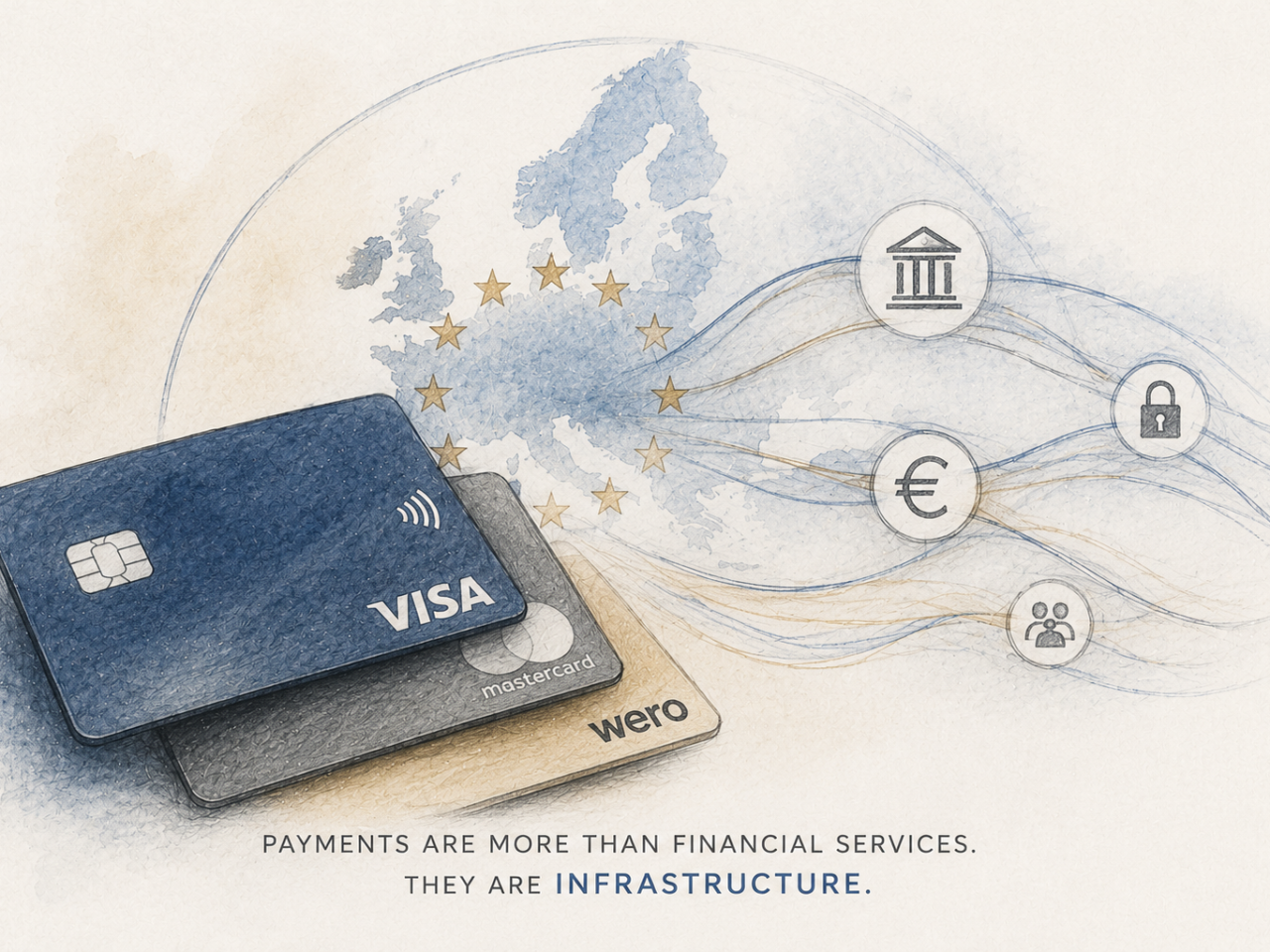
Why Europe’s Digital Economy Depends on Invisible Infrastructure
Paying for a cup of coffee has become one of the simplest actions in modern life. A card is tapped, a phone is held against a terminal and within seconds the transaction is complete. Yet behind that everyday moment lies a sophisticated financial infrastructure connecting banks, payment networks, clearing systems and central banks. As Europe becomes increasingly digital, understanding who operates that invisible architecture is becoming a strategic question in its own right.
For most people, a payment begins and ends with a familiar gesture. Whether using a debit card, a smartphone or a digital wallet, the experience feels almost effortless. The technology has become so intuitive that few consumers pause to consider what actually happens after pressing “Pay.”
In reality, a digital payment is the result of several independent systems working together. The payment application initiates the transaction, banks verify the accounts involved, payment networks route the request, clearing and settlement systems complete the transfer, and central bank infrastructure provides the monetary foundation that ultimately makes the entire process possible.
Every payment may feel instantaneous. The infrastructure behind it has taken decades to build.
Like electricity or telecommunications, this architecture has been designed to remain invisible. Its success is measured precisely by the fact that people rarely notice it.
Read More
Category: Financial Infrastructure, Capital, Essays, Featured Headlines, Financial Governance, Governance, Infrastructure, Insights · Tags: Digital Payments, European Financial Architecture, European Payments Initiative, Financial Infrastructure, payment infrastructure, Payment Networks, Serie - A European Financial Architecture, Strategic Autonomy, Wero
Posted by Altair Media on July 26, 2026 · Leave a Comment

Why Europe’s future depends on turning savings into productive investment
Every day, millions of Europeans save money. Some save for retirement. Others build financial reserves for their families or invest through pension funds, insurance policies or investment portfolios. Collectively, European households possess one of the largest pools of private wealth in the world.
Yet an important question often remains unnoticed. How does personal savings become economic growth?
Money sitting in a savings account does not build semiconductor factories. It does not finance photonics companies, artificial intelligence or quantum technologies. Savings create economic value only when they begin to move. Only when they become investment can they finance the industries that shape tomorrow’s economy.
Savings create potential. Investment creates progress.
That transformation lies at the heart of every successful economic system.
Savings Are Only the Beginning
Saving is often viewed as the final destination. Economically, however, it is only the starting point.
Households deposit money in banks. Pension funds collect retirement contributions. Insurance companies manage long-term reserves, while investment funds pool the capital of millions of individual investors. Together they form an enormous reservoir of financial resources.
The strategic question is not whether Europe possesses capital. It does. The question is whether that capital reaches the businesses capable of creating Europe’s future prosperity.
European households save more than many of their international peers. Yet a significant share of those savings remains in low-risk deposits or fragmented national investment systems rather than flowing towards productive long-term investment.
Europe’s challenge is not creating wealth. It is putting that wealth to work.
Europe’s challenge is therefore not insufficient savings. It is insufficient mobilisation of those savings.
From Savings to Investment
Savings resemble water stored behind a dam. They represent enormous potential, but potential alone generates little value. Only when that water begins to flow through banks, pension funds, investment funds and capital markets can it power the wider economy.
Investment finances new businesses, enables established companies to expand, supports scientific research, strengthens industrial capacity and accelerates the commercialisation of new technologies. It connects today’s savings with tomorrow’s prosperity.
This is why economists often describe investment as the bridge between accumulated wealth and long-term economic growth.
Not Every Euro Finds Its Way
Europe does not lack savings. In fact, European households collectively possess enormous financial wealth. The challenge is that this capital does not always find its way towards Europe’s own innovation economy.
Some remains in bank deposits. Some is invested conservatively in low-risk assets. Some flows to larger and more liquid international markets where investors perceive greater opportunities for long-term returns. The paradox is difficult to ignore.
Capital follows confidence, liquidity and opportunity—not political borders.
Europe possesses vast private wealth, yet many of its most innovative companies continue to search elsewhere for the capital needed to grow.
Money naturally follows confidence. Investors are attracted to markets that combine scale, liquidity and predictable regulation. Europe’s challenge is therefore not to prevent capital from crossing borders, but to ensure that its own financial markets become equally attractive destinations for long-term investment.
From Banks to Capital Markets
For much of the twentieth century, Europe’s banking system successfully connected savers with businesses. That model helped build Europe’s industrial economy and remains one of its greatest strengths. Today’s innovation economy, however, increasingly requires a second financing model.
Artificial intelligence, semiconductors, photonics, quantum technologies and advanced manufacturing often require years of research before generating commercial returns. Many of these companies possess few physical assets that banks can use as collateral. Their greatest value lies in scientific knowledge, intellectual property, software and future commercial potential. This is precisely where capital markets become indispensable.
By providing long-term equity investment rather than traditional lending, they allow investors to share entrepreneurial risk while giving innovative companies the time needed to develop new technologies and scale internationally.
Banks and capital markets therefore do not compete. They complement one another.
Why This Matters for Europe
Europe’s ambitions are becoming increasingly capital intensive. Building competitive AI ecosystems, strengthening semiconductor production, expanding photonics, developing quantum technologies and accelerating the energy transition all require patient investment over many years.
The fundamental question is therefore no longer whether Europe has sufficient savings. The question is whether Europe’s financial system can transform those savings into long-term productive investment.
Prosperity begins with savings. Europe’s future depends on where those savings flow.
This is ultimately why the Capital Markets Union matters. It is not designed to replace Europe’s banks. It seeks to strengthen an additional source of financing that complements them and enables Europe’s next generation of companies to grow.
The Capital Markets Union has therefore become far more than a financial project. It has become an industrial strategy.
Beyond Savings
Economic growth does not begin with capital markets. It begins with trust. People save because they believe in the future. Investors commit capital because they believe businesses will grow. Financial institutions exist because societies trust them to allocate resources responsibly.
Capital follows confidence. When confidence weakens, investment slows. When confidence grows, savings begin to move through the financial system and become factories, laboratories, infrastructure and new technologies.
The real challenge for Europe is therefore not simply to accumulate wealth. It is to build the financial architecture capable of transforming that wealth into long-term prosperity.
Looking Ahead
If savings provide the fuel of the economy, stock exchanges increasingly function as part of its distribution network. They connect companies with investors, create liquidity, establish market valuations and make long-term ownership possible.
Understanding that journey means understanding the institutions that make it possible.
The next article examines the exchange group that perhaps illustrates this transformation better than any other. Euronext.
Capital markets do not create wealth. They determine where wealth creates the future.
This article is part of Europe’s Capital Markets, an ongoing series within Europe’s Financial Architecture examining the institutions, markets and financial infrastructure shaping Europe’s economic future.
Credit
Illustration: Altair Media (AI-generated)
Caption
Every economy begins with savings. Its future depends on how effectively those savings become investment. Europe’s financial architecture determines whether today’s capital becomes tomorrow’s innovation, industry and prosperity.
Category: Financial Governance, Capital, Financial Infrastructure, Governance, Infrastructure · Tags: capital markets union, Economic Growth, Europe's Financial Architecture, Europe’s Capital Markets, Financial Infrastructure, Investment, Long-Term Finance, Savings, Serie - Europe’s Capital Markets
