Payments Are More Than Financial Services
Why Europe’s Digital Economy Depends on Invisible Infrastructure
Paying for a cup of coffee has become one of the simplest actions in modern life. A card is tapped, a phone is held against a terminal and within seconds the transaction is complete. Yet behind that everyday moment lies a sophisticated financial infrastructure connecting banks, payment networks, clearing systems and central banks. As Europe becomes increasingly digital, understanding who operates that invisible architecture is becoming a strategic question in its own right.
For most people, a payment begins and ends with a familiar gesture. Whether using a debit card, a smartphone or a digital wallet, the experience feels almost effortless. The technology has become so intuitive that few consumers pause to consider what actually happens after pressing “Pay.”
In reality, a digital payment is the result of several independent systems working together. The payment application initiates the transaction, banks verify the accounts involved, payment networks route the request, clearing and settlement systems complete the transfer, and central bank infrastructure provides the monetary foundation that ultimately makes the entire process possible.
Every payment may feel instantaneous. The infrastructure behind it has taken decades to build.
Like electricity or telecommunications, this architecture has been designed to remain invisible. Its success is measured precisely by the fact that people rarely notice it.
Looking Beyond the Payment App
The visibility of modern payment services can sometimes obscure the complexity beneath them.
Consumers recognise brands such as Visa, Mastercard, Apple Pay, Google Pay and PayPal because these are the services they encounter every day. Increasingly, European consumers are also becoming familiar with Wero, the digital payment service developed through the European Payments Initiative.
These brands, however, do not all perform the same function. Apple Pay and Google Pay provide a consumer interface, while Visa and Mastercard operate global payment networks that connect financial institutions across borders. Beneath both layers sits another, largely unseen infrastructure responsible for clearing, settlement and the secure movement of money between banks.
Consumers see the payment. Infrastructure makes the payment possible.
Understanding this distinction changes the debate. What appears to be a single payment service is, in fact, an ecosystem of interconnected infrastructures.
Why Infrastructure Matters
Infrastructure rarely attracts public attention while it functions smoothly. Roads, electricity grids and telecommunications networks are often taken for granted until disruption reveals how essential they are. Payment systems are no different.
Every salary, pension, tax payment and online purchase depends upon infrastructure that must operate continuously, securely and at enormous scale. Modern economies cannot function without it.
For that reason, payment systems deserve to be understood not merely as financial services but as critical infrastructure supporting the wider economy.
Europe’s Strategic Question
This does not mean Europe should question the quality of today’s global payment networks. Quite the opposite.
Visa and Mastercard have spent decades building exceptionally reliable systems that have transformed international commerce. Their scale, resilience and efficiency explain why they are trusted across much of the world.
The strategic question is therefore not whether these networks perform well. It is whether one of the world’s largest economic blocs should rely so extensively on infrastructure that is developed, governed and ultimately controlled beyond its own institutional framework.
That question has already emerged in discussions about semiconductors, cloud computing and artificial intelligence. Increasingly, it is becoming part of the conversation about payments as well.
Wero and Europe’s Response
Europe has not limited itself to asking these questions. It has also begun developing new answers.
The European Payments Initiative (EPI) brings together a consortium of European banks with the ambition of strengthening Europe’s own payment ecosystem. Its consumer-facing service, Wero, has already been introduced in several countries and is gradually expanding from account-to-account transfers towards online and point-of-sale payments.
Wero is more than a payment service. It reflects Europe’s ambition to strengthen its own financial infrastructure.
Whether Wero ultimately becomes Europe’s dominant payment solution remains to be seen. Its significance lies elsewhere.
Wero demonstrates that Europe increasingly regards payment infrastructure as a strategic capability rather than simply another commercial market. Like investments in semiconductor manufacturing, cloud services and digital connectivity, it reflects a broader ambition to strengthen Europe’s resilience in areas that have become essential to the functioning of society.
Payment Sovereignty
The concept of sovereignty is sometimes misunderstood. In this context, it does not imply isolation, protectionism or replacing every successful international platform with a European alternative. Open markets remain one of Europe’s greatest strengths.
Instead, payment sovereignty concerns resilience. It asks whether Europe possesses sufficient capabilities of its own to ensure that essential financial infrastructure continues to operate regardless of geopolitical tensions, technological disruption or changing commercial relationships.
That is a fundamentally different question from consumer choice. Consumers choose payment methods. Societies depend upon payment infrastructure.
A New Understanding of Infrastructure
Europe’s understanding of infrastructure has changed profoundly during the past decade.
Energy security, cloud computing, semiconductor manufacturing and artificial intelligence are increasingly viewed as strategic capabilities rather than ordinary commercial sectors. They are recognised as systems upon which economic resilience, technological competitiveness and political autonomy increasingly depend.
Payments may feel like financial services. In reality, they have become strategic infrastructure.
Payment infrastructure is gradually joining that same category. The infrastructure beneath every payment may be invisible, but its importance extends far beyond finance. It has become part of the institutional architecture that enables Europe’s digital economy to function every day.
Final Reflection
Most people never think about the journey a payment takes after they tap a card or unlock a smartphone. That is precisely the point. The best infrastructure quietly performs its role without demanding attention.
Yet as Europe reflects on its digital future, the infrastructure behind payments deserves to become more visible. Not because existing systems have failed, but because understanding who operates society’s essential networks has become an increasingly important part of economic resilience.
Payments may feel like financial services. In reality, they have become part of Europe’s strategic infrastructure.
This article is part of A European Financial Architecture
Rethinking money, banking and public trust in twenty-first century Europe.
Credit
Altair Media (Editorial Illustration)
Caption
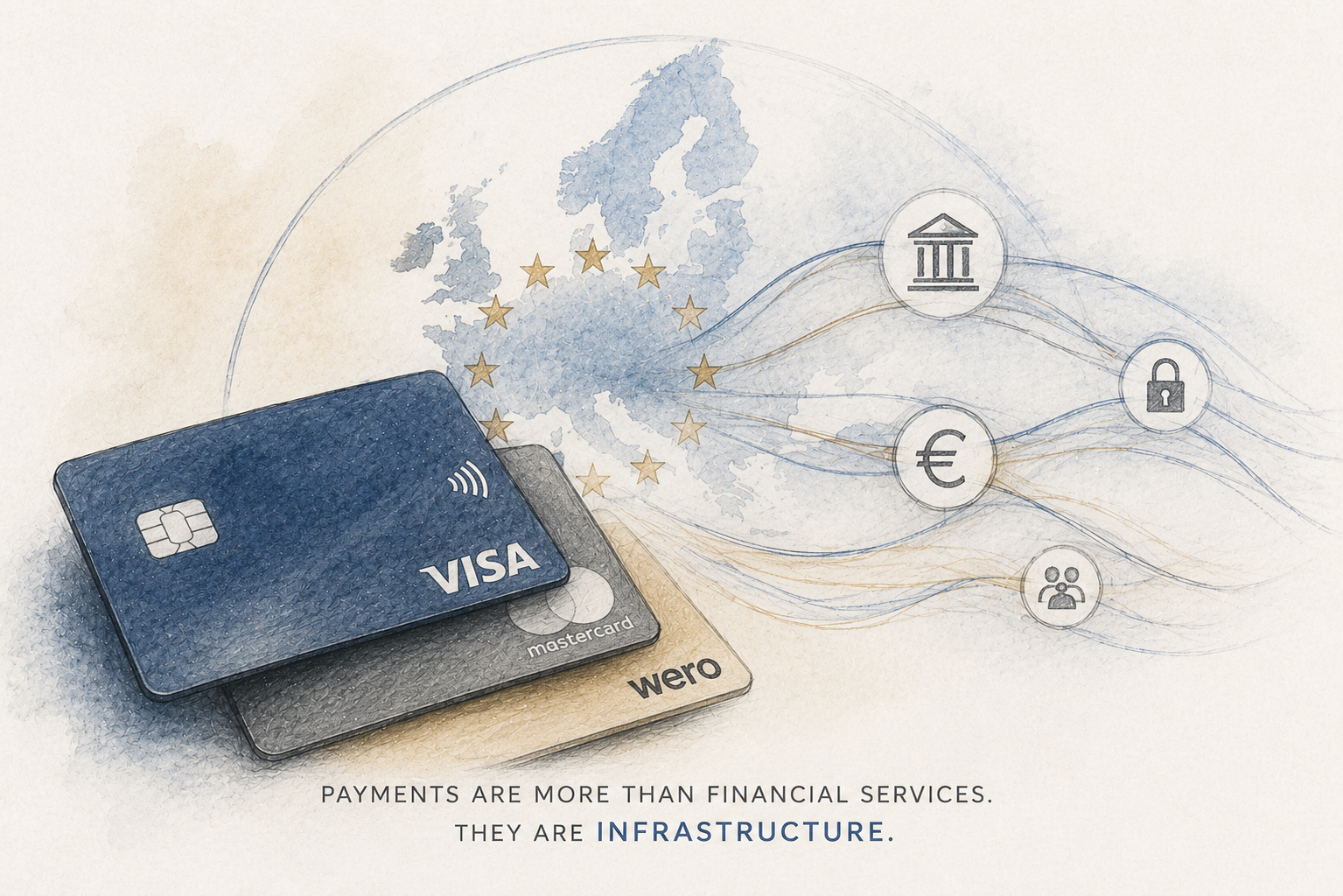
Visa, Mastercard and Wero are the visible face of digital payments. Behind every transaction, however, lies a much deeper architecture of payment networks, banks, clearing systems and public institutions that quietly keeps Europe’s digital economy moving.
