EIF — Guardian of the Transition
Europe can finance research and create startups. The harder question is what happens next: who helps companies cross the gap between technological promise and something private capital is prepared to finance at scale?
GUARDIAN FILE — The European Investment Fund occupies one of the least visible but most consequential positions in Europe’s capital architecture. It rarely appears as the investor behind a single famous company. Instead, it works through venture funds, private-equity funds, banks and other financial intermediaries — sharing risk so that capital can move before conventional markets are ready to carry it alone.
That makes EIF fundamentally different from ESMA. ESMA helps guard the interface between markets. EIF operates earlier, where innovation meets finance and where uncertainty still makes capital difficult to mobilise.
In 2025, EIF worked with more than 300 partners, committing €15.7 billion that ultimately helped make around €130 billion of financing available across businesses, individuals and infrastructure. Its network extends across banks, venture-capital and private-equity funds, private-credit providers and other intermediaries.
The numbers are large. But EIF’s real significance lies in the mechanism behind them. It does not simply provide capital. It changes who is willing to take the risk. And that creates an unusual measure of success. A guardian such as ESMA remains necessary as markets grow. EIF succeeds partly when markets it helped create become strong enough to need less of it.
🟦 Is EIF financing companies — or building the market around them?
This distinction is essential. EIF is part of the EIB Group and specialises in guarantees and equity investment, but its principal model is intermediated finance. Rather than functioning as a bank for European startups, it usually works through financial institutions and investment funds that ultimately provide the financing.
Its guarantees allow lenders to share risk. Its equity activities provide capital to venture and private-equity funds that then invest across the European company lifecycle. That changes the nature of the intervention.
If EIF backs a venture fund, it does not merely help finance one startup. It can help create an investment vehicle capable of financing many companies while attracting additional investors alongside it.
If it guarantees part of a bank’s portfolio, the objective is similarly broader than one loan. Risk-sharing can enable lenders to enter financing segments they would otherwise consider too uncertain, unfamiliar or difficult to price.
EIF therefore does not primarily sit between government and company. It sits between public risk capacity and private financial judgement. EIF guards the transition, not the company. Its role is not to determine which European startup should succeed, but to strengthen the financial pathways through which private investors can make that judgement themselves.
🟦 Why should public capital take risks that private investors are unwilling to take?
This is where the model becomes more controversial. Markets price risk for a reason. If a bank will not lend or an investment fund cannot attract investors, there is always the possibility that the economics simply do not justify the risk. Public intervention cannot make bad economics disappear.
But innovation creates another problem. New technologies, inexperienced fund managers, emerging sectors and companies without conventional collateral can be difficult to finance precisely because markets have little history with which to assess them. That creates the central tension around EIF’s mandate. When does public risk correct a market gap — and when does it simply conceal a market signal?
The difference matters.
If public backing merely makes an already attractive investment cheaper for private investors, little new capacity has been created. But if it enables a new venture fund to establish a track record, gives a bank enough confidence to enter an unfamiliar financing segment or creates a structure through which institutional investors can approach European technology at an acceptable level of risk, the effect is different.
The public balance sheet is then not replacing the market. It is trying to make a market possible.
🟦 Does EIF crowd private capital in — or teach investors to wait for the public anchor?
This may be the harder long-term question. EIF has spent decades supporting the development of European venture and private-capital markets. Its model relies partly on a signalling effect: an EIF commitment can demonstrate that a fund, manager or investment strategy has passed extensive institutional scrutiny.
That matters particularly for less established fund teams or investment areas where private limited partners may have little previous experience. An EIF commitment therefore does more than add money. It can add credibility.
For other investors, the presence of a large institutional anchor with substantial due-diligence capacity can make an unfamiliar fund or market easier to assess. But that creates its own dependency risk.
If private investors repeatedly wait for EIF to move first, signalling can gradually become substitution. The European Tech Champions Initiative illustrates both sides of that equation.
ETCI does not invest directly in individual technology champions. It is a fund-of-funds, managed by EIF, designed to help Europe create larger growth funds capable of financing those companies themselves. Its first phase assembled €3.9 billion of commitments and supported a new generation of large European growth funds. That is a very different form of industrial intervention.
Europe is not choosing individual technology companies. It is trying to build stronger pools of investment capacity around them. But this also gives EIF a clear measure of success.
If European venture and growth funds remain structurally dependent on public anchoring after years of market development, has the transition actually been completed? A catalyst should help something become sustainable. It should not become something the market can never function without.
🟦 If Scaleup Europe can write the large cheque, why does Europe still need EIF?
The answer reveals how Europe’s capital architecture is beginning to acquire different layers. Scaleup Europe is designed to make very large investments in fast-growing strategic technology companies. Its multibillion-euro structure is managed by EQT, with individual investment decisions deliberately separated from political selection.
EIF performs a different role. Through mechanisms including guarantees, venture-fund commitments, TechEU and the European Tech Champions Initiative, it works further down and across the financing ecosystem. It helps create funds, lenders and investment structures capable of bringing more companies towards investability and scale.
ETCI 2.0 pushes that model further by opening the architecture more deliberately to institutional investors including pension funds and insurers. That addresses a much larger European paradox. Europe does not primarily lack savings. It lacks transmission mechanisms capable of turning institutional savings into risk capital for technological growth.
ETCI 2.0 is an attempt to build precisely such a mechanism. This also clarifies the difference between EIF and Scaleup Europe. EIF can help build the market beneath the cheque. Scaleup Europe can write the large cheque once a company has reached sufficient scale.
They are not consecutive steps in a formal pipeline. But they address different weaknesses within the same capital lifecycle. A continent cannot solve its scale-up problem simply by placing a large fund at the top.
It also needs enough venture managers, growth funds, lenders and institutional investors underneath it to ensure that companies can reach that point in the first place.
🟦 Where should EIF stop — and the market begin?
Every Guardian needs a boundary. For ESMA, the boundary lies between protecting market integrity and controlling the market. For EIF, it lies between making risk investable and becoming the permanent bearer of that risk. That distinction is fundamental.
Europe needs public financial capacity because private markets do not always develop spontaneously around new technologies, unfamiliar risks or strategic sectors. But the objective of a catalytic institution cannot simply be to maximise the amount of economic activity that depends on it. Its success should eventually become visible elsewhere.
A first-time venture manager becomes an established one. An emerging investment segment begins attracting conventional institutional capital. A growth fund raises its next generation with less dependence on public anchoring. Banks become better able to assess risks they previously avoided. And pension funds and insurers become more comfortable allocating capital towards European private markets through structures suited to their own risk mandates.
The question is therefore not how much capital EIF can permanently control. It is how much capital becomes capable of moving because EIF helped build the route.
Guardian
ESMA guards a market that already exists. EIF operates closer to the moment before a market fully forms. It shares risk, anchors investment vehicles and connects public financial capacity with private judgement. In doing so, it helps companies, technologies and investment ecosystems move from something markets regard as uncertain towards something they are prepared to finance.
That is why Guardian of the Transition fits. EIF guards the transition, not the company. Its task is not to determine which European businesses should win, nor to make private investors unnecessary. Its deeper role is to strengthen the bridge across the point where innovation has outgrown early public support but private capital is not yet ready to carry the risk alone. And that produces a paradox.
EIF becomes more important when markets are weak. But its ultimate success should be measured partly by whether those markets eventually become strong enough to need less of it.
That leaves Europe with the deeper question behind the institution: Can public risk be used not to replace private capital, but to create the conditions under which private capital learns to move on its own?
Credit
Illustration: Altair Media / OpenAI
Caption
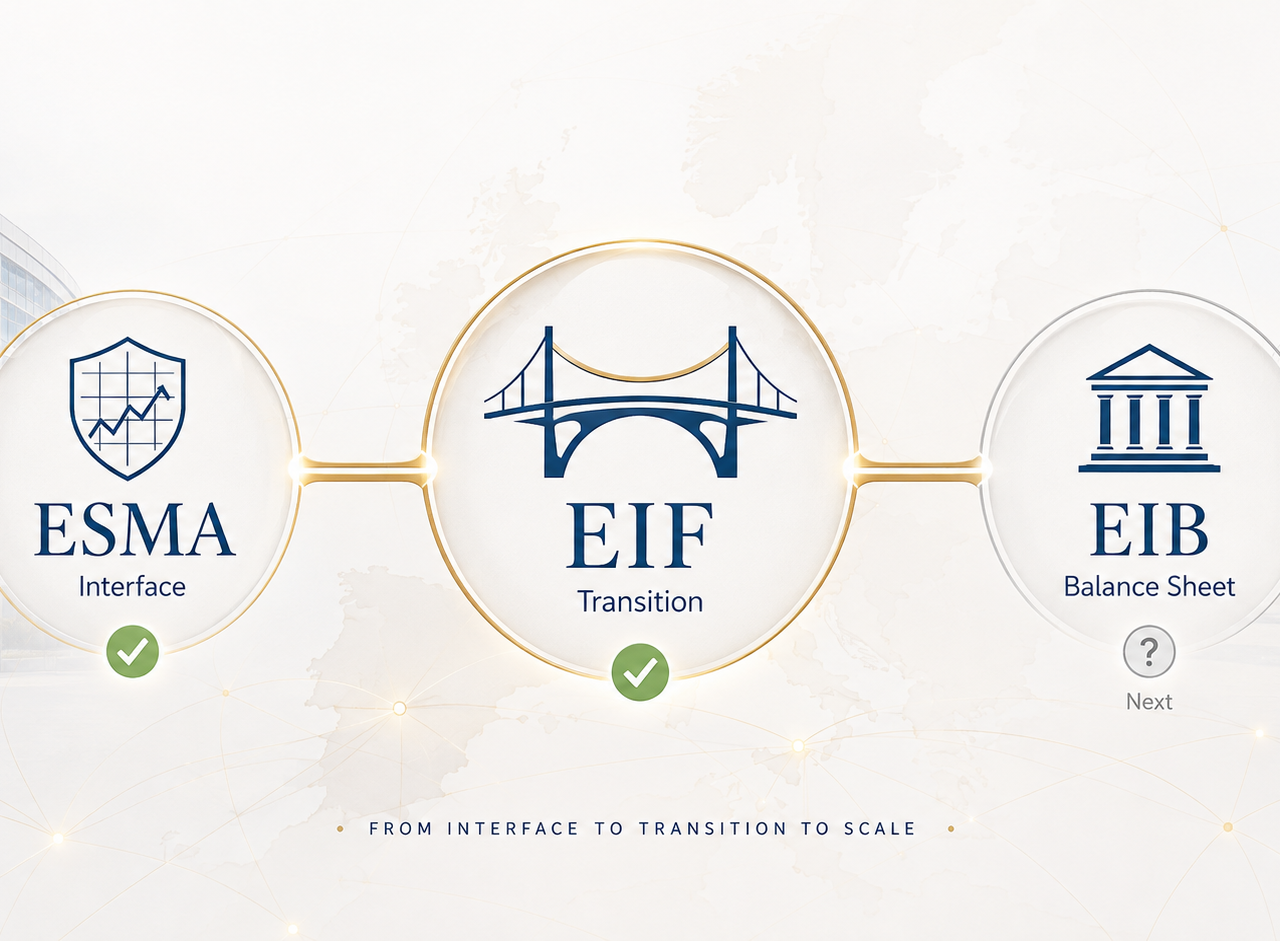
Phase III begins to reveal a functional architecture: ESMA guards the market interface, EIF strengthens the transition from innovation to investability, and the EIB represents the next layer — the balance-sheet capacity required for larger strategic investment.